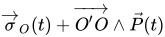
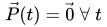
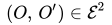
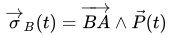
Début de la boite de navigation du chapitre
fin de la boite de navigation du chapitre
En raison de limitations techniques, la typographie souhaitable du titre, «
Outils mathématiques pour la physique - bis (PCSI) : Les torseurs Outils mathématiques pour la physique - bis (PCSI)/Les torseurs », n'a pu être restituée correctement ci-dessus.
Un espace tridimensionnel
E
{\displaystyle \;{\mathcal {E}}\;}
est dit
∙
{\displaystyle \bullet \;}
affine si on peut y définir le parallélisme ainsi que la notion de barycentre [ 1] et Un espace tridimensionnel
E
{\displaystyle \;\color {transparent}{\mathcal {E}}\;}
est dit
∙
{\displaystyle \bullet \;}
euclidien si la « direction de l'espace affine »[ 2] est un espace
R
−
{\displaystyle \;\mathbb {R} -}
vectoriel [ 3] dans lequel on définit Un espace tridimensionnel
E
{\displaystyle \;\color {transparent}{\mathcal {E}}\;}
est dit
∙
{\displaystyle \color {transparent}{\bullet }\;}
euclidien un produit scalaire [ 4] permettant de déterminer la distance entre deux points de l'espace affine [ 5] et Un espace tridimensionnel
E
{\displaystyle \;\color {transparent}{\mathcal {E}}\;}
est dit
∙
{\displaystyle \color {transparent}{\bullet }\;}
euclidien un produit scalaire permettant de déterminer l'angle entre deux bipoints[ 6] .
Un champ de vecteurs d'un espace affine euclidien tridimensionnel a été introduit dans le paragraphe « définition intrinsèque d'un champ (ou d'une fonction) vectoriel(le) de l'espace » du chap.
13
{\displaystyle 13}
de la leçon « Outils mathématiques pour la physique (PCSI) », sa définition est rappelée ci-dessous :
Champ de vecteurs d'un espace affine euclidien tridimensionnel
On définit un champ de vecteurs
f
→
{\displaystyle \;{\vec {f}}\;}
en
M
{\displaystyle \;M\;}
point de l'
espace affine euclidien tridimensionnel
E
{\displaystyle \;{\mathcal {E}}\;}
[ 7] selon :
M
→
f
→
f
→
(
M
)
∈
V
,
∀
M
∈
E
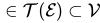
{\displaystyle \;M\;{\overset {\vec {f}}{\rightarrow }}\;{\vec {f}}(M)\in {\mathcal {V}},\;\forall \;M\in {\mathcal {E}}\;}
[ 7] , où
V
{\displaystyle \;{\mathcal {V}}\;}
est l'espace
R
−
{\displaystyle \;\mathbb {R} -}
vectoriel de dimension trois, « direction de l'
espace affine »
[ 2] euclidien
E
{\displaystyle \;{\mathcal {E}}}
.
Équiprojectivité d'un champ de vecteur d'un espace affine euclidien tridimensionnel
Un champ de vecteurs
f
→
(
M
)
{\displaystyle \;{\vec {f}}(M)\;}
défini en
M
∈
E
{\displaystyle \;M\in {\mathcal {E}}\;}
[ 7] est «
équiprojectif » si
∀
(
M
,
N
)
∈
E
2
,
f
→
(
M
)
⋅
M
N
→
=
f
→
(
N
)
⋅
M
N
→
{\displaystyle \;\forall \;\left(M\,,\,N\right)\in {\mathcal {E}}^{2},\;{\vec {f}}(M)\cdot {\overrightarrow {MN}}={\vec {f}}(N)\cdot {\overrightarrow {MN}}}
.
On démontre alors qu'il existe un
endomorphisme [ 8] antisymétrique [ 9]
u
{\displaystyle \;u\;}
tel que
∀
(
M
,
N
)
∈
E
2
,
f
→
(
N
)
=
f
→
(
M
)
+
u
(
M
N
→
)
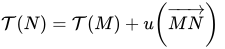
{\displaystyle \;\forall \;\left(M\,,\,N\right)\in {\mathcal {E}}^{2},\;{\vec {f}}(N)={\vec {f}}(M)+u\!\left({\overrightarrow {MN}}\right)}
.
Les torseurs sont essentiellement utilisés en mécanique
(
{\displaystyle \;{\big (}}
et plus particulièrement en mécanique du solide
)
{\displaystyle {\big )}}
, ils servent à modéliser des champs de vecteurs possédant des propriétés particulières comme
le champ de vitesses d'un solide [ 10] défini en chacun des points de ce dernier
[
{\displaystyle \;{\big [}}
les propriétés particulières traduisant le fait que la distance entre deux points quelconques du solide reste constante
]
{\displaystyle {\big ]}\;}
ou
le champ de moments de forces de même source[ 11] appliquées en chacun des points d'un solide [ 10]
[
{\displaystyle \;{\big [}}
ici encore les propriétés particulières traduisent le fait que les points d'application des forces restent à une distance constante les uns des autres
]
{\displaystyle {\big ]}\;}
ou
…
{\displaystyle \;\ldots \;}
Définition d'un torseur
Un
torseur est un
champ de vecteurs équiprojectif
t
→
(
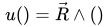
)
{\displaystyle \;{\vec {t}}()\;}
[ 12] défini sur un
espace affine euclidien
E
{\displaystyle \;{\mathcal {E}}\;}
[ 7] tridimensionnel soit plus précisément
Un torseur est une application
T
{\displaystyle \;{\mathcal {T}}\;}
de
E
{\displaystyle \;{\mathcal {E}}\;}
[ 7] dans
V
{\displaystyle \;{\mathcal {V}}}
[
{\displaystyle \;{\big [}}
direction
[ 2] de
E
]
{\displaystyle \;{\mathcal {E}}{\big ]}\;}
telle que
∀
M
∈
E
{\displaystyle \;\forall \;M\in {\mathcal {E}}\;}
[ 7] ,
M
→
T
T
(
M
)
=
t
→
M
∈
V
{\displaystyle M\;{\overset {\mathcal {T}}{\rightarrow }}\;{\mathcal {T}}(M)={\vec {t}}_{M}\in {\mathcal {V}}\;}
vérifiant
∀
(
M
,
N
)
∈
E
2
{\displaystyle \;\forall \;\left(M\,,\,N\right)\in {\mathcal {E}}^{2}\;}
[ 7] ,
t
→
M
⋅
M
N
→
=
t
→
N
⋅
M
N
→
{\displaystyle {\vec {t}}_{M}\cdot {\overrightarrow {MN}}={\vec {t}}_{N}\cdot {\overrightarrow {MN}}\;}
[ 13] .
Appellation :
T
(
M
)
{\displaystyle \;{\mathcal {T}}(M)\;}
où
M
∈
E
{\displaystyle \;M\in {\mathcal {E}}\;}
est appelé « moment du torseur
T
{\displaystyle \;{\mathcal {T}}\;}
au point
M
{\displaystyle \;M\;}
», c'est donc un élément de
V
{\displaystyle \;{\mathcal {V}}}
[
{\displaystyle \;{\big [}}
direction[ 2] de
E
]
{\displaystyle \;{\mathcal {E}}{\big ]}}
, Appellation :
T
(
M
)
{\displaystyle \;\color {transparent}{{\mathcal {T}}(M)}\;}
où
M
∈
E
{\displaystyle \;\color {transparent}{M\in {\mathcal {E}}}\;}
est appelé « moment du torseur
T
{\displaystyle \;\color {transparent}{\mathcal {T}}\;}
au point
M
{\displaystyle \;\color {transparent}{M}\;}
», le torseur
T
{\displaystyle \;{\mathcal {T}}\;}
étant une application de
E
{\displaystyle \;{\mathcal {E}}\;}
[ 7] dans
V
{\displaystyle \;{\mathcal {V}}}
[
{\displaystyle \;{\big [}}
direction[ 2] de
E
]
{\displaystyle \;{\mathcal {E}}{\big ]}}
.
Début d’un théorème
Relation de Varignon (ou règle de transport des moments)
La
relation de Varignon [ 14]
(
{\displaystyle \;{\big (}}
admise
)
{\displaystyle {\big )}\;}
s'énonce sous une forme directe et une forme réciproque :
Forme directe : Soit un
torseur
T
{\displaystyle \;{\mathcal {T}}\;}
sur
E
{\displaystyle \;{\mathcal {E}}}
, il existe un unique vecteur
R
→
{\displaystyle \;{\vec {R}}\;}
de
V
{\displaystyle \;{\mathcal {V}}}
[
{\displaystyle \;{\big [}}
direction
[ 2] de
E
]
{\displaystyle \;{\mathcal {E}}{\big ]}\;}
vérifiant
∀
(
M
,
N
)
∈
E
2
,
T
(
N
)
=
T
(
M
)
+
R
→
∧
M
N
→
{\displaystyle \;\forall \;\left(M\,,\,N\right)\in {\mathcal {E}}^{2},\quad {\mathcal {T}}(N)={\mathcal {T}}(M)+{\vec {R}}\wedge {\overrightarrow {MN}}\;}
[ 15] ,
R
→
{\displaystyle \;{\vec {R}}\;}
étant « la résultante du torseur ».
Forme réciproque : Si
T
{\displaystyle \;{\mathcal {T}}\;}
est une application de
E
{\displaystyle \;{\mathcal {E}}\;}
sur
V
{\displaystyle \;{\mathcal {V}}}
[
{\displaystyle \;{\big [}}
direction[ 2] de
E
]
{\displaystyle \;{\mathcal {E}}{\big ]}\;}
et Forme réciproque : s'il existe un couple
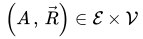
(
A
,
R
→
)
∈
E
×
V
{\displaystyle \;\left(A\,,\,{\vec {R}}\right)\in {\mathcal {E}}\times {\mathcal {V}}\;}
tel que
∀
M
∈
E
,
T
(
M
)
=
T
(
A
)
+
R
→
∧
A
M
→
{\displaystyle \quad \forall \;M\in {\mathcal {E}},\;{\mathcal {T}}(M)={\mathcal {T}}(A)+{\vec {R}}\wedge {\overrightarrow {AM}}}
Forme réciproque : alors
T
{\displaystyle \;{\mathcal {T}}\;}
est un torseur sur
E
{\displaystyle \;{\mathcal {E}}\;}
et
R
→
{\displaystyle \;{\vec {R}}\;}
en est « la résultante ».
Fin du théorème
Remarque : D'après la relation de Varignon [ 14] , on constate que
R
→
{\displaystyle \;{\vec {R}}\;}
d'une part et
{
T
(
M
)
,
T
(
N
)
}
{\displaystyle \;\left\lbrace {\mathcal {T}}(M)\,,\,{\mathcal {T}}(N)\right\rbrace \;}
d'autre part ne se comportent pas de la même façon lors d'un changement d'orientation de
E
{\displaystyle \;{\mathcal {E}}\;}
[ 16] , Remarque : D'après la relation de Varignon, il y a deux types de torseurs suivant le comportement comparé de
R
→
{\displaystyle \;{\vec {R}}\;}
et de
M
N
→
{\displaystyle \;{\overrightarrow {MN}}\;}
[
M
N
→
{\displaystyle {\Big [}{\overrightarrow {MN}}}
, par construction, ne dépendant pas de l'orientation de l'espace Remarque : D'après la relation de Varignon, il y a deux types de torseurs suivant le comportement comparé de
R
→
{\displaystyle \;\color {transparent}{\vec {R}}\;}
et de
M
N
→
{\displaystyle \;\color {transparent}{\overrightarrow {MN}}\;}
[
M
N
→
{\displaystyle \color {transparent}{{\Big [}{\overrightarrow {MN}}}}
, est nécessairement un vecteur polaire
(
{\displaystyle \;{\big (}}
ou vrai vecteur
)
{\displaystyle {\big )}\;}
[ 17]
]
{\displaystyle {\Big ]}}
: Remarque : D'après la relation de Varignon, il y a deux types de torseurs
▸
{\displaystyle \blacktriangleright \;}
le 1er type de torseur correspondant à
R
→
{\displaystyle \;{\vec {R}}\;}
ne dépendant pas de l'orientation de l'espace affine
⇒
{\displaystyle \Rightarrow }
R
→
{\displaystyle \;{\vec {R}}\;}
est un vecteur polaire Remarque : D'après la relation de Varignon, il y a deux types de torseurs
▸
{\displaystyle \color {transparent}{\blacktriangleright }\;}
le 1er type de torseur correspondant à
R
→
{\displaystyle \;\color {transparent}{\vec {R}}\;}
ne dépendant pas de l'orientation de l'espace affine
⇒
{\displaystyle \color {transparent}{\Rightarrow }}
R
→
{\displaystyle \;\color {transparent}{\vec {R}}\;}
(
{\displaystyle {\big (}}
ou vrai vecteur
)
{\displaystyle {\big )}\;}
[ 17] , Remarque : D'après la relation de Varignon, il y a deux types de torseurs
▸
{\displaystyle \color {transparent}{\blacktriangleright }\;}
le 1er type de torseur
≻
{\displaystyle \succ \;}
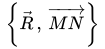
{
R
→
,
M
N
→
}
{\displaystyle \;\left\lbrace {\vec {R}}\,,\,{\overrightarrow {MN}}\right\rbrace \;}
étant des vecteurs polaires
(
{\displaystyle \;{\big (}}
ou vrais vecteurs
)
{\displaystyle {\big )}\;}
[ 17] , Remarque : D'après la relation de Varignon, il y a deux types de torseurs
▸
{\displaystyle \color {transparent}{\blacktriangleright }\;}
le 1er type de torseur
≻
{\displaystyle \color {transparent}{\succ }\;}
R
→
,
M
N
→
{\displaystyle \;\color {transparent}{{\vec {R}}\,,\,{\overrightarrow {MN}}}\;}
étant des vecteurs
(
{\displaystyle {\big (}}
c'est-à-dire indépendants de l'orientation de l'espace affine
)
{\displaystyle {\big )}\;}
⇒
{\displaystyle \Rightarrow }
Remarque : D'après la relation de Varignon, il y a deux types de torseurs
▸
{\displaystyle \color {transparent}{\blacktriangleright }\;}
le 1er type de torseur
≻
{\displaystyle \color {transparent}{\succ }\;}
R
→
∧
M
N
→
{\displaystyle \;{\vec {R}}\wedge {\overrightarrow {MN}}\;}
est un vecteur axial [ 18]
(
{\displaystyle \;{\big (}}
ou pseudo-vecteur
)
{\displaystyle {\big )}\;}
[ 19] car la multiplication vectorielle Remarque : D'après la relation de Varignon, il y a deux types de torseurs
▸
{\displaystyle \color {transparent}{\blacktriangleright }\;}
le 1er type de torseur
≻
{\displaystyle \color {transparent}{\succ }\;}
R
→
∧
M
N
→
{\displaystyle \;\color {transparent}{{\vec {R}}\wedge {\overrightarrow {MN}}}\;}
est un vecteur axial dépend de l'orientation de l'espace affine et Remarque : D'après la relation de Varignon, il y a deux types de torseurs
▸
{\displaystyle \color {transparent}{\blacktriangleright }\;}
le 1er type de torseur
≻
{\displaystyle \succ \;}
{
T
(
M
)
,
T
(
N
)
}
{\displaystyle \;\left\lbrace {\mathcal {T}}(M)\,,\,{\mathcal {T}}(N)\right\rbrace \;}
[
{\displaystyle {\big [}}
comme
R
→
∧
M
N
→
]
{\displaystyle \;{\vec {R}}\wedge {\overrightarrow {MN}}{\big ]}\;}
sont des vecteurs axiaux
(
{\displaystyle \;{\big (}}
ou pseudo-vecteurs
)
{\displaystyle {\big )}\;}
[ 19] car Remarque : D'après la relation de Varignon, il y a deux types de torseurs
▸
{\displaystyle \color {transparent}{\blacktriangleright }\;}
le 1er type de torseur
≻
{\displaystyle \color {transparent}{\succ }\;}
T
(
M
)
,
T
(
N
)
{\displaystyle \;\color {transparent}{{\mathcal {T}}(M)\,,\,{\mathcal {T}}(N)}\;}
[
{\displaystyle \color {transparent}{\big [}}
comme
R
→
∧
M
N
→
]
{\displaystyle \;\color {transparent}{{\vec {R}}\wedge {\overrightarrow {MN}}{\big ]}}\;}
sont dépendants de l'orientation de l'espace affine , Remarque : D'après la relation de Varignon, il y a deux types de torseurs
▸
{\displaystyle \blacktriangleright \;}
le 2ème type de torseur correspondant à
R
→
{\displaystyle \;{\vec {R}}\;}
dépendant de l'orientation de l'espace affine
⇒
{\displaystyle \Rightarrow }
R
→
{\displaystyle \;{\vec {R}}\;}
est un vecteur axial Remarque : D'après la relation de Varignon, il y a deux types de torseurs
▸
{\displaystyle \color {transparent}{\blacktriangleright }\;}
le 2ème type de torseur correspondant à
R
→
{\displaystyle \;\color {transparent}{\vec {R}}\;}
dépendant de l'orientation de l'espace affine
⇒
{\displaystyle \color {transparent}{\Rightarrow }}
R
→
{\displaystyle \;\color {transparent}{\vec {R}}\;}
(
{\displaystyle {\big (}}
ou pseudo-vecteur
)
{\displaystyle {\big )}\;}
[ 19] et Remarque : D'après la relation de Varignon, il y a deux types de torseurs
▸
{\displaystyle \color {transparent}{\blacktriangleright }\;}
le 2ème type de torseur comme
M
N
→
{\displaystyle \;{\overrightarrow {MN}}\;}
est un vecteur polaire
(
{\displaystyle \;{\big (}}
ou vrai vecteur
)
{\displaystyle {\big )}\;}
[ 17] on en déduit que, Remarque : D'après la relation de Varignon, il y a deux types de torseurs
▸
{\displaystyle \color {transparent}{\blacktriangleright }\;}
le 2ème type de torseur comme
M
N
→
{\displaystyle \;\color {transparent}{\overrightarrow {MN}}\;}
R
→
∧
M
N
→
{\displaystyle {\vec {R}}\wedge {\overrightarrow {MN}}\;}
est un vecteur polaire [ 20]
(
{\displaystyle \;{\big (}}
ou vrai vecteur
)
{\displaystyle {\big )}\;}
[ 17] car la multiplication Remarque : D'après la relation de Varignon, il y a deux types de torseurs
▸
{\displaystyle \color {transparent}{\blacktriangleright }\;}
le 2ème type de torseur comme
M
N
→
{\displaystyle \;\color {transparent}{\overrightarrow {MN}}\;}
R
→
∧
M
N
→
{\displaystyle \;\color {transparent}{{\vec {R}}\wedge {\overrightarrow {MN}}}\;}
est vectorielle dépend de l'orientation de l'espace affine , en résumé : Remarque : D'après la relation de Varignon, il y a deux types de torseurs
▸
{\displaystyle \color {transparent}{\blacktriangleright }\;}
le 2ème type de torseur
≻
{\displaystyle \succ \;}
{
T
(
M
)
,
T
(
N
)
}
{\displaystyle \left\lbrace {\mathcal {T}}(M)\,,\,{\mathcal {T}}(N)\right\rbrace \;}
[
{\displaystyle {\big [}}
comme
M
N
→
{\displaystyle \;{\overrightarrow {MN}}\;}
et
R
→
∧
M
N
→
]
{\displaystyle \;{\vec {R}}\wedge {\overrightarrow {MN}}{\big ]}\;}
sont des vecteurs polaires Remarque : D'après la relation de Varignon, il y a deux types de torseurs
▸
{\displaystyle \color {transparent}{\blacktriangleright }\;}
le 2ème type de torseur
≻
{\displaystyle \color {transparent}{\succ }\;}
{
T
(
M
)
,
T
(
N
)
}
{\displaystyle \color {transparent}{\left\lbrace {\mathcal {T}}(M)\,,\,{\mathcal {T}}(N)\right\rbrace }\;}
[
{\displaystyle \color {transparent}{\big [}}
comme
M
N
→
{\displaystyle \;\color {transparent}{\overrightarrow {MN}}\;}
et
R
→
∧
M
N
→
]
{\displaystyle \;\color {transparent}{{\vec {R}}\wedge {\overrightarrow {MN}}{\big ]}}\;}
sont des
(
{\displaystyle {\big (}}
ou vrais vecteurs
)
{\displaystyle {\big )}\;}
[ 17] car Remarque : D'après la relation de Varignon, il y a deux types de torseurs
▸
{\displaystyle \color {transparent}{\blacktriangleright }\;}
le 2ème type de torseur
≻
{\displaystyle \color {transparent}{\succ }\;}
{
T
(
M
)
,
T
(
N
)
}
{\displaystyle \color {transparent}{\left\lbrace {\mathcal {T}}(M)\,,\,{\mathcal {T}}(N)\right\rbrace }\;}
[
{\displaystyle \color {transparent}{\big [}}
comme
M
N
→
{\displaystyle \;\color {transparent}{\overrightarrow {MN}}\;}
et
R
→
∧
M
N
→
]
{\displaystyle \;\color {transparent}{{\vec {R}}\wedge {\overrightarrow {MN}}{\big ]}}\;}
indépendants de l'orientation de l'espace et Remarque : D'après la relation de Varignon, il y a deux types de torseurs
▸
{\displaystyle \color {transparent}{\blacktriangleright }\;}
le 2ème type de torseur
≻
{\displaystyle \succ \;}
R
→
{\displaystyle {\vec {R}}\;}
est un vecteur axial
(
{\displaystyle \;{\big (}}
ou pseudo-vecteur
)
{\displaystyle {\big )}\;}
[ 19] , dépendant de l'orientation de l'espace affine .
Réduction d'un torseur en un point quelconque de l'espace affine euclidien tridimensionnel sur lequel il est défini[ modifier | modifier le wikicode ]
Un torseur
T
{\displaystyle \;{\mathcal {T}}\;}
défini sur l'espace affine euclidien tridimensionnel
E
{\displaystyle \;{\mathcal {E}}\;}
[ 7] est déterminé par un couple de deux vecteurs
∈
{\displaystyle \;\in \;}
chacun à
V
{\displaystyle \;{\mathcal {V}}}
[
{\displaystyle \;{\big [}}
direction[ 2] de
E
]
{\displaystyle \;{\mathcal {E}}{\big ]}}
; on distingue deux types de torseurs suivant que sa résultante
R
→
{\displaystyle \;{\vec {R}}\;}
est un vecteur polaire
(
{\displaystyle \;{\big (}}
ou vrai vecteur
)
{\displaystyle {\big )}\;}
[ 17] ou on distingue deux types de torseurs suivant que sa résultante
R
→
{\displaystyle \;\color {transparent}{\vec {R}}\;}
est un vecteur axial
(
{\displaystyle \;{\big (}}
ou pseudo-vecteur
)
{\displaystyle {\big )}\;}
[ 19] :
Cas d'un torseur dont la résultante est un vecteur polaire
(
{\displaystyle \;{\big (}}
ou vrai vecteur
)
{\displaystyle {\big )}\;}
[ 17] : le torseur
T
{\displaystyle \;{\mathcal {T}}\;}
défini sur l'espace affine euclidien tridimensionnel
E
{\displaystyle \;{\mathcal {E}}\;}
[ 7] Cas d'un torseur dont la résultante est un vecteur polaire
(
{\displaystyle \;\color {transparent}{\big (}}
ou vrai vecteur
)
{\displaystyle \color {transparent}{\big )}\;}
: le torseur
T
{\displaystyle \;\color {transparent}{\mathcal {T}}\;}
étant déterminé par un couple de deux vecteurs
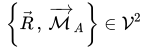
{
R
→
,
M
→
A
}
∈
V
2
{\displaystyle \;\left\lbrace {\vec {R}}\,,\,{\overrightarrow {\mathcal {M}}}_{A}\right\rbrace \in {\mathcal {V}}^{2}}
[
V
{\displaystyle \;{\big [}{\mathcal {V}}}
étant la direction[ 2] de
E
]
{\displaystyle \;{\mathcal {E}}{\big ]}}
, Cas d'un torseur dont la résultante est un vecteur polaire
(
{\displaystyle \;\color {transparent}{\big (}}
ou vrai vecteur
)
{\displaystyle \color {transparent}{\big )}\;}
: on distingue chacun d'eux suivant leur dépendance à l'orientation de l'espace de la façon suivante : Cas d'un torseur dont la résultante est un vecteur polaire
(
{\displaystyle \;\color {transparent}{\big (}}
ou vrai vecteur
)
{\displaystyle \color {transparent}{\big )}\;}
: on distingue
∙
{\displaystyle \bullet \;}
un 1er vrai vecteur
(
{\displaystyle \;{\big (}}
ou vecteur polaire
)
{\displaystyle {\big )}\;}
[ 17]
R
→
{\displaystyle \;{\vec {R}}\;}
indépendant du point
A
{\displaystyle \;A\;}
en lequel
T
{\displaystyle \;{\mathcal {T}}\;}
est appliqué et Cas d'un torseur dont la résultante est un vecteur polaire
(
{\displaystyle \;\color {transparent}{\big (}}
ou vrai vecteur
)
{\displaystyle \color {transparent}{\big )}\;}
: on distingue
∙
{\displaystyle \bullet \;}
un 2nd pseudo-vecteur
(
{\displaystyle \;{\big (}}
ou vecteur axial
)
{\displaystyle {\big )}\;}
[ 19]
M
→
A
{\displaystyle \;{\overrightarrow {\mathcal {M}}}_{A}\;}
[ 21] dépendant a priori du point
A
{\displaystyle \;A\;}
où
T
{\displaystyle \;{\mathcal {T}}\;}
est appliqué ;
Cas d'un torseur dont la résultante est un vecteur polaire
(
{\displaystyle \;\color {transparent}{\big (}}
ou vrai vecteur
)
{\displaystyle \color {transparent}{\big )}\;}
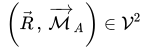
: ce couple d'un vrai vecteur [ 17] et d'un pseudo-vecteur [ 19]
(
R
→
,
M
→
A
)
∈
V
2
{\displaystyle \;\left({\vec {R}}\,,\,{\overrightarrow {\mathcal {M}}}_{A}\right)\in {\mathcal {V}}^{2}\;}
[ 22] Cas d'un torseur dont la résultante est un vecteur polaire
(
{\displaystyle \;\color {transparent}{\big (}}
ou vrai vecteur
)
{\displaystyle \color {transparent}{\big )}\;}
: ce couple d'un vrai vecteur et d'un pseudo-vecteur constitue « la réduction du torseur
T
{\displaystyle \;{\mathcal {T}}\;}
au point
A
∈
E
{\displaystyle \;A\in {\mathcal {E}}\;}
[ 7] », Cas d'un torseur dont la résultante est un vecteur polaire
(
{\displaystyle \;\color {transparent}{\big (}}
ou vrai vecteur
)
{\displaystyle \color {transparent}{\big )}\;}
: ce couple
∙
{\displaystyle \bullet \;}
le 1er vecteur « polaire »[ 17]
R
→
{\displaystyle \;{\vec {R}}\;}
étant la résultante du torseur et Cas d'un torseur dont la résultante est un vecteur polaire
(
{\displaystyle \;\color {transparent}{\big (}}
ou vrai vecteur
)
{\displaystyle \color {transparent}{\big )}\;}
: ce couple
∙
{\displaystyle \bullet \;}
le 2nd vecteur « axial »[ 19]
M
→
A
{\displaystyle \;{\overrightarrow {\mathcal {M}}}_{\!A}\;}
le moment du torseur au point
A
{\displaystyle \;A}
,
Cas d'un torseur dont la résultante est un vecteur polaire
(
{\displaystyle \;\color {transparent}{\big (}}
ou vrai vecteur
)
{\displaystyle \color {transparent}{\big )}\;}
: cette réduction du torseur
T
{\displaystyle \;{\mathcal {T}}\;}
en
A
∈
E
{\displaystyle \;A\in {\mathcal {E}}\;}
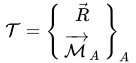
[ 7] s'écrivant symboliquement
T
=
{
R
→
M
→
A
}
A
{\displaystyle \;{\mathcal {T}}=\left\lbrace {\begin{array}{c}{\vec {R}}\\{\overrightarrow {\mathcal {M}}}_{A}\end{array}}\right\rbrace _{A}\;}
[ 23] , [ 24] .
Remarques : D'après la note « 24 », l'ensemble des torseurs formant un espace vectoriel de dimension six, Remarques : D'après la note « 24 », il est possible de décrire un torseur , après avoir choisi une base orthonormée
{
u
→
x
,
u
→
y
,
u
→
z
,
u
→
l
,
u
→
m
,
u
→
n
}
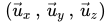
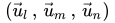
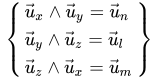
{\displaystyle \;\left\lbrace {\vec {u}}_{x}\,,\,{\vec {u}}_{y}\,,\,{\vec {u}}_{z}\,,\,{\vec {u}}_{l}\,,\,{\vec {u}}_{m}\,,\,{\vec {u}}_{n}\right\rbrace \;}
[ 25] de cet espace vectoriel de dimension six, Remarques : D'après la note « 24 », il est possible de décrire un torseur, par les six composantes de sa réduction en un point
A
{\displaystyle \;A\;}
quelconque de
E
{\displaystyle \;{\mathcal {E}}\;}
[ 7] , Remarques : D'après la note « 24 », il est possible de décrire un torseur, par ces six composantes constituant les coordonnées plückeriennes[ 26] de la réduction du torseur au point
A
∈
E
{\displaystyle \;A\in {\mathcal {E}}\;}
[ 7] soit, Remarques : D'après la note « 24 », il est possible de décrire avec
{
R
→
=
X
u
→
x
+
Y
u
→
y
+
Z
u
→
z
M
→
A
=
L
A
u
→
l
+
M
A
u
→
m
+
N
A
u
→
m
}
{\displaystyle \;\left\lbrace {\begin{array}{l c l}{\vec {R}}\!\!\!&=&\!\!\!X\;{\vec {u}}_{x}+Y\;{\vec {u}}_{y}+Z\;{\vec {u}}_{z}\\{\overrightarrow {\mathcal {M}}}_{A}\!\!\!&=&\!\!\!L_{A}\;{\vec {u}}_{l}+M_{A}\;{\vec {u}}_{m}+N_{A}\;{\vec {u}}_{m}\end{array}}\right\rbrace \;}
[ 27] , [ 28] , il est possible de réécrire la réduction du torseur
T
{\displaystyle \;{\mathcal {T}}\;}
au point
A
∈
E
{\displaystyle \;A\in {\mathcal {E}}\;}
[ 7] par Remarques : D'après la note « 24 », il est possible de décrire un torseur, par ces six composantes constituant ses coordonnées plückeriennes
T
=
{
X
L
A
Y
M
A
Z
N
A
}
A
,
(
u
→
x
u
→
l
u
→
y
u
→
m
u
→
z
u
→
n
)
{\displaystyle \;{\mathcal {T}}=\left\lbrace {\begin{array}{l l}X&L_{A}\\Y&M_{A}\\Z&N_{A}\end{array}}\right\rbrace _{A,\;\left({\begin{array}{l l}{\vec {u}}_{x}&{\vec {u}}_{l}\\{\vec {u}}_{y}&{\vec {u}}_{m}\\{\vec {u}}_{z}&{\vec {u}}_{n}\end{array}}\right)}}
.
Remarques : D'après la relation de Varignon [ 14] , la connaissance de « la réduction du torseur
T
{\displaystyle \;{\mathcal {T}}\;}
en un point quelconque
A
∈
E
{\displaystyle \;A\in {\mathcal {E}}\;}
[ 7] » permet de déduire le torseur en n'importe quel point
P
∈
E
{\displaystyle \;P\in {\mathcal {E}}\;}
[ 7] selon Remarques : D'après la relation de Varignon, la connaissance de « la réduction du torseur
T
{\displaystyle \;\color {transparent}{\mathcal {T}}\;}
en un point quelconque
A
∈
E
{\displaystyle \;\color {transparent}{A\in {\mathcal {E}}}\;}
» permet de déduire le torseur
M
→
P
=
M
→
A
+
R
→
∧
A
M
→
{\displaystyle \;{\overrightarrow {\mathcal {M}}}_{P}={\overrightarrow {\mathcal {M}}}_{A}+{\vec {R}}\wedge {\overrightarrow {AM}}\;}
[ 29] , [ 30] .
Exemples :
∙
{\displaystyle \bullet \;}
les torseurs statiques , voir le paragraphe « torseur statique » plus loin dans ce chapitre, la résultante étant appelée résultante dynamique notée
F
→
ext
{\displaystyle \;{\vec {F}}_{\text{ext}}\;}
[ 31] et Exemples :
∙
{\displaystyle \color {transparent}{\bullet }\;}
les torseurs statiques, voir le paragraphe « torseur statique » plus loin dans ce chapitre, le moment résultant en
A
{\displaystyle \;A\;}
appelé moment résultant dynamique en
A
{\displaystyle \;A}
, noté
M
→
A
,
ext
{\displaystyle \;{\overrightarrow {\mathcal {M}}}_{\!A,\,{\text{ext}}}\;}
[ 32] ; Exemples :
∙
{\displaystyle \bullet \;}
les torseurs cinétiques des systèmes fermés définis dans un référentiel
R
{\displaystyle \;{\mathcal {R}}\;}
fixé, voir le paragraphe « torseur cinématique » plus loin dans ce chapitre, Exemples :
∙
{\displaystyle \color {transparent}{\bullet }\;}
les torseurs cinétiques des systèmes fermés définis dans un référentiel
R
{\displaystyle \;\color {transparent}{\mathcal {R}}\;}
fixé, la résultante étant appelée résultante cinétique , notée
P
→
/
R
(
t
)
{\displaystyle \;{\vec {P}}_{/\,{\mathcal {R}}}(t)\;}
[ 33] et Exemples :
∙
{\displaystyle \color {transparent}{\bullet }\;}
les torseurs cinétiques des systèmes fermés définis dans un référentiel
R
{\displaystyle \;\color {transparent}{\mathcal {R}}\;}
fixé, le moment résultant en
A
{\displaystyle \;A\;}
appelé moment cinétique résultant en
A
{\displaystyle \;A}
, noté
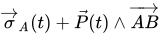
σ
→
A
/
R
(
t
)
{\displaystyle \;{\vec {\sigma }}_{\!A\,/\,{\mathcal {R}}}(t)\;}
[ 34] , Exemples :
∙
{\displaystyle \color {transparent}{\bullet }\;}
les torseurs cinétiques des systèmes fermés définis dans un référentiel
R
{\displaystyle \;\color {transparent}{\mathcal {R}}\;}
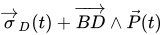
fixé, la relation de Varignon [ 14] s'écrivant en
P
{\displaystyle \;P\;}
selon
σ
→
P
/
R
(
t
)
=
σ
→
A
/
R
(
t
)
+
P
→
/
R
(
t
)
∧
A
P
→
(
t
)
{\displaystyle \;{\vec {\sigma }}_{\!P\,/\,{\mathcal {R}}}(t)={\vec {\sigma }}_{\!A\,/\,{\mathcal {R}}}(t)+{\vec {P}}_{/\,{\mathcal {R}}}(t)\wedge {\overrightarrow {AP}}(t)\;}
[ 35] ; Exemples :
∙
{\displaystyle \bullet \;}
les torseurs dynamiques des systèmes fermés définis dans un référentiel
R
{\displaystyle \;{\mathcal {R}}\;}
fixé, voir le paragraphe « torseur dynamique » plus loin dans ce chapitre, Exemples :
∙
{\displaystyle \color {transparent}{\bullet }\;}
les torseurs dynamiques des systèmes fermés définis dans un référentiel
R
{\displaystyle \;\color {transparent}{\mathcal {R}}\;}
fixé, la résultante étant appelée, par certains, quantité d'accélération [ 36] , [ 37] , notée
(
d
P
→
/
R
d
t
)
R
(
t
)
{\displaystyle \;\left({\dfrac {d\,{\vec {P}}_{/\,{\mathcal {R}}}}{dt}}\right)_{\!{\mathcal {R}}}(t)\;}
[ 38] et Exemples :
∙
{\displaystyle \color {transparent}{\bullet }\;}
les torseurs dynamiques des systèmes fermés définis dans un référentiel
R
{\displaystyle \;\color {transparent}{\mathcal {R}}\;}
fixé, le moment résultant en
A
{\displaystyle \;A\;}
(
{\displaystyle {\big (}}
fixe dans
R
)
{\displaystyle \;{\mathcal {R}}{\big )}}
, appelé moment résultant du torseur dynamique en
A
{\displaystyle \;A}
, Exemples :
∙
{\displaystyle \color {transparent}{\bullet }\;}
les torseurs dynamiques des systèmes fermés définis dans un référentiel
R
{\displaystyle \;\color {transparent}{\mathcal {R}}\;}
fixé, le moment résultant en
A
{\displaystyle \;\color {transparent}{A}\;}
(
{\displaystyle \color {transparent}{\big (}}
fixe dans
R
)
{\displaystyle \;\color {transparent}{{\mathcal {R}}{\big )}}}
, noté
(
d
σ
→
A
/
R
d
t
)
R
(
t
)
{\displaystyle \;\left({\dfrac {d\,{\vec {\sigma }}_{\!A\,/\,{\mathcal {R}}}}{dt}}\right)_{\!{\mathcal {R}}}(t)\;}
[ 38] , [ 39] , Exemples :
∙
{\displaystyle \color {transparent}{\bullet }\;}
les torseurs dynamiques des systèmes fermés définis dans un référentiel
R
{\displaystyle \;\color {transparent}{\mathcal {R}}\;}
fixé, la relation de Varignon [ 14] s'écrivant en
P
{\displaystyle \;P\;}
(
{\displaystyle {\big (}}
fixe dans
R
)
{\displaystyle \;{\mathcal {R}}{\big )}}
,
(
A
{\displaystyle \;{\big (}A\;}
étant aussi fixe dans
R
)
{\displaystyle \;{\mathcal {R}}{\big )}}
, selon Exemples :
∙
{\displaystyle \color {transparent}{\bullet }\;}
les torseurs dynamiques des systèmes fermés définis dans un référentiel
R
{\displaystyle \;\color {transparent}{\mathcal {R}}\;}
fixé, la relation de Varignon s'écrivant
d
σ
→
P
/
R
d
t
(
t
)
=
d
σ
→
A
/
R
d
t
(
t
)
+
d
P
→
/
R
d
t
(
t
)
∧
A
P
→
(
t
)
{\displaystyle \;{\dfrac {d\,{\vec {\sigma }}_{\!P\,/\,{\mathcal {R}}}}{dt}}(t)={\dfrac {d\,{\vec {\sigma }}_{\!A\,/\,{\mathcal {R}}}}{dt}}(t)+{\dfrac {d\,{\vec {P}}_{/\,{\mathcal {R}}}}{dt}}(t)\wedge {\overrightarrow {AP}}(t)\;}
[ 40] .
Cas d'un torseur dont la résultante est un vecteur axial
(
{\displaystyle \;{\big (}}
ou pseudo-vecteur
)
{\displaystyle {\big )}\;}
[ 19] : le torseur
T
{\displaystyle \;{\mathcal {T}}\;}
défini sur l'espace affine euclidien tridimensionnel
E
{\displaystyle \;{\mathcal {E}}\;}
[ 7] Cas d'un torseur dont la résultante est un vecteur axial
(
{\displaystyle \;\color {transparent}{\big (}}
ou pseudo-vecteur
)
{\displaystyle \color {transparent}{\big )}\;}
: le torseur
T
{\displaystyle \;\color {transparent}{\mathcal {T}}\;}
étant déterminé par un couple de deux vecteurs
{
R
→
,
M
→
A
}
∈
V
2
{\displaystyle \;\left\lbrace {\vec {R}}\,,\,{\overrightarrow {\mathcal {M}}}_{A}\right\rbrace \in {\mathcal {V}}^{2}}
[
V
{\displaystyle \;{\big [}{\mathcal {V}}}
étant la direction[ 2] de
E
]
{\displaystyle \;{\mathcal {E}}{\big ]}}
, Cas d'un torseur dont la résultante est un vecteur axial
(
{\displaystyle \;\color {transparent}{\big (}}
ou pseudo-vecteur
)
{\displaystyle \color {transparent}{\big )}\;}
: on distingue chacun d'eux suivant leur dépendance à l'orientation de l'espace de la façon suivante : Cas d'un torseur dont la résultante est un vecteur axial
(
{\displaystyle \;\color {transparent}{\big (}}
ou pseudo-vecteur
)
{\displaystyle \color {transparent}{\big )}\;}
: on distingue
∙
{\displaystyle \bullet \;}
un 1er pseudo-vecteur
(
{\displaystyle \;{\big (}}
ou vecteur axial
)
{\displaystyle {\big )}\;}
[ 19]
R
→
{\displaystyle \;{\vec {R}}\;}
indépendant du point
A
{\displaystyle \;A\;}
en lequel
T
{\displaystyle \;{\mathcal {T}}\;}
est appliqué et Cas d'un torseur dont la résultante est un vecteur axial
(
{\displaystyle \;\color {transparent}{\big (}}
ou pseudo-vecteur
)
{\displaystyle \color {transparent}{\big )}\;}
: on distingue
∙
{\displaystyle \bullet \;}
un 2nd vrai vecteur
(
{\displaystyle \;{\big (}}
ou vecteur polaire
)
{\displaystyle {\big )}\;}
[ 17]
M
→
A
{\displaystyle \;{\overrightarrow {\mathcal {M}}}_{A}\;}
[ 21] dépendant a priori du point
A
{\displaystyle \;A\;}
où
T
{\displaystyle \;{\mathcal {T}}\;}
est appliqué ; Cas d'un torseur dont la résultante est un vecteur axial
(
{\displaystyle \;\color {transparent}{\big (}}
ou pseudo-vecteur
)
{\displaystyle \color {transparent}{\big )}\;}
: ce couple d'un pseudo-vecteur [ 19] et d'un vrai vecteur [ 17]
(
R
→
,
M
→
A
)
∈
V
2
{\displaystyle \;\left({\vec {R}}\,,\,{\overrightarrow {\mathcal {M}}}_{A}\right)\in {\mathcal {V}}^{2}\;}
[ 22] Cas d'un torseur dont la résultante est un vecteur axial
(
{\displaystyle \;\color {transparent}{\big (}}
ou pseudo-vecteur
)
{\displaystyle \color {transparent}{\big )}\;}
: ce couple d'un pseudo-vecteur et d'un vrai vecteur constitue « la réduction du torseur
T
{\displaystyle \;{\mathcal {T}}\;}
au point
A
∈
E
{\displaystyle \;A\in {\mathcal {E}}\;}
[ 7] », Cas d'un torseur dont la résultante est un vecteur axial
(
{\displaystyle \;\color {transparent}{\big (}}
ou pseudo-vecteur
)
{\displaystyle \color {transparent}{\big )}\;}
: ce couple
∙
{\displaystyle \bullet \;}
le 1er vecteur « axial »[ 19]
R
→
{\displaystyle \;{\vec {R}}\;}
étant la résultante du torseur et Cas d'un torseur dont la résultante est un vecteur axial
(
{\displaystyle \;\color {transparent}{\big (}}
ou pseudo-vecteur
)
{\displaystyle \color {transparent}{\big )}\;}
: ce couple
∙
{\displaystyle \bullet \;}
le 2nd vecteur « polaire »[ 17]
M
→
A
{\displaystyle \;{\overrightarrow {\mathcal {M}}}_{\!A}\;}
le moment du torseur au point
A
{\displaystyle \;A}
,
Cas d'un torseur dont la résultante est un vecteur axial
(
{\displaystyle \;\color {transparent}{\big (}}
ou pseudo-vecteur
)
{\displaystyle \color {transparent}{\big )}\;}
: cette réduction du torseur
T
{\displaystyle \;{\mathcal {T}}\;}
en
A
∈
E
{\displaystyle \;A\in {\mathcal {E}}\;}
[ 7] s'écrivant symboliquement
T
=
{
R
→
M
→
A
}
A
{\displaystyle \;{\mathcal {T}}=\left\lbrace {\begin{array}{c}{\vec {R}}\\{\overrightarrow {\mathcal {M}}}_{A}\end{array}}\right\rbrace _{A}\;}
[ 23] , [ 41] .
Remarques : D'après la note « 24 », l'ensemble des torseurs formant un espace vectoriel de dimension six, Remarques : D'après la note « 24 », il est possible de décrire un torseur , après avoir choisi une base orthonormée

{
u
→
′
x
,
u
→
′
y
,
u
→
′
z
,
u
→
x
,
u
→
y
,
u
→
z
}
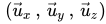
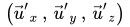
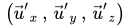
{\displaystyle \;\left\lbrace {{\vec {u}}'}_{x}\,,\,{{\vec {u}}'}_{y}\,,\,{{\vec {u}}'}_{z}\,,\,{\vec {u}}_{x}\,,\,{\vec {u}}_{y}\,,\,{\vec {u}}_{z}\right\rbrace \;}
[ 42] de cet espace vectoriel de dimension six, Remarques : D'après la note « 24 », il est possible de décrire un torseur, par les six composantes de sa réduction en un point
A
{\displaystyle \;A\;}
quelconque de
E
{\displaystyle \;{\mathcal {E}}\;}
[ 7] , Remarques : D'après la note « 24 », il est possible de décrire un torseur, par ces six composantes constituant les coordonnées plückeriennes[ 26] de la réduction du torseur au point
A
∈
E
{\displaystyle \;A\in {\mathcal {E}}\;}
[ 7] soit, Remarques : D'après la note « 24 », il est possible de décrire avec
{
R
→
=
X
u
→
′
x
+
Y
u
→
′
y
+
Z
u
→
′
z
M
→
A
=
L
A
u
→
x
+
M
A
u
→
y
+
N
A
u
→
z
}
{\displaystyle \;\left\lbrace {\begin{array}{l c l}{\vec {R}}\!\!\!&=&\!\!\!X\;{{\vec {u}}'}_{x}+Y\;{{\vec {u}}'}_{y}+Z\;{{\vec {u}}'}_{z}\\{\overrightarrow {\mathcal {M}}}_{A}\!\!\!&=&\!\!\!L_{A}\;{\vec {u}}_{x}+M_{A}\;{\vec {u}}_{y}+N_{A}\;{\vec {u}}_{z}\end{array}}\right\rbrace \;}
[ 43] , [ 44] , il est possible de réécrire la réduction du torseur
T
{\displaystyle \;{\mathcal {T}}\;}
au point
A
∈
E
{\displaystyle \;A\in {\mathcal {E}}\;}
[ 7] par Remarques : D'après la note « 24 », il est possible de décrire un torseur, par ces six composantes constituant ses coordonnées plückeriennes
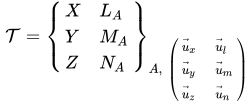
T
=
{
X
L
A
Y
M
A
Z
N
A
}
A
,
(
u
→
′
x
u
→
x
u
→
′
y
u
→
y
u
→
′
z
u
→
z
)
{\displaystyle \;{\mathcal {T}}=\left\lbrace {\begin{array}{l l}X&L_{A}\\Y&M_{A}\\Z&N_{A}\end{array}}\right\rbrace _{A,\;\left({\begin{array}{l}{{\vec {u}}'}_{x}&{\vec {u}}_{x}\\{{\vec {u}}'}_{y}&{\vec {u}}_{y}\\{{\vec {u}}'}_{z}&{\vec {u}}_{z}\end{array}}\right)}}
.
Remarques : D'après la relation de Varignon [ 14] , la connaissance de « la réduction du torseur
T
{\displaystyle \;{\mathcal {T}}\;}
en un point quelconque
A
∈
E
{\displaystyle \;A\in {\mathcal {E}}\;}
[ 7] » permet de déduire le torseur en n'importe quel point
P
∈
E
{\displaystyle \;P\in {\mathcal {E}}\;}
[ 7] selon Remarques : D'après la relation de Varignon, la connaissance de « la réduction du torseur
T
{\displaystyle \;\color {transparent}{\mathcal {T}}\;}
en un point quelconque
A
∈
E
{\displaystyle \;\color {transparent}{A\in {\mathcal {E}}}\;}
» permet de déduire le torseur
M
→
P
=
M
→
A
+
R
→
∧
A
M
→
{\displaystyle \;{\overrightarrow {\mathcal {M}}}_{P}={\overrightarrow {\mathcal {M}}}_{A}+{\vec {R}}\wedge {\overrightarrow {AM}}\;}
[ 29] , [ 45] .
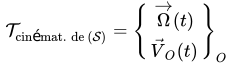
Exemple : les torseurs cinématiques des solides définis dans un référentiel
R
{\displaystyle \;{\mathcal {R}}\;}
fixé, voir le paragraphe « torseur cinématique » plus loin dans ce chapitre, Exemple : les torseurs cinématiques des solides définis dans un référentiel
R
{\displaystyle \;\color {transparent}{\mathcal {R}}\;}
fixé, la résultante étant appelée vecteur rotation instantanée notée
Ω
→
(
t
)
{\displaystyle \;{\overrightarrow {\Omega }}(t)\;}
[ 46] , Exemple : les torseurs cinématiques des solides définis dans un référentiel
R
{\displaystyle \;\color {transparent}{\mathcal {R}}\;}
fixé, le moment résultant en un point
A
{\displaystyle \;A\;}
du solide étant appelé vecteur vitesse de
A
{\displaystyle \;A\;}
dans le référentiel
R
{\displaystyle \;{\mathcal {R}}}
, Exemple : les torseurs cinématiques des solides définis dans un référentiel
R
{\displaystyle \;\color {transparent}{\mathcal {R}}\;}
fixé, le moment résultant en un point
A
{\displaystyle \;\color {transparent}{A}\;}
du solide étant noté
V
→
A
/
R
(
t
)
{\displaystyle \;{\vec {V}}_{A\,/\,{\mathcal {R}}}(t)\;}
[ 47] , Exemple : les torseurs cinématiques des solides définis dans un référentiel
R
{\displaystyle \;\color {transparent}{\mathcal {R}}\;}
fixé, la relation de Varignon [ 14] s'écrivant en
P
{\displaystyle \;P}
, point du solide , selon
V
→
P
/
R
(
t
)
=
V
→
A
/
R
(
t
)
+
Ω
→
(
t
)
∧
A
P
→
(
t
)
{\displaystyle \;{\vec {V}}_{P\,/\,{\mathcal {R}}}(t)={\vec {V}}_{A\,/\,{\mathcal {R}}}(t)+{\overrightarrow {\Omega }}(t)\wedge {\overrightarrow {AP}}(t)\;}
[ 48]
Deux torseurs
T
1
{\displaystyle \;{\mathcal {T}}_{1}\;}
et
T
2
{\displaystyle \;{\mathcal {T}}_{2}\;}
sont égaux ssi leurs éléments de réduction au même point
A
{\displaystyle \;A\;}
sont égaux soit «
T
1
=
T
2
{\displaystyle \;{\mathcal {T}}_{1}={\mathcal {T}}_{2}\;}
⇔
{\displaystyle \Leftrightarrow }
{
R
→
1
=
R
→
2
M
1
→
A
=
M
2
→
A
}
A
{\displaystyle \;\left\lbrace {\begin{array}{c}{\vec {R}}_{1}={\vec {R}}_{2}\\{\overrightarrow {{\mathcal {M}}_{1}}}_{A}={\overrightarrow {{\mathcal {M}}_{2}}}_{A}\end{array}}\right\rbrace _{A}\;}
».
La somme de deux torseurs
T
1
{\displaystyle \;{\mathcal {T}}_{1}\;}
et
T
2
{\displaystyle \;{\mathcal {T}}_{2}\;}
est le torseur dont les éléments de réduction en un point
A
{\displaystyle \;A\;}
sont la somme des éléments de réduction de chacun des torseurs au même point
A
{\displaystyle \;A\;}
soit
«
T
=
T
1
+
T
2
{\displaystyle \;{\mathcal {T}}={\mathcal {T}}_{1}+{\mathcal {T}}_{2}\;}
⇔
{\displaystyle \Leftrightarrow }
{
R
→
=
R
→
1
+
R
→
2
M
→
A
=
M
1
→
A
+
M
2
→
A
}
A
{\displaystyle \;\left\lbrace {\begin{array}{r c l}{\vec {R}}\!\!&=&\!\!{\vec {R}}_{1}+{\vec {R}}_{2}\\{\overrightarrow {\mathcal {M}}}_{A}\!\!&=&\!\!{\overrightarrow {{\mathcal {M}}_{1}}}_{A}+{\overrightarrow {{\mathcal {M}}_{2}}}_{A}\end{array}}\right\rbrace _{A}\;}
».
Soit
T
{\displaystyle \;{\mathcal {T}}\;}
un torseur quelconque,
∀
λ
∈
R
{\displaystyle \;\forall \;\lambda \in \mathbb {R} }
, le torseur
λ
×
T
{\displaystyle \;\lambda \times {\mathcal {T}}\;}
est le torseur dont les éléments de réduction en un point
A
{\displaystyle \;A\;}
sont
λ
{\displaystyle \;\lambda \;}
fois les éléments de réduction du torseur au même point
A
{\displaystyle \;A\;}
soit
«
T
(
×
λ
)
=
λ
×
T
{\displaystyle \;{\mathcal {T}}_{(\times \,\lambda )}=\lambda \times {\mathcal {T}}\;}
⇔
{\displaystyle \Leftrightarrow }
{
R
→
(
×
λ
)
=
λ
×
R
→
M
→
(
×
λ
)
A
=
λ
×
M
→
A
}
A
{\displaystyle \;\left\lbrace {\begin{array}{r c l}{\vec {R}}_{(\times \,\lambda )}\!\!&=&\!\!\lambda \times {\vec {R}}\\{\overrightarrow {\mathcal {M}}}_{(\times \,\lambda )_{A}}\!\!&=&\!\!\lambda \times {\overrightarrow {\mathcal {M}}}_{A}\end{array}}\right\rbrace _{A}\;}
».
Un torseur
T
{\displaystyle \;{\mathcal {T}}\;}
est nul ssi ses éléments de réduction en un point
A
{\displaystyle \;A\;}
sont tous deux nuls soit «
T
=
0
{\displaystyle \;{\mathcal {T}}=0\;}
⇔
{\displaystyle \Leftrightarrow }
{
R
→
=
0
→
M
→
A
=
0
→
}
A
{\displaystyle \;\left\lbrace {\begin{array}{r c l}{\vec {R}}\!\!&=&\!\!{\vec {0}}\\{\overrightarrow {\mathcal {M}}}_{A}\!\!&=&\!\!{\overrightarrow {0}}\end{array}}\right\rbrace _{A}\;}
»[ 49] .
Ce sont :
∙
{\displaystyle \bullet \;}
la résultante
R
→
{\displaystyle \;{\vec {R}}\;}
du torseur
T
{\displaystyle \;{\mathcal {T}}}
, Ce sont :
∙
{\displaystyle \bullet \;}
la projection du moment
M
→
P
,
∀
P
∈
E
{\displaystyle \;{\overrightarrow {\mathcal {M}}}_{P},\;\forall P\,\in \,{\mathcal {E}}\;}
du torseur
T
{\displaystyle \;{\mathcal {T}}}
sur sa résultante
R
→
{\displaystyle \;{\vec {R}}\;}
soit «
M
→
P
⋅
R
→
,
∀
P
∈
E
{\displaystyle \;{\overrightarrow {\mathcal {M}}}_{P}\cdot {\vec {R}},\;\forall \,P\,\in {\mathcal {E}}\;}
» appelée « invariant scalaire du torseur » Ce sont :
∙
{\displaystyle \color {transparent}{\bullet }\;}
la projection du moment
M
→
P
,
∀
P
∈
E
{\displaystyle \;\color {transparent}{{\overrightarrow {\mathcal {M}}}_{P},\;\forall P\,\in \,{\mathcal {E}}}\;}
du torseur
T
{\displaystyle \;\color {transparent}{\mathcal {T}}}
sur sa résultante
R
→
{\displaystyle \;\color {transparent}{\vec {R}}\;}
[
{\displaystyle {\bigg [}}
se démontre d'après la relation de Varignon [ 14] :
∀
(
P
,
Q
)
∈
E
2
,
M
→
Q
=
M
→
P
+
R
→
∧
P
Q
→
{\displaystyle \;\forall \;\left(P\,,\,Q\right)\in {\mathcal {E}}^{2},\;{\overrightarrow {\mathcal {M}}}_{Q}={\overrightarrow {\mathcal {M}}}_{P}+{\vec {R}}\wedge {\overrightarrow {PQ}}\;}
⇒
{\displaystyle \Rightarrow }
Ce sont :
∙
{\displaystyle \color {transparent}{\bullet }\;}
la projection du moment
M
→
P
,
∀
P
∈
E
{\displaystyle \;\color {transparent}{{\overrightarrow {\mathcal {M}}}_{P},\;\forall P\,\in \,{\mathcal {E}}}\;}
du torseur
T
{\displaystyle \;\color {transparent}{\mathcal {T}}}
sur sa résultante
R
→
{\displaystyle \;\color {transparent}{\vec {R}}\;}
[
{\displaystyle \color {transparent}{\bigg [}}
M
→
Q
⋅
R
→
=
M
→
P
⋅
R
→
+
[
R
→
∧
P
Q
→
]
⋅
R
→
{\displaystyle \;{\overrightarrow {\mathcal {M}}}_{Q}\cdot {\vec {R}}={\overrightarrow {\mathcal {M}}}_{P}\cdot {\vec {R}}\;{\cancel {+\left[{\vec {R}}\wedge {\overrightarrow {PQ}}\right]\cdot {\vec {R}}}}\;}
[ 50]
]
{\displaystyle {\bigg ]}\;}
et Ce sont :
∙
{\displaystyle \bullet \;}
la relation d'équiprojectivité «
∀
(
P
,
Q
)
∈
E
2
,
M
→
P
⋅
P
Q
→
=
M
→
Q
⋅
P
Q
→
{\displaystyle \;\forall \;\left(P\,,\,Q\right)\in {\mathcal {E}}^{2},\;{\overrightarrow {\mathcal {M}}}_{P}\cdot {\overrightarrow {PQ}}={\overrightarrow {\mathcal {M}}}_{Q}\cdot {\overrightarrow {PQ}}\;}
»
[
{\displaystyle \;{\big [}}
contenu dans la définition d'un torseur [ 51]
]
{\displaystyle {\big ]}}
.
Définition
Un point
A
∈
E
{\displaystyle \;A\in {\mathcal {E}}\;}
en lequel le
moment du torseur
T
{\displaystyle \;{\mathcal {T}}\;}
a même direction que la
résultante
R
→
{\displaystyle \;{\vec {R}}\;}
de ce dernier
[ 52] est dit «
central »
[ 53] c'est-à-dire
A
{\displaystyle \;A\;}
est un point central[ 53] du torseur
T
{\displaystyle \;{\mathcal {T}}\;}
ssi
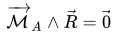
M
→
A
∧
R
→
=
0
→
{\displaystyle \;{\overrightarrow {\mathcal {M}}}_{A}\wedge {\vec {R}}={\vec {0}}\;}
[ 54]
⇔
{\displaystyle \Leftrightarrow }
∃
λ
∈
R
,
M
→
A
=
λ
R
→
{\displaystyle \;\exists \;\lambda \in \mathbb {R} ,\;{\overrightarrow {\mathcal {M}}}_{A}=\lambda \;{\vec {R}}}
.
Définition
L'ensemble
Δ
T
{\displaystyle \;\Delta _{\mathcal {T}}\;}
des points centraux du
torseur
T
{\displaystyle \;{\mathcal {T}}\;}
définit «
l'axe central » du
torseur
T
{\displaystyle \;{\mathcal {T}}\;}
c'est-à-dire
Δ
T
{\displaystyle \;\Delta _{\mathcal {T}}\;}
est l'axe central du torseur
T
{\displaystyle \;{\mathcal {T}}\;}
⇔
{\displaystyle \Leftrightarrow }
Δ
T
=
{
A
∈
E
,
M
→
A
∧
R
→
=
0
→
}
{\displaystyle \;\Delta _{\mathcal {T}}=\left\lbrace A\in {\mathcal {E}},\;{\overrightarrow {\mathcal {M}}}_{A}\wedge {\vec {R}}={\vec {0}}\right\rbrace \;}
[ 55] .
Si la résultante
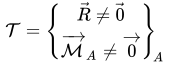
R
→
{\displaystyle \;{\vec {R}}\;}
du torseur
T
{\displaystyle \;{\mathcal {T}}\;}
est
≠
0
→
{\displaystyle \;\neq {\vec {0}}}
,
∙
{\displaystyle \bullet \;}
son axe central
Δ
T
{\displaystyle \;\Delta _{\mathcal {T}}\;}
est une droite de vecteur directeur
R
→
{\displaystyle \;{\vec {R}}\;}
et dans la mesure où on admet l'existence d'un point central
A
{\displaystyle \;A\;}
[ 56] Si la résultante
R
→
{\displaystyle \;\color {transparent}{\vec {R}}\;}
du torseur
T
{\displaystyle \;\color {transparent}{\mathcal {T}}\;}
est
≠
0
→
{\displaystyle \;\color {transparent}{\neq {\vec {0}}}}
,
∙
{\displaystyle \color {transparent}{\bullet }\;}
son axe central
Δ
T
{\displaystyle \;\color {transparent}{\Delta _{\mathcal {T}}}\;}
c'est la droite de vecteur directeur
R
→
{\displaystyle \;{\vec {R}}\;}
issue de
A
{\displaystyle \;A\;}
en effet, Si la résultante
R
→
{\displaystyle \;\color {transparent}{\vec {R}}\;}
du torseur
T
{\displaystyle \;\color {transparent}{\mathcal {T}}\;}
est
≠
0
→
{\displaystyle \;\color {transparent}{\neq {\vec {0}}}}
,
∙
{\displaystyle \color {transparent}{\bullet }\;}
son axe central
Δ
T
{\displaystyle \;\color {transparent}{\Delta _{\mathcal {T}}}\;}
≻
{\displaystyle \succ \;}
d'après la relation de Varignon [ 14] on peut écrire
∀
(
P
,
Q
≠
P
)
∈
E
2
,
M
→
Q
=
M
→
P
+
R
→
∧
P
Q
→
{\displaystyle \;\forall \;\left(P\,,\,Q\neq P\right)\in {\mathcal {E}}^{2},\;{\overrightarrow {\mathcal {M}}}_{Q}={\overrightarrow {\mathcal {M}}}_{P}+{\vec {R}}\wedge {\overrightarrow {PQ}}\;}
dont on déduit Si la résultante
R
→
{\displaystyle \;\color {transparent}{\vec {R}}\;}
du torseur
T
{\displaystyle \;\color {transparent}{\mathcal {T}}\;}
est
≠
0
→
{\displaystyle \;\color {transparent}{\neq {\vec {0}}}}
,
∙
{\displaystyle \color {transparent}{\bullet }\;}
son axe central
Δ
T
{\displaystyle \;\color {transparent}{\Delta _{\mathcal {T}}}\;}
≻
{\displaystyle \color {transparent}{\succ }\;}
M
→
Q
∧
R
→
=
M
→
P
∧
R
→
+
[
R
→
∧
P
Q
→
]
∧
R
→
{\displaystyle {\overrightarrow {\mathcal {M}}}_{Q}\wedge {\vec {R}}={\overrightarrow {\mathcal {M}}}_{P}\wedge {\vec {R}}+\left[{\vec {R}}\wedge {\overrightarrow {PQ}}\right]\wedge {\vec {R}}\;}
ou, en utilisant une formule du double produit vectoriel[ 57] Si la résultante
R
→
{\displaystyle \;\color {transparent}{\vec {R}}\;}
du torseur
T
{\displaystyle \;\color {transparent}{\mathcal {T}}\;}
est
≠
0
→
{\displaystyle \;\color {transparent}{\neq {\vec {0}}}}
,
∙
{\displaystyle \color {transparent}{\bullet }\;}
son axe central
Δ
T
{\displaystyle \;\color {transparent}{\Delta _{\mathcal {T}}}\;}
≻
{\displaystyle \color {transparent}{\succ }\;}
M
→
Q
∧
R
→
=
M
→
P
∧
R
→
−
[
P
Q
→
⋅
R
→
]
R
→
+
R
→
2
P
Q
→
{\displaystyle {\overrightarrow {\mathcal {M}}}_{Q}\wedge {\vec {R}}={\overrightarrow {\mathcal {M}}}_{P}\wedge {\vec {R}}-\left[{\overrightarrow {PQ}}\cdot {\vec {R}}\right]{\vec {R}}+{\vec {R}}^{2}\;{\overrightarrow {PQ}}\;}
et par suite,
∀
(
P
,
Q
≠
P
)
∈
Δ
T
{\displaystyle \;\forall \;\left(P\,,\,Q\neq P\right)\in \Delta _{\mathcal {T}}}
,
{
M
→
Q
∧
R
→
=
0
→
M
→
P
∧
R
→
=
0
→
}
{\displaystyle \;\left\lbrace {\begin{array}{l}{\overrightarrow {\mathcal {M}}}_{Q}\wedge {\vec {R}}={\vec {0}}\\{\overrightarrow {\mathcal {M}}}_{P}\wedge {\vec {R}}={\vec {0}}\end{array}}\right\rbrace \;}
d'où Si la résultante
R
→
{\displaystyle \;\color {transparent}{\vec {R}}\;}
du torseur
T
{\displaystyle \;\color {transparent}{\mathcal {T}}\;}
est
≠
0
→
{\displaystyle \;\color {transparent}{\neq {\vec {0}}}}
, son
∙
{\displaystyle \color {transparent}{\bullet }\;}
axe central
Δ
T
{\displaystyle \;\color {transparent}{\Delta _{\mathcal {T}}}\;}
≻
{\displaystyle \color {transparent}{\succ }\;}
M
→
Q
∧
R
→
=
M
→
P
∧
R
→
−
[
P
Q
→
⋅
R
→
]
R
→
+
R
→
2
P
Q
→
{\displaystyle {\cancel {{\overrightarrow {\mathcal {M}}}_{Q}\wedge {\vec {R}}}}={\cancel {{\overrightarrow {\mathcal {M}}}_{P}\wedge {\vec {R}}}}-\left[{\overrightarrow {PQ}}\cdot {\vec {R}}\right]{\vec {R}}+{\vec {R}}^{2}\;{\overrightarrow {PQ}}\;}
avec
P
Q
→
≠
0
→
{\displaystyle \;{\overrightarrow {PQ}}\neq {\vec {0}}\;}
⇒
{\displaystyle \Rightarrow }
P
Q
→
=
P
Q
→
⋅
R
→
R
→
2
R
→
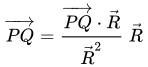
{\displaystyle \;{\overrightarrow {PQ}}={\dfrac {{\overrightarrow {PQ}}\cdot {\vec {R}}}{{\vec {R}}^{2}}}\;{\vec {R}}\;}
établissant la propriété directe Si la résultante
R
→
{\displaystyle \;\color {transparent}{\vec {R}}\;}
du torseur
T
{\displaystyle \;\color {transparent}{\mathcal {T}}\;}
est
≠
0
→
{\displaystyle \;\color {transparent}{\neq {\vec {0}}}}
,
∙
{\displaystyle \color {transparent}{\bullet }\;}
son axe central
Δ
T
{\displaystyle \;\color {transparent}{\Delta _{\mathcal {T}}}\;}
≻
{\displaystyle \color {transparent}{\succ }\;}
« si
(
P
,
Q
≠
P
)
∈
Δ
T
{\displaystyle \;\left(P\,,\,Q\neq P\right)\in \Delta _{\mathcal {T}}}
, alors ils sont sur une droite de vecteur directeur
R
→
{\displaystyle \;{\vec {R}}\;}
» ou encore Si la résultante
R
→
{\displaystyle \;\color {transparent}{\vec {R}}\;}
du torseur
T
{\displaystyle \;\color {transparent}{\mathcal {T}}\;}
est
≠
0
→
{\displaystyle \;\color {transparent}{\neq {\vec {0}}}}
,
∙
{\displaystyle \color {transparent}{\bullet }\;}
son axe central
Δ
T
{\displaystyle \;\color {transparent}{\Delta _{\mathcal {T}}}\;}
≻
{\displaystyle \color {transparent}{\succ }\;}
l'« ensemble des points centraux[ 56] du torseur
T
{\displaystyle \;{\mathcal {T}}\;}
est
⊂
{\displaystyle \;\subset \;}
dans la droite de vecteur directeur
R
→
{\displaystyle \;{\vec {R}}\;}
passant par
A
{\displaystyle \;A\;}
», Si la résultante
R
→
{\displaystyle \;\color {transparent}{\vec {R}}\;}
du torseur
T
{\displaystyle \;\color {transparent}{\mathcal {T}}\;}
est
≠
0
→
{\displaystyle \;\color {transparent}{\neq {\vec {0}}}}
,
∙
{\displaystyle \color {transparent}{\bullet }\;}
son axe central
Δ
T
{\displaystyle \;\color {transparent}{\Delta _{\mathcal {T}}}\;}
≻
{\displaystyle \succ \;}
réciproquement, si
A
Q
→
=
λ
R
→
,
∀
λ
∈
R
∗
{\displaystyle \;{\overrightarrow {AQ}}=\lambda \;{\vec {R}},\;\forall \lambda \in \mathbb {R} ^{*}\;}
avec
A
{\displaystyle \;A\;}
point central[ 56] dont l'existence est admise, Si la résultante
R
→
{\displaystyle \;\color {transparent}{\vec {R}}\;}
du torseur
T
{\displaystyle \;\color {transparent}{\mathcal {T}}\;}
est
≠
0
→
{\displaystyle \;\color {transparent}{\neq {\vec {0}}}}
,
∙
{\displaystyle \color {transparent}{\bullet }\;}
son axe central
Δ
T
{\displaystyle \;\color {transparent}{\Delta _{\mathcal {T}}}\;}
≻
{\displaystyle \color {transparent}{\succ }\;}
réciproquement, la relation de Varignon [ 14] donne
M
→
Q
=
M
→
A
+
R
→
∧
A
Q
→
{\displaystyle \;{\overrightarrow {\mathcal {M}}}_{Q}={\overrightarrow {\mathcal {M}}}_{A}\;{\cancel {+\;{\vec {R}}\wedge {\overrightarrow {AQ}}}}\;}
[ 58]
⇒
{\displaystyle \Rightarrow }
M
→
Q
∧
R
→
=
M
→
A
∧
R
→
{\displaystyle \;{\overrightarrow {\mathcal {M}}}_{Q}\wedge {\vec {R}}={\overrightarrow {\mathcal {M}}}_{A}\wedge {\vec {R}}\;}
et par suite, Si la résultante
R
→
{\displaystyle \;\color {transparent}{\vec {R}}\;}
du torseur
T
{\displaystyle \;\color {transparent}{\mathcal {T}}\;}
est
≠
0
→
{\displaystyle \;\color {transparent}{\neq {\vec {0}}}}
,
∙
{\displaystyle \color {transparent}{\bullet }\;}
son axe central
Δ
T
{\displaystyle \;\color {transparent}{\Delta _{\mathcal {T}}}\;}
≻
{\displaystyle \color {transparent}{\succ }\;}
réciproquement,
M
→
A
∧
R
→
=
0
→
{\displaystyle {\overrightarrow {\mathcal {M}}}_{A}\wedge {\vec {R}}={\vec {0}}\;}
(
A
{\displaystyle {\big (}A\;}
point central[ 56] de
T
)
{\displaystyle \;{\mathcal {T}}{\big )}\;}
⇒
{\displaystyle \Rightarrow }
M
→
Q
∧
R
→
=
0
→
{\displaystyle {\overrightarrow {\mathcal {M}}}_{Q}\wedge {\vec {R}}={\vec {0}}\;}
c'est-à-dire
Q
{\displaystyle \;Q\;}
est un point central[ 56] de
T
{\displaystyle \;{\mathcal {T}}}
, Si la résultante
R
→
{\displaystyle \;\color {transparent}{\vec {R}}\;}
du torseur
T
{\displaystyle \;\color {transparent}{\mathcal {T}}\;}
est
≠
0
→
{\displaystyle \;\color {transparent}{\neq {\vec {0}}}}
,
∙
{\displaystyle \color {transparent}{\bullet }\;}
son axe central
Δ
T
{\displaystyle \;\color {transparent}{\Delta _{\mathcal {T}}}\;}
≻
{\displaystyle \color {transparent}{\succ }\;}
réciproquement, d'où l'« ensemble des points de la droite de vecteur directeur
R
→
{\displaystyle \;{\vec {R}}\;}
passant par
A
{\displaystyle \;A\;}
est
⊂
{\displaystyle \;\subset \;}
dans l'axe central
Δ
T
{\displaystyle \;\Delta _{\mathcal {T}}\;}
», Si la résultante
R
→
{\displaystyle \;\color {transparent}{\vec {R}}\;}
du torseur
T
{\displaystyle \;\color {transparent}{\mathcal {T}}\;}
est
≠
0
→
{\displaystyle \;\color {transparent}{\neq {\vec {0}}}}
,
∙
{\displaystyle \color {transparent}{\bullet }\;}
son axe central
Δ
T
{\displaystyle \;\color {transparent}{\Delta _{\mathcal {T}}}\;}
finalement « la droite de vecteur directeur
R
→
{\displaystyle \;{\vec {R}}\;}
issue du point central[ 56]
A
{\displaystyle \;A}
(
{\displaystyle \;{\big (}}
existence admise
)
{\displaystyle {\big )}\;}
est l'axe central
Δ
T
{\displaystyle \;\Delta _{\mathcal {T}}\;}
du torseur
T
{\displaystyle \;{\mathcal {T}}\;}
» ;
Si la résultante
R
→
{\displaystyle \;\color {transparent}{\vec {R}}\;}
du torseur
T
{\displaystyle \;\color {transparent}{\mathcal {T}}\;}
est
≠
0
→
{\displaystyle \;\color {transparent}{\neq {\vec {0}}}}
,
∙
{\displaystyle \bullet \;}
le moment du torseur
T
{\displaystyle \;{\mathcal {T}}\;}
est le même en tout point de l'axe central
Δ
T
{\displaystyle \;\Delta _{\mathcal {T}}\;}
en effet,
Δ
T
{\displaystyle \;\Delta _{\mathcal {T}}\;}
étant une droite de vecteur directeur
R
→
{\displaystyle \;{\vec {R}}\;}
Si la résultante
R
→
{\displaystyle \;\color {transparent}{\vec {R}}\;}
du torseur
T
{\displaystyle \;\color {transparent}{\mathcal {T}}\;}
est
≠
0
→
{\displaystyle \;\color {transparent}{\neq {\vec {0}}}}
,
∙
{\displaystyle \color {transparent}{\bullet }\;}
le moment du torseur
T
{\displaystyle \;\color {transparent}{\mathcal {T}}\;}
est le même en tout point de l'axe central
Δ
T
{\displaystyle \;\color {transparent}{\Delta _{\mathcal {T}}}\;}
en effet, dans la mesure où on admet l'existence d'un point central
A
{\displaystyle \;A\;}
[ 56] , Si la résultante
R
→
{\displaystyle \;\color {transparent}{\vec {R}}\;}
du torseur
T
{\displaystyle \;\color {transparent}{\mathcal {T}}\;}
est
≠
0
→
{\displaystyle \;\color {transparent}{\neq {\vec {0}}}}
,
∙
{\displaystyle \color {transparent}{\bullet }\;}
le moment du torseur
T
{\displaystyle \;\color {transparent}{\mathcal {T}}\;}
est le même la relation de Varignon [ 14] nous donne
M
→
Q
=
M
→
P
+
R
→
∧
P
Q
→
,
∀
(
P
,
Q
≠
P
)
∈
Δ
T
{\displaystyle \;{\overrightarrow {\mathcal {M}}}_{Q}={\overrightarrow {\mathcal {M}}}_{P}\;{\cancel {+\;{\vec {R}}\wedge {\overrightarrow {PQ}}}},\;\forall \;\left(P\,,\,Q\neq P\right)\in \Delta _{\mathcal {T}}\;}
C.Q.F.D.[ 59] ;
Si la résultante
R
→
{\displaystyle \;\color {transparent}{\vec {R}}\;}
du torseur
T
{\displaystyle \;\color {transparent}{\mathcal {T}}\;}
est
≠
0
→
{\displaystyle \;\color {transparent}{\neq {\vec {0}}}}
,
∙
{\displaystyle \bullet \;}
la norme du moment du torseur
T
{\displaystyle \;{\mathcal {T}}\;}
est minimale sur son axe central
Δ
T
{\displaystyle \;\Delta _{\mathcal {T}}\;}
en effet,
Δ
T
{\displaystyle \;\Delta _{\mathcal {T}}\;}
étant une droite de vecteur directeur
R
→
{\displaystyle \;{\vec {R}}}
Si la résultante
R
→
{\displaystyle \;\color {transparent}{\vec {R}}\;}
du torseur
T
{\displaystyle \;\color {transparent}{\mathcal {T}}\;}
est
≠
0
→
{\displaystyle \;\color {transparent}{\neq {\vec {0}}}}
,
∙
{\displaystyle \color {transparent}{\bullet }\;}
la norme du moment du torseur
T
{\displaystyle \;\color {transparent}{\mathcal {T}}\;}
est minimale sur son axe central
Δ
T
{\displaystyle \;\color {transparent}{\Delta _{\mathcal {T}}}\;}
en effet, dans la mesure où on admet l'existence d'un point central
A
{\displaystyle \;A\;}
[ 56] , Si la résultante
R
→
{\displaystyle \;\color {transparent}{\vec {R}}\;}
du torseur
T
{\displaystyle \;\color {transparent}{\mathcal {T}}\;}
est
≠
0
→
{\displaystyle \;\color {transparent}{\neq {\vec {0}}}}
,
∙
{\displaystyle \color {transparent}{\bullet }\;}
la norme du moment du torseur
T
{\displaystyle \;\color {transparent}{\mathcal {T}}\;}
est minimale la relation de Varignon [ 14] nous donne
M
→
Q
=
M
→
P
+
R
→
∧
P
Q
→
{\displaystyle \;{\overrightarrow {\mathcal {M}}}_{Q}={\overrightarrow {\mathcal {M}}}_{P}+{\vec {R}}\wedge {\overrightarrow {PQ}}\;}
avec
P
∈
Δ
T
{\displaystyle \;P\in \Delta _{\mathcal {T}}}
,
∀
Q
∉
Δ
T
{\displaystyle \;\forall \;Q\;\notin \;\Delta _{\mathcal {T}}}
, Si la résultante
R
→
{\displaystyle \;\color {transparent}{\vec {R}}\;}
du torseur
T
{\displaystyle \;\color {transparent}{\mathcal {T}}\;}
est
≠
0
→
{\displaystyle \;\color {transparent}{\neq {\vec {0}}}}
,
∙
{\displaystyle \color {transparent}{\bullet }\;}
la norme du moment du torseur
T
{\displaystyle \;\color {transparent}{\mathcal {T}}\;}
est minimale la relation de Varignon nous donne où
M
→
P
{\displaystyle \;{\overrightarrow {\mathcal {M}}}_{P}\;}
est
∥
{\displaystyle \;\parallel \;}
à
R
→
{\displaystyle \;{\vec {R}}\;}
et
R
→
∧
P
Q
→
{\displaystyle \;{\vec {R}}\wedge {\overrightarrow {PQ}}}
⊥
{\displaystyle \;\perp \;}
à
R
→
{\displaystyle \;{\vec {R}}\;}
donc à
M
→
P
{\displaystyle \;{\overrightarrow {\mathcal {M}}}_{P}\;}
⇒
{\displaystyle \Rightarrow }
Si la résultante
R
→
{\displaystyle \;\color {transparent}{\vec {R}}\;}
du torseur
T
{\displaystyle \;\color {transparent}{\mathcal {T}}\;}
est
≠
0
→
{\displaystyle \;\color {transparent}{\neq {\vec {0}}}}
,
∙
{\displaystyle \color {transparent}{\bullet }\;}
la norme du moment du torseur
T
{\displaystyle \;\color {transparent}{\mathcal {T}}\;}
est minimale la relation de Varignon nous donne
‖
M
→
Q
‖
2
=
‖
M
→
P
‖
2
+
‖
R
→
∧
P
Q
→
‖
2
{
∀
Q
∉
Δ
T
P
∈
Δ
T
}
{\displaystyle \Vert {\overrightarrow {\mathcal {M}}}_{Q}\Vert ^{2}=\Vert {\overrightarrow {\mathcal {M}}}_{P}\Vert ^{2}+\Vert {\vec {R}}\wedge {\overrightarrow {PQ}}\Vert ^{2}\;\left\lbrace {\begin{array}{l}\forall \;Q\!\!&\notin \Delta _{\mathcal {T}}\\P\!\!&\in \Delta _{\mathcal {T}}\end{array}}\right\rbrace \;}
[ 60] d'où Si la résultante
R
→
{\displaystyle \;\color {transparent}{\vec {R}}\;}
du torseur
T
{\displaystyle \;\color {transparent}{\mathcal {T}}\;}
est
≠
0
→
{\displaystyle \;\color {transparent}{\neq {\vec {0}}}}
,
∙
{\displaystyle \color {transparent}{\bullet }\;}
la norme du moment du torseur
T
{\displaystyle \;\color {transparent}{\mathcal {T}}\;}
est minimale la relation de Varignon nous donne
‖
M
→
Q
‖
2
>
‖
M
→
P
‖
2
{\displaystyle \Vert {\overrightarrow {\mathcal {M}}}_{Q}\Vert ^{2}>\Vert {\overrightarrow {\mathcal {M}}}_{P}\Vert ^{2}\;}
car
‖
R
→
∧
P
Q
→
‖
2
≠
0
{\displaystyle \;\Vert {\vec {R}}\wedge {\overrightarrow {PQ}}\Vert ^{2}\neq 0\;}
pour
{
∀
Q
∉
Δ
T
P
∈
Δ
T
}
{\displaystyle \;\left\lbrace \!{\begin{array}{r l}\forall \;Q\!\!\!\!&\notin \Delta _{\mathcal {T}}\\P\!\!\!\!&\in \Delta _{\mathcal {T}}\end{array}}\!\right\rbrace }
, Si la résultante
R
→
{\displaystyle \;\color {transparent}{\vec {R}}\;}
du torseur
T
{\displaystyle \;\color {transparent}{\mathcal {T}}\;}
est
≠
0
→
{\displaystyle \;\color {transparent}{\neq {\vec {0}}}}
,
∙
{\displaystyle \color {transparent}{\bullet }\;}
la norme du moment du torseur
T
{\displaystyle \;\color {transparent}{\mathcal {T}}\;}
est minimale la relation de Varignon nous donne vrai
∀
P
∈
Δ
T
{\displaystyle \;\forall \;P\;\in \Delta _{\mathcal {T}}}
, le moment du torseur
T
{\displaystyle \;{\mathcal {T}}\;}
Si la résultante
R
→
{\displaystyle \;\color {transparent}{\vec {R}}\;}
du torseur
T
{\displaystyle \;\color {transparent}{\mathcal {T}}\;}
est
≠
0
→
{\displaystyle \;\color {transparent}{\neq {\vec {0}}}}
,
∙
{\displaystyle \color {transparent}{\bullet }\;}
la norme du moment du torseur
T
{\displaystyle \;\color {transparent}{\mathcal {T}}\;}
est minimale la relation de Varignon nous donne vrai
∀
P
∈
Δ
T
{\displaystyle \;\color {transparent}{\forall \;P\;\in \Delta _{\mathcal {T}}}}
, étant constant sur son axe central
Δ
T
{\displaystyle \;\Delta _{\mathcal {T}}\;}
d'où Si la résultante
R
→
{\displaystyle \;\color {transparent}{\vec {R}}\;}
du torseur
T
{\displaystyle \;\color {transparent}{\mathcal {T}}\;}
est
≠
0
→
{\displaystyle \;\color {transparent}{\neq {\vec {0}}}}
,
∙
{\displaystyle \color {transparent}{\bullet }\;}
la norme du moment du torseur
T
{\displaystyle \;\color {transparent}{\mathcal {T}}\;}
est minimale la relation de Varignon nous donne
‖
M
→
Q
‖
2
>
‖
M
→
P
‖
2
,
{
∀
Q
∉
Δ
T
∀
P
∈
Δ
T
}
{\displaystyle \Vert {\overrightarrow {\mathcal {M}}}_{Q}\Vert ^{2}>\Vert {\overrightarrow {\mathcal {M}}}_{P}\Vert ^{2},\;\left\lbrace \!{\begin{array}{r l}\forall \;Q\!\!\!\!&\notin \Delta _{\mathcal {T}}\\\forall \;P\!\!\!\!&\in \Delta _{\mathcal {T}}\end{array}}\!\right\rbrace \;}
C.Q.F.D.[ 59] .
Le torseur nul
N
{\displaystyle \;{\mathcal {N}}\;}
est le torseur dont les éléments de réduction en un point quelconque
P
∈
E
{\displaystyle \;P\in {\mathcal {E}}\;}
sont nuls soit
N
=
{
R
→
=
0
→
M
→
P
=
0
→
}
P
{\displaystyle \;{\mathcal {N}}=\left\lbrace {\begin{array}{r l}{\vec {R}}\!\!\!\!&={\vec {0}}\\{\overrightarrow {\mathcal {M}}}_{P}\!\!\!\!&={\overrightarrow {0}}\end{array}}\right\rbrace _{P}\;}
[ 61] .
Un torseur couple
C
{\displaystyle \;{\mathcal {C}}\;}
est un torseur pour lequel les éléments de réduction en n'importe quel point
P
∈
E
{\displaystyle \;P\;\in {\mathcal {E}}\;}
se réduisent à son moment non nul
M
→
P
{\displaystyle \;{\overrightarrow {\mathcal {M}}}_{P}\;}
soit
∀
P
∈
E
,
C
=
{
R
→
=
0
→
M
→
P
≠
0
→
}
P
{\displaystyle \;\forall \;P\in {\mathcal {E}},\;\;{\mathcal {C}}=\left\lbrace {\begin{array}{r l}{\vec {R}}\!\!\!\!&={\vec {0}}\\{\overrightarrow {\mathcal {M}}}_{P}\!\!\!\!&\neq {\overrightarrow {0}}\end{array}}\right\rbrace _{P}}
.
« Le moment d'un torseur couple
C
{\displaystyle \;{\mathcal {C}}\;}
est constant en tout point
P
∈
E
{\displaystyle \;P\;\in {\mathcal {E}}\;}
» en effet la relation de Varignon [ 14] appliquée à
C
{\displaystyle \;{\mathcal {C}}\;}
en
∀
(
P
,
Q
≠
P
)
∈
E
2
{\displaystyle \;\forall \,\left(P\,,\,Q\neq P\right)\in {\mathcal {E}}^{2}\;}
⇒
{\displaystyle \Rightarrow }
M
→
Q
=
M
→
P
+
0
→
∧
P
Q
→
{\displaystyle \;{\overrightarrow {\mathcal {M}}}_{Q}={\overrightarrow {\mathcal {M}}}_{P}\;{\cancel {+\;{\vec {0}}\wedge {\overrightarrow {PQ}}}}\;}
soit « Le moment d'un torseur couple
C
{\displaystyle \;\color {transparent}{\mathcal {C}}\;}
est constant en tout point
P
∈
E
{\displaystyle \;\color {transparent}{P\;\in {\mathcal {E}}}\;}
» en effet la relation de Varignon appliquée à
C
{\displaystyle \;\color {transparent}{\mathcal {C}}\;}
en
∀
(
P
,
Q
≠
P
)
∈
E
2
{\displaystyle \;\color {transparent}{\forall \,\left(P\,,\,Q\neq P\right)\in {\mathcal {E}}^{2}}\;}
⇒
{\displaystyle \color {transparent}{\Rightarrow }}
M
→
P
=
cste
→
∀
P
∈
E
{\displaystyle \;{\overrightarrow {\mathcal {M}}}_{P}={\overrightarrow {\text{cste}}}\;\;\forall \;P\;\in {\mathcal {E}}}
« Le moment d'un torseur couple
C
{\displaystyle \;\color {transparent}{\mathcal {C}}\;}
est constant en tout point
P
∈
E
{\displaystyle \;\color {transparent}{P\;\in {\mathcal {E}}}\;}
»
[
{\displaystyle {\big [}}
une conséquence est qu'il est inutile de préciser en quel point les éléments de réduction du couple sont évalués, « Le moment d'un torseur couple
C
{\displaystyle \;\color {transparent}{\mathcal {C}}\;}
est constant en tout point
P
∈
E
{\displaystyle \;\color {transparent}{P\;\in {\mathcal {E}}}\;}
»
[
{\displaystyle \color {transparent}{\big [}}
ainsi le moment du couple
C
{\displaystyle \;{\mathcal {C}}\;}
sera-t-il simplement noté
M
{\displaystyle \;{\mathcal {M}}\;}
sans ajouter
P
{\displaystyle \;_{P}\;}
en indice précisant le point
P
{\displaystyle \;P\;}
où il est évalué
]
{\displaystyle {\big ]}}
;
un torseur couple
C
{\displaystyle \;{\mathcal {C}}\;}
n'a pas d'axe central
∄
Δ
C
{\displaystyle \;\nexists \;\Delta _{\mathcal {C}}}
, en effet l'existence d'un point central[ 56] pour un torseur couple impliquerait qu'en ce point le moment du couple soit nul puisque colinéaire à sa résultante
0
→
{\displaystyle \;{\vec {0}}}
, un torseur couple
C
{\displaystyle \;\color {transparent}{\mathcal {C}}\;}
n'a pas d'axe central
∄
Δ
C
{\displaystyle \;\color {transparent}{\nexists \;\Delta _{\mathcal {C}}}}
, en effet l'existence d'un point central pour un torseur couple impliquerait ce qui est impossible, le moment d'un torseur couple étant constant
≠
0
→
{\displaystyle \;\neq {\overrightarrow {0}}\;}
[ 62] .
La somme de deux couples
C
1
{\displaystyle \;{\mathcal {C}}_{1}\;}
et
C
2
{\displaystyle \;{\mathcal {C}}_{2}\;}
est un couple si leurs moments
M
1
{\displaystyle \;{\mathcal {M}}_{1}\;}
et
M
2
{\displaystyle \;{\mathcal {M}}_{2}\;}
ne sont pas opposés , en effet
∀
P
∈
E
{\displaystyle \;\forall \;P\;\in {\mathcal {E}}}
, les éléments de réduction de chacun des couples étant La somme de deux couples
C
1
{\displaystyle \;\color {transparent}{{\mathcal {C}}_{1}}\;}
et
C
2
{\displaystyle \;\color {transparent}{{\mathcal {C}}_{2}}\;}
est un couple si leurs moments
M
1
{\displaystyle \;\color {transparent}{{\mathcal {M}}_{1}}\;}
et
M
2
{\displaystyle \;\color {transparent}{{\mathcal {M}}_{2}}\;}
ne sont pas opposés, en effet
∀
P
∈
E
{\displaystyle \;\color {transparent}{\forall \;P\;\in {\mathcal {E}}}}
, les éléments de réduction
C
1
=
{
R
→
1
=
0
→
M
→
1
≠
0
→
}
P
{\displaystyle {\mathcal {C}}_{1}=\left\lbrace {\begin{array}{c}{\vec {R}}_{1}={\vec {0}}\\{\overrightarrow {\mathcal {M}}}_{1}\neq {\overrightarrow {0}}\end{array}}\right\rbrace _{P}\;}
et
C
2
=
{
R
→
2
=
0
→
M
→
2
≠
0
→
}
P
{\displaystyle \;{\mathcal {C}}_{2}=\left\lbrace {\begin{array}{c}{\vec {R}}_{2}={\vec {0}}\\{\overrightarrow {\mathcal {M}}}_{2}\neq {\overrightarrow {0}}\end{array}}\right\rbrace _{P}}
, La somme de deux couples
C
1
{\displaystyle \;\color {transparent}{{\mathcal {C}}_{1}}\;}
et
C
2
{\displaystyle \;\color {transparent}{{\mathcal {C}}_{2}}\;}
est un couple si leurs moments
M
1
{\displaystyle \;\color {transparent}{{\mathcal {M}}_{1}}\;}
et
M
2
{\displaystyle \;\color {transparent}{{\mathcal {M}}_{2}}\;}
ne sont pas opposés, en effet on en déduit ceux de la somme des deux couples au même point
P
{\displaystyle \;P}
La somme de deux couples
C
1
{\displaystyle \;\color {transparent}{{\mathcal {C}}_{1}}\;}
et
C
2
{\displaystyle \;\color {transparent}{{\mathcal {C}}_{2}}\;}
est un couple si leurs moments
M
1
{\displaystyle \;\color {transparent}{{\mathcal {M}}_{1}}\;}
et
M
2
{\displaystyle \;\color {transparent}{{\mathcal {M}}_{2}}\;}
ne sont pas opposés, en effet on en déduit ceux
C
1
+
C
2
=
{
R
→
1
+
R
→
2
=
0
→
M
→
1
+
M
→
2
≠
0
→
}
P
{\displaystyle \;{\mathcal {C}}_{1}+{\mathcal {C}}_{2}=\left\lbrace {\begin{array}{c}{\vec {R}}_{1}+{\vec {R}}_{2}={\vec {0}}\\{\overrightarrow {\mathcal {M}}}_{1}+{\overrightarrow {\mathcal {M}}}_{2}\neq {\overrightarrow {0}}\end{array}}\right\rbrace _{P}\;}
[ 63] assurant que La somme de deux couples
C
1
{\displaystyle \;\color {transparent}{{\mathcal {C}}_{1}}\;}
et
C
2
{\displaystyle \;\color {transparent}{{\mathcal {C}}_{2}}\;}
est un couple si leurs moments
M
1
{\displaystyle \;\color {transparent}{{\mathcal {M}}_{1}}\;}
et
M
2
{\displaystyle \;\color {transparent}{{\mathcal {M}}_{2}}\;}
ne sont pas opposés, en effet on en déduit cette somme est un couple de moment
M
→
1
+
M
→
2
{\displaystyle \;{\overrightarrow {\mathcal {M}}}_{1}+{\overrightarrow {\mathcal {M}}}_{2}}
;
si les moments des deux couples
C
1
{\displaystyle \;{\mathcal {C}}_{1}\;}
et
C
2
{\displaystyle \;{\mathcal {C}}_{2}\;}
sont opposés , la somme de ces deux couples
C
1
+
C
2
{\displaystyle \;{\mathcal {C}}_{1}+{\mathcal {C}}_{2}\;}
est le torseur nul
N
{\displaystyle \;{\mathcal {N}}}
.
Un torseur glisseur
G
{\displaystyle \;{\mathcal {G}}\;}
est un torseur pour lequel il existe un point particulier
A
∈
E
{\displaystyle \;A\in {\mathcal {E}}\;}
en lequel les éléments de réduction non nuls se réduisent à sa résultante
R
→
{\displaystyle \;{\vec {R}}}
, son moment en
A
{\displaystyle \;A\;}
étant nul, c'est-à-dire Un torseur glisseur
G
{\displaystyle \;\color {transparent}{\mathcal {G}}\;}
est un torseur pour lequel
∃
A
∈
E
,
G
=
{
R
→
≠
0
→
M
→
A
=
0
→
}
A
{\displaystyle \;\exists \;A\in {\mathcal {E}},\;{\mathcal {G}}=\left\lbrace {\begin{array}{c}{\vec {R}}\neq {\vec {0}}\\{\overrightarrow {\mathcal {M}}}_{A}={\overrightarrow {0}}\end{array}}\right\rbrace _{A}}
.
« Le moment d'un torseur glisseur
G
{\displaystyle \;{\mathcal {G}}\;}
est nul en tout point de son axe central
Δ
G
{\displaystyle \;\Delta _{\mathcal {G}}\;}
» en effet le point particulier
A
∈
E
{\displaystyle \;A\in {\mathcal {E}}\;}
est un point de
Δ
G
{\displaystyle \;\Delta _{\mathcal {G}}\;}
c'est-à-dire un point central[ 56] du glisseur
G
{\displaystyle \;{\mathcal {G}}}
, « Le moment d'un torseur glisseur
G
{\displaystyle \;\color {transparent}{\mathcal {G}}\;}
est nul en tout point de son axe central
Δ
G
{\displaystyle \;\color {transparent}{\Delta _{\mathcal {G}}}\;}
» en effet
[
{\displaystyle {\Big [}}
de
M
→
A
=
0
→
{\displaystyle \;{\overrightarrow {\mathcal {M}}}_{A}={\overrightarrow {0}}\;}
on tire
M
→
A
∧
R
→
=
0
→
{\displaystyle \;{\overrightarrow {\mathcal {M}}}_{A}\wedge {\vec {R}}={\vec {0}}\;}
soit
M
→
A
=
λ
R
→
{\displaystyle \;{\overrightarrow {\mathcal {M}}}_{A}=\lambda \;{\vec {R}}\;}
avec
λ
=
0
{\displaystyle \;\lambda =0\;}
[ 64] c'est-à-dire une 1ère justification ou « Le moment d'un torseur glisseur
G
{\displaystyle \;\color {transparent}{\mathcal {G}}\;}
est nul en tout point de son axe central
Δ
G
{\displaystyle \;\color {transparent}{\Delta _{\mathcal {G}}}\;}
» en effet
[
{\displaystyle \color {transparent}{\Big [}}
l'axe central
Δ
G
{\displaystyle \;\Delta _{\mathcal {G}}\;}
étant le lieu à
‖
M
→
P
‖
{\displaystyle \;\Vert {\overrightarrow {\mathcal {M}}}_{P}\Vert \;}
minimale[ 65] ,
M
→
A
=
0
→
{\displaystyle \;{\overrightarrow {\mathcal {M}}}_{A}={\overrightarrow {0}}\;}
⇒
{\displaystyle \Rightarrow }
‖
M
→
A
‖
{\displaystyle \;\Vert {\overrightarrow {\mathcal {M}}}_{A}\Vert \;}
minimale d'où
A
∈
Δ
G
{\displaystyle \;A\in \Delta _{\mathcal {G}}}
« Le moment d'un torseur glisseur
G
{\displaystyle \;\color {transparent}{\mathcal {G}}\;}
est nul en tout point de son axe central
Δ
G
{\displaystyle \;\color {transparent}{\Delta _{\mathcal {G}}}\;}
» en effet
[
{\displaystyle \color {transparent}{\Big [}}
l'axe central
Δ
G
{\displaystyle \;\color {transparent}{\Delta _{\mathcal {G}}}\;}
étant le lieu à
‖
M
→
P
‖
{\displaystyle \;\color {transparent}{\Vert {\overrightarrow {\mathcal {M}}}_{P}\Vert }\;}
minimale,
M
→
A
=
0
→
{\displaystyle \;\color {transparent}{{\overrightarrow {\mathcal {M}}}_{A}={\overrightarrow {0}}}\;}
⇒
{\displaystyle \color {transparent}{\Rightarrow }}
c'est-à-dire une 2ème justification
]
{\displaystyle {\Big ]}\;}
et « Le moment d'un torseur glisseur
G
{\displaystyle \;\color {transparent}{\mathcal {G}}\;}
est nul en tout point de son axe central
Δ
G
{\displaystyle \;\color {transparent}{\Delta _{\mathcal {G}}}\;}
» en effet le moment du torseur
G
{\displaystyle \;{\mathcal {G}}\;}
en tout point de son axe central
Δ
G
{\displaystyle \;\Delta _{\mathcal {G}}\;}
étant le même[ 66] est égal à celui de
A
{\displaystyle \;A\;}
d'où « Le moment d'un torseur glisseur
G
{\displaystyle \;\color {transparent}{\mathcal {G}}\;}
est nul en tout point de son axe central
Δ
G
{\displaystyle \;\color {transparent}{\Delta _{\mathcal {G}}}\;}
»
∀
P
∈
Δ
G
{\displaystyle \;\forall \;P\;\in \Delta _{\mathcal {G}}}
,
M
→
P
=
0
→
{\displaystyle \;{\overrightarrow {\mathcal {M}}}_{P}={\overrightarrow {0}}\;}
C.Q.F.D.[ 59] ;
l'axe central
Δ
G
{\displaystyle \;\Delta _{\mathcal {G}}\;}
d'un torseur glisseur
G
{\displaystyle \;{\mathcal {G}}\;}
est encore appelé support du glisseur ;
en tout point
Q
∉
Δ
G
{\displaystyle \;Q\notin \Delta _{\mathcal {G}}\;}
les éléments de réduction du torseur glisseur sont tous deux non nuls c'est-à-dire
∀
Q
∉
Δ
G
,
G
=
{
R
→
≠
0
→
M
→
Q
=
R
→
∧
A
Q
→
≠
0
→
}
Q
{\displaystyle \;\forall \;Q\;\notin \Delta _{\mathcal {G}},\;{\mathcal {G}}=\left\lbrace {\begin{array}{l l l}{\vec {R}}\!\!&\!\!&\neq {\vec {0}}\\{\overrightarrow {\mathcal {M}}}_{Q}\!\!&={\vec {R}}\wedge {\overrightarrow {AQ}}\!\!&\neq {\overrightarrow {0}}\end{array}}\right\rbrace _{Q}}
, en effet en tout point
Q
∉
Δ
G
{\displaystyle \;\color {transparent}{Q\notin \Delta _{\mathcal {G}}}\;}
les éléments de réduction du torseur glisseur sont tous deux non nuls le moment du glisseur
G
{\displaystyle \;{\mathcal {G}}\;}
en
Q
∉
Δ
G
{\displaystyle \;Q\;\notin \Delta _{\mathcal {G}}\;}
s'obtient par relation de Varignon [ 14] à partir de
A
∈
Δ
G
{\displaystyle \;A\;\in \Delta _{\mathcal {G}}\;}
soit en tout point
Q
∉
Δ
G
{\displaystyle \;\color {transparent}{Q\notin \Delta _{\mathcal {G}}}\;}
les éléments de réduction du torseur glisseur sont tous deux non nuls
M
→
Q
=
M
→
A
+
R
→
∧
A
Q
→
≠
0
→
{\displaystyle \;{\overrightarrow {\mathcal {M}}}_{Q}={\cancel {{\overrightarrow {\mathcal {M}}}_{A}\;+}}{\vec {R}}\wedge {\overrightarrow {AQ}}\neq {\overrightarrow {0}}\;}
car
A
Q
→
{\displaystyle \;{\overrightarrow {AQ}}\;}
non colinéaire à
R
→
{\displaystyle \;{\vec {R}}\;}
[ 67] C.Q.F.D.[ 59] .
Un torseur
T
{\displaystyle \;{\mathcal {T}}\;}
dont les éléments de réduction en un point
B
∈
E
{\displaystyle \;B\in {\mathcal {E}}\;}
sont non nuls et
⊥
{\displaystyle \;\perp }
soit
T
=
{
R
→
≠
0
→
M
→
B
[
≠
0
→
⊥
à
R
→
]
}
B
{\displaystyle \;{\mathcal {T}}=\left\lbrace {\begin{array}{c}{\vec {R}}\neq {\vec {0}}\\{\overrightarrow {\mathcal {M}}}_{B}\left[{\begin{array}{c}\neq {\overrightarrow {0}}\\\perp \;{\text{à}}\;{\vec {R}}\end{array}}\right]\end{array}}\right\rbrace _{B}\;}
Un torseur
T
{\displaystyle \;\color {transparent}{\mathcal {T}}\;}
dont les éléments de réduction en un point
B
∈
E
{\displaystyle \;\color {transparent}{B\in {\mathcal {E}}}\;}
sont non nuls et
⊥
{\displaystyle \;\color {transparent}{\perp }}
est un glisseur en effet, appliquant la relation de Varignon [ 14] en
P
{\displaystyle \;P\;}
a priori quelconque
∈
E
{\displaystyle \;\in {\mathcal {E}}\;}
à partir de
B
{\displaystyle \;B\;}
⇒
{\displaystyle \Rightarrow }
Un torseur
T
{\displaystyle \;\color {transparent}{\mathcal {T}}\;}
dont les éléments de réduction en un point
B
∈
E
{\displaystyle \;\color {transparent}{B\in {\mathcal {E}}}\;}
sont non nuls et
⊥
{\displaystyle \;\color {transparent}{\perp }}
est un glisseur en effet,
M
→
P
=
M
→
B
+
R
→
∧
B
P
→
{\displaystyle {\overrightarrow {\mathcal {M}}}_{P}={\overrightarrow {\mathcal {M}}}_{B}+{\vec {R}}\wedge {\overrightarrow {BP}}\;}
avec
M
→
B
{\displaystyle \;{\overrightarrow {\mathcal {M}}}_{B}\;}
et
R
→
∧
B
P
→
{\displaystyle \;{\vec {R}}\wedge {\overrightarrow {BP}}\;}
tous deux
⊥
{\displaystyle \;\perp \;}
à
R
→
{\displaystyle \;{\vec {R}}}
, permettant de Un torseur
T
{\displaystyle \;\color {transparent}{\mathcal {T}}\;}
dont les éléments de réduction en un point
B
∈
E
{\displaystyle \;\color {transparent}{B\in {\mathcal {E}}}\;}
sont non nuls et
⊥
{\displaystyle \;\color {transparent}{\perp }}
est un glisseur en effet, choisir
P
0
∈
E
{\displaystyle \;P_{0}\in {\mathcal {E}}\;}
vérifiant
M
→
P
0
=
0
→
{\displaystyle \;{\overrightarrow {\mathcal {M}}}_{P_{0}}={\overrightarrow {0}}\;}
c'est-à-dire
R
→
∧
B
P
0
→
=
−
M
→
B
{\displaystyle \;{\vec {R}}\wedge {\overrightarrow {BP_{0}}}=-{\overrightarrow {\mathcal {M}}}_{B}\;}
⇒
{\displaystyle \Rightarrow }
Un torseur
T
{\displaystyle \;\color {transparent}{\mathcal {T}}\;}
dont les éléments de réduction en un point
B
∈
E
{\displaystyle \;\color {transparent}{B\in {\mathcal {E}}}\;}
sont non nuls et
⊥
{\displaystyle \;\color {transparent}{\perp }}
est un glisseur en effet, choisir
P
0
∈
E
{\displaystyle \;\color {transparent}{P_{0}\in {\mathcal {E}}}\;}
≻
{\displaystyle \succ \;}
R
→
∧
B
P
0
→
{\displaystyle {\vec {R}}\wedge {\overrightarrow {BP_{0}}}\;}
et
M
→
B
{\displaystyle \;{\overrightarrow {\mathcal {M}}}_{B}\;}
colinéaires
⇔
{\displaystyle \Leftrightarrow }
(
R
→
∧
B
P
0
→
)
∧
M
→
B
=
0
→
{\displaystyle \;\left({\vec {R}}\wedge {\overrightarrow {BP_{0}}}\right)\wedge {\overrightarrow {\mathcal {M}}}_{B}={\vec {0}}\;}
ou, Un torseur
T
{\displaystyle \;\color {transparent}{\mathcal {T}}\;}
dont les éléments de réduction en un point
B
∈
E
{\displaystyle \;\color {transparent}{B\in {\mathcal {E}}}\;}
sont non nuls et
⊥
{\displaystyle \;\color {transparent}{\perp }}
est un glisseur en effet, choisir
P
0
∈
E
{\displaystyle \;\color {transparent}{P_{0}\in {\mathcal {E}}}\;}
≻
{\displaystyle \color {transparent}{\succ }\;}
en utilisant une des formules du double produit vectoriel[ 57] on obtient Un torseur
T
{\displaystyle \;\color {transparent}{\mathcal {T}}\;}
dont les éléments de réduction en un point
B
∈
E
{\displaystyle \;\color {transparent}{B\in {\mathcal {E}}}\;}
sont non nuls et
⊥
{\displaystyle \;\color {transparent}{\perp }}
est un glisseur en effet, choisir
P
0
∈
E
{\displaystyle \;\color {transparent}{P_{0}\in {\mathcal {E}}}\;}
≻
{\displaystyle \color {transparent}{\succ }\;}
−
(
B
P
0
→
⋅
M
→
B
)
R
→
+
(
R
→
⋅
M
→
B
)
B
P
0
→
=
0
→
{\displaystyle -\left({\overrightarrow {BP_{0}}}\cdot {\overrightarrow {\mathcal {M}}}_{B}\right)\,{\vec {R}}\,{\cancel {+\left({\vec {R}}\cdot {\overrightarrow {\mathcal {M}}}_{B}\right)\,{\overrightarrow {BP_{0}}}}}={\vec {0}}\;}
[ 68] c'est-à-dire Un torseur
T
{\displaystyle \;\color {transparent}{\mathcal {T}}\;}
dont les éléments de réduction en un point
B
∈
E
{\displaystyle \;\color {transparent}{B\in {\mathcal {E}}}\;}
sont non nuls et
⊥
{\displaystyle \;\color {transparent}{\perp }}
est un glisseur en effet, choisir
P
0
∈
E
{\displaystyle \;\color {transparent}{P_{0}\in {\mathcal {E}}}\;}
≻
{\displaystyle \color {transparent}{\succ }\;}
B
P
0
→
⊂
{\displaystyle {\overrightarrow {BP_{0}}}\;\subset \;}
dans le plan
⊥
{\displaystyle \;\perp \;}
à
M
→
B
{\displaystyle \;{\overrightarrow {\mathcal {M}}}_{B}\;}
en
B
{\displaystyle \;B\;}
(
{\displaystyle {\big (}}
C.N.[ 69] non S.[ 70]
)
{\displaystyle {\big )}\;}
avec Un torseur
T
{\displaystyle \;\color {transparent}{\mathcal {T}}\;}
dont les éléments de réduction en un point
B
∈
E
{\displaystyle \;\color {transparent}{B\in {\mathcal {E}}}\;}
sont non nuls et
⊥
{\displaystyle \;\color {transparent}{\perp }}
est un glisseur en effet, choisir
P
0
∈
E
{\displaystyle \;\color {transparent}{P_{0}\in {\mathcal {E}}}\;}
≻
{\displaystyle \succ \;}
choix supplémentaire de
B
P
0
→
⊂
{\displaystyle \;{\overrightarrow {BP_{0}}}\;\subset \;}
dans le plan
⊥
{\displaystyle \;\perp \;}
à
R
→
{\displaystyle \;{\vec {R}}\;}
en
B
{\displaystyle \;B\;}
[ 71] soit Un torseur
T
{\displaystyle \;\color {transparent}{\mathcal {T}}\;}
dont les éléments de réduction en un point
B
∈
E
{\displaystyle \;\color {transparent}{B\in {\mathcal {E}}}\;}
sont non nuls et
⊥
{\displaystyle \;\color {transparent}{\perp }}
est un glisseur en effet, choisir
P
0
∈
E
{\displaystyle \;\color {transparent}{P_{0}\in {\mathcal {E}}}\;}
≻
{\displaystyle \color {transparent}{\succ }\;}
B
P
0
→
⊂
{\displaystyle {\overrightarrow {BP_{0}}}\;\subset \;}
dans le plan
⊥
{\displaystyle \;\perp \;}
à
(
R
→
,
M
→
B
)
{\displaystyle \;\left({\vec {R}}\,,\,{\overrightarrow {\mathcal {M}}}_{B}\right)\;}
en
B
{\displaystyle \;B\;}
[ 71]
⇒
{\displaystyle \Rightarrow }
le trièdre Un torseur
T
{\displaystyle \;\color {transparent}{\mathcal {T}}\;}
dont les éléments de réduction en un point
B
∈
E
{\displaystyle \;\color {transparent}{B\in {\mathcal {E}}}\;}
sont non nuls et
⊥
{\displaystyle \;\color {transparent}{\perp }}
est un glisseur en effet, choisir
P
0
∈
E
{\displaystyle \;\color {transparent}{P_{0}\in {\mathcal {E}}}\;}
≻
{\displaystyle \color {transparent}{\succ }\;}
(
R
→
,
M
→
B
,
B
P
0
→
)
{\displaystyle \left({\vec {R}}\,,\,{\overrightarrow {\mathcal {M}}}_{B}\,,\,{\overrightarrow {BP_{0}}}\right)\;}
est orthogonal [ 72] ou, avec
B
P
0
→
∧
R
→
=
M
→
B
{\displaystyle \;{\overrightarrow {BP_{0}}}\wedge {\vec {R}}={\overrightarrow {\mathcal {M}}}_{B}\;}
[ 73] , Un torseur
T
{\displaystyle \;\color {transparent}{\mathcal {T}}\;}
dont les éléments de réduction en un point
B
∈
E
{\displaystyle \;\color {transparent}{B\in {\mathcal {E}}}\;}
sont non nuls et
⊥
{\displaystyle \;\color {transparent}{\perp }}
est un glisseur en effet, choisir
P
0
∈
E
{\displaystyle \;\color {transparent}{P_{0}\in {\mathcal {E}}}\;}
≻
{\displaystyle \color {transparent}{\succ }\;}
(
R
→
,
M
→
B
,
B
P
0
→
)
{\displaystyle \left({\vec {R}}\,,\,{\overrightarrow {\mathcal {M}}}_{B}\,,\,{\overrightarrow {BP_{0}}}\right)\;}
orthogonal [ 72] direct[ 74] dans
E
{\displaystyle \;{\mathcal {E}}\;}
orienté à droite[ 75] , Un torseur
T
{\displaystyle \;\color {transparent}{\mathcal {T}}\;}
dont les éléments de réduction en un point
B
∈
E
{\displaystyle \;\color {transparent}{B\in {\mathcal {E}}}\;}
sont non nuls et
⊥
{\displaystyle \;\color {transparent}{\perp }}
est un glisseur en effet, choisir
P
0
∈
E
{\displaystyle \;\color {transparent}{P_{0}\in {\mathcal {E}}}\;}
≻
{\displaystyle \color {transparent}{\succ }\;}
⇒
{\displaystyle \Rightarrow }
sens de
B
P
0
→
{\displaystyle \;{\overrightarrow {BP_{0}}}\;}
déterminé par la règle de la main droite[ 76] , finalement Un torseur
T
{\displaystyle \;\color {transparent}{\mathcal {T}}\;}
dont les éléments de réduction en un point
B
∈
E
{\displaystyle \;\color {transparent}{B\in {\mathcal {E}}}\;}
sont non nuls et
⊥
{\displaystyle \;\color {transparent}{\perp }}
est un glisseur en effet, choisir
P
0
∈
E
{\displaystyle \;\color {transparent}{P_{0}\in {\mathcal {E}}}\;}
≻
{\displaystyle \succ \;}
la condition
B
P
0
→
∧
R
→
=
M
→
B
{\displaystyle \;{\overrightarrow {BP_{0}}}\wedge {\vec {R}}={\overrightarrow {\mathcal {M}}}_{B}\;}
[ 73]
⇒
{\displaystyle \Rightarrow }
‖
B
P
0
→
∧
R
→
‖
=
‖
M
→
B
‖
{\displaystyle \;\Vert {\overrightarrow {BP_{0}}}\wedge {\vec {R}}\Vert =\Vert {\overrightarrow {\mathcal {M}}}_{B}\Vert \;}
ou, Un torseur
T
{\displaystyle \;\color {transparent}{\mathcal {T}}\;}
dont les éléments de réduction en un point
B
∈
E
{\displaystyle \;\color {transparent}{B\in {\mathcal {E}}}\;}
sont non nuls et
⊥
{\displaystyle \;\color {transparent}{\perp }}
est un glisseur en effet, choisir
P
0
∈
E
{\displaystyle \;\color {transparent}{P_{0}\in {\mathcal {E}}}\;}
≻
{\displaystyle \color {transparent}{\succ }\;}
‖
B
P
0
→
‖
‖
R
→
‖
|
sin
(
B
P
0
→
R
→
)
^
|
=
‖
M
→
B
‖
{\displaystyle \Vert {\overrightarrow {BP_{0}}}\Vert \;\Vert {\vec {R}}\Vert \;{\bigg \vert }\sin \!{\widehat {{\Big (}{\overrightarrow {BP_{0}}}\,\,{\vec {R}}{\Big )}}}{\bigg \vert }=\Vert {\overrightarrow {\mathcal {M}}}_{B}\Vert \;}
[ 77] soit, avec
B
P
0
→
{\displaystyle \;{\overrightarrow {BP_{0}}}\;}
⊥
{\displaystyle \perp \;}
à
R
→
{\displaystyle \;{\vec {R}}}
, Un torseur
T
{\displaystyle \;\color {transparent}{\mathcal {T}}\;}
dont les éléments de réduction en un point
B
∈
E
{\displaystyle \;\color {transparent}{B\in {\mathcal {E}}}\;}
sont non nuls et
⊥
{\displaystyle \;\color {transparent}{\perp }}
est un glisseur en effet, choisir
P
0
∈
E
{\displaystyle \;\color {transparent}{P_{0}\in {\mathcal {E}}}\;}
≻
{\displaystyle \color {transparent}{\succ }\;}
‖
B
P
0
→
‖
‖
R
→
‖
=
‖
M
→
B
‖
{\displaystyle \Vert {\overrightarrow {BP_{0}}}\Vert \;\Vert {\vec {R}}\Vert =\Vert {\overrightarrow {\mathcal {M}}}_{B}\Vert \;}
⇒
{\displaystyle \Rightarrow }
‖
B
P
0
→
‖
=
‖
M
→
B
‖
‖
R
→
‖
{\displaystyle \;\Vert {\overrightarrow {BP_{0}}}\Vert ={\dfrac {\Vert {\overrightarrow {\mathcal {M}}}_{B}\Vert }{\Vert {\vec {R}}\Vert }}\;}
C.Q.F.D.[ 59] , [ 78] d'où Un torseur
T
{\displaystyle \;\color {transparent}{\mathcal {T}}\;}
dont les éléments de réduction en un point
B
∈
E
{\displaystyle \;\color {transparent}{B\in {\mathcal {E}}}\;}
sont non nuls et
⊥
{\displaystyle \;\color {transparent}{\perp }}
est un glisseur en effet, la déduction que le torseur
T
{\displaystyle \;{\mathcal {T}}\;}
est un glisseur de support passant par ce point particulier
P
0
{\displaystyle \;P_{0}}
.
Un torseur
T
{\displaystyle \;{\mathcal {T}}\;}
non nul et à résultante non nulle est un glisseur ssi son invariant scalaire [ 79] est nul soit Un torseur
T
{\displaystyle \;\color {transparent}{\mathcal {T}}\;}
non nul et à résultante non nulle est un glisseur ssi «
M
→
P
⋅
R
→
=
0
,
∀
P
∈
E
{\displaystyle \;{\overrightarrow {\mathcal {M}}}_{P}\cdot {\vec {R}}=0,\;\forall \;P\in {\mathcal {E}}\;}
» en effet
≻
{\displaystyle \succ \;}
si
T
{\displaystyle \;{\mathcal {T}}\;}
est un glisseur et si
P
∈
Δ
T
{\displaystyle \;P\in \Delta _{\mathcal {T}}}
[
{\displaystyle \;{\big [}}
son axe central
]
{\displaystyle {\big ]}}
,
M
→
P
=
0
→
{\displaystyle \;{\overrightarrow {\mathcal {M}}}_{P}={\overrightarrow {0}}\;}
[ 80] dont on déduit Un torseur
T
{\displaystyle \;\color {transparent}{\mathcal {T}}\;}
non nul et à résultante non nulle est un glisseur ssi «
M
→
P
⋅
R
→
=
0
,
∀
P
∈
E
{\displaystyle \;\color {transparent}{{\overrightarrow {\mathcal {M}}}_{P}\cdot {\vec {R}}=0,\;\forall \;P\in {\mathcal {E}}}\;}
» en effet
≻
{\displaystyle \color {transparent}{\succ }\;}
si
T
{\displaystyle \;\color {transparent}{\mathcal {T}}\;}
est un glisseur et si
P
∈
Δ
T
{\displaystyle \;\color {transparent}{P\in \Delta _{\mathcal {T}}}}
[
{\displaystyle \;\color {transparent}{\big [}}
son axe central
]
{\displaystyle \color {transparent}{\big ]}}
,
M
→
P
⋅
R
→
=
0
,
∀
P
∈
Δ
T
{\displaystyle {\overrightarrow {\mathcal {M}}}_{P}\cdot {\vec {R}}=0,\;\forall \;P\in \Delta _{\mathcal {T}}\;}
alors que Un torseur
T
{\displaystyle \;\color {transparent}{\mathcal {T}}\;}
non nul et à résultante non nulle est un glisseur ssi «
M
→
P
⋅
R
→
=
0
,
∀
P
∈
E
{\displaystyle \;\color {transparent}{{\overrightarrow {\mathcal {M}}}_{P}\cdot {\vec {R}}=0,\;\forall \;P\in {\mathcal {E}}}\;}
» en effet
≻
{\displaystyle \color {transparent}{\succ }\;}
si
T
{\displaystyle \;\color {transparent}{\mathcal {T}}\;}
est un glisseur et si
P
∉
Δ
T
{\displaystyle \;P\notin \Delta _{\mathcal {T}}}
,
M
→
P
≠
0
→
{\displaystyle \;{\overrightarrow {\mathcal {M}}}_{P}\neq {\overrightarrow {0}}\;}
est
⊥
{\displaystyle \;\perp \;}
à
R
→
{\displaystyle \;{\vec {R}}\;}
[ 81] dont on déduit Un torseur
T
{\displaystyle \;\color {transparent}{\mathcal {T}}\;}
non nul et à résultante non nulle est un glisseur ssi «
M
→
P
⋅
R
→
=
0
,
∀
P
∈
E
{\displaystyle \;\color {transparent}{{\overrightarrow {\mathcal {M}}}_{P}\cdot {\vec {R}}=0,\;\forall \;P\in {\mathcal {E}}}\;}
» en effet
≻
{\displaystyle \color {transparent}{\succ }\;}
si
T
{\displaystyle \;\color {transparent}{\mathcal {T}}\;}
est un glisseur et si
P
∉
Δ
T
{\displaystyle \;\color {transparent}{P\notin \Delta _{\mathcal {T}}}}
M
→
P
⋅
R
→
=
0
,
∀
P
∉
Δ
T
{\displaystyle \;{\overrightarrow {\mathcal {M}}}_{P}\cdot {\vec {R}}=0,\;\forall \;P\notin \Delta _{\mathcal {T}}\;}
[ 82] d'où la proposition directe ; Un torseur
T
{\displaystyle \;\color {transparent}{\mathcal {T}}\;}
non nul et à résultante non nulle est un glisseur ssi «
M
→
P
⋅
R
→
=
0
,
∀
P
∈
E
{\displaystyle \;\color {transparent}{{\overrightarrow {\mathcal {M}}}_{P}\cdot {\vec {R}}=0,\;\forall \;P\in {\mathcal {E}}}\;}
» en effet
≻
{\displaystyle \succ \;}
si
M
→
P
⋅
R
→
=
0
,
∀
P
∈
E
{\displaystyle \;{\overrightarrow {\mathcal {M}}}_{P}\cdot {\vec {R}}=0,\;\forall \;P\in {\mathcal {E}}}
(
R
→
{\displaystyle \;{\big (}{\vec {R}}\;}
étant
≠
0
→
)
{\displaystyle \;\neq {\vec {0}}{\big )}}
, deux hypothèses peuvent être conjecturées : Un torseur
T
{\displaystyle \;\color {transparent}{\mathcal {T}}\;}
non nul et à résultante non nulle est un glisseur ssi «
M
→
P
⋅
R
→
=
0
,
∀
P
∈
E
{\displaystyle \;\color {transparent}{{\overrightarrow {\mathcal {M}}}_{P}\cdot {\vec {R}}=0,\;\forall \;P\in {\mathcal {E}}}\;}
» en effet
≻
{\displaystyle \color {transparent}{\succ }\;}
si
M
→
P
⋅
R
→
=
0
,
∀
P
∈
E
{\displaystyle \;\color {transparent}{{\overrightarrow {\mathcal {M}}}_{P}\cdot {\vec {R}}=0,\;\forall \;P\in {\mathcal {E}}}}
∙
{\displaystyle \bullet \;}
il existe des points
P
0
{\displaystyle \;P_{0}\;}
en lesquels
M
→
P
0
=
0
→
{\displaystyle \;{\overrightarrow {\mathcal {M}}}_{P_{0}}={\overrightarrow {0}}\;}
[ 83]
⇒
{\displaystyle \Rightarrow }
Un torseur
T
{\displaystyle \;\color {transparent}{\mathcal {T}}\;}
non nul et à résultante non nulle est un glisseur ssi «
M
→
P
⋅
R
→
=
0
,
∀
P
∈
E
{\displaystyle \;\color {transparent}{{\overrightarrow {\mathcal {M}}}_{P}\cdot {\vec {R}}=0,\;\forall \;P\in {\mathcal {E}}}\;}
» en effet
≻
{\displaystyle \color {transparent}{\succ }\;}
si
M
→
P
⋅
R
→
=
0
,
∀
P
∈
E
{\displaystyle \;\color {transparent}{{\overrightarrow {\mathcal {M}}}_{P}\cdot {\vec {R}}=0,\;\forall \;P\in {\mathcal {E}}}}
∙
{\displaystyle \color {transparent}{\bullet }\;}
il existe le torseur
T
{\displaystyle \;{\mathcal {T}}\;}
est un glisseur par définition[ 84] ou Un torseur
T
{\displaystyle \;\color {transparent}{\mathcal {T}}\;}
non nul et à résultante non nulle est un glisseur ssi «
M
→
P
⋅
R
→
=
0
,
∀
P
∈
E
{\displaystyle \;\color {transparent}{{\overrightarrow {\mathcal {M}}}_{P}\cdot {\vec {R}}=0,\;\forall \;P\in {\mathcal {E}}}\;}
» en effet
≻
{\displaystyle \color {transparent}{\succ }\;}
si
M
→
P
⋅
R
→
=
0
,
∀
P
∈
E
{\displaystyle \;\color {transparent}{{\overrightarrow {\mathcal {M}}}_{P}\cdot {\vec {R}}=0,\;\forall \;P\in {\mathcal {E}}}}
∙
{\displaystyle \bullet \;}
il n'existe aucun point
P
{\displaystyle \;P\;}
en lesquels
M
→
P
=
0
→
{\displaystyle \;{\overrightarrow {\mathcal {M}}}_{P}={\overrightarrow {0}}\;}
⇒
{\displaystyle \Rightarrow }
Un torseur
T
{\displaystyle \;\color {transparent}{\mathcal {T}}\;}
non nul et à résultante non nulle est un glisseur ssi «
M
→
P
⋅
R
→
=
0
,
∀
P
∈
E
{\displaystyle \;\color {transparent}{{\overrightarrow {\mathcal {M}}}_{P}\cdot {\vec {R}}=0,\;\forall \;P\in {\mathcal {E}}}\;}
» en effet
≻
{\displaystyle \color {transparent}{\succ }\;}
si
M
→
P
⋅
R
→
=
0
,
∀
P
∈
E
{\displaystyle \;\color {transparent}{{\overrightarrow {\mathcal {M}}}_{P}\cdot {\vec {R}}=0,\;\forall \;P\in {\mathcal {E}}}}
∙
{\displaystyle \color {transparent}{\bullet }\;}
il n'existe
M
→
P
(
≠
0
→
)
⊥
R
→
{\displaystyle {\overrightarrow {\mathcal {M}}}_{P}\;{\big (}\neq {\overrightarrow {0}}{\big )}\;\perp \;{\vec {R}}\;}
∀
P
∈
E
{\displaystyle \forall \;P\in {\mathcal {E}}}
, parmi ces points, Un torseur
T
{\displaystyle \;\color {transparent}{\mathcal {T}}\;}
non nul et à résultante non nulle est un glisseur ssi «
M
→
P
⋅
R
→
=
0
,
∀
P
∈
E
{\displaystyle \;\color {transparent}{{\overrightarrow {\mathcal {M}}}_{P}\cdot {\vec {R}}=0,\;\forall \;P\in {\mathcal {E}}}\;}
» en effet
≻
{\displaystyle \color {transparent}{\succ }\;}
si
M
→
P
⋅
R
→
=
0
,
∀
P
∈
E
{\displaystyle \;\color {transparent}{{\overrightarrow {\mathcal {M}}}_{P}\cdot {\vec {R}}=0,\;\forall \;P\in {\mathcal {E}}}}
∙
{\displaystyle \color {transparent}{\bullet }\;}
il n'existe on choisit un
P
0
{\displaystyle \;P_{0}\;}
et d'autres
Q
{\displaystyle \;Q\;}
tels que Un torseur
T
{\displaystyle \;\color {transparent}{\mathcal {T}}\;}
non nul et à résultante non nulle est un glisseur ssi «
M
→
P
⋅
R
→
=
0
,
∀
P
∈
E
{\displaystyle \;\color {transparent}{{\overrightarrow {\mathcal {M}}}_{P}\cdot {\vec {R}}=0,\;\forall \;P\in {\mathcal {E}}}\;}
» en effet
≻
{\displaystyle \color {transparent}{\succ }\;}
si
M
→
P
⋅
R
→
=
0
,
∀
P
∈
E
{\displaystyle \;\color {transparent}{{\overrightarrow {\mathcal {M}}}_{P}\cdot {\vec {R}}=0,\;\forall \;P\in {\mathcal {E}}}}
∙
{\displaystyle \color {transparent}{\bullet }\;}
il n'existe on choisit
P
0
Q
→
{\displaystyle {\overrightarrow {P_{0}Q}}\;}
soit
⊥
{\displaystyle \perp \;}
à
R
→
{\displaystyle \;{\vec {R}}\;}
et
M
→
P
0
{\displaystyle \;{\overrightarrow {\mathcal {M}}}_{P_{0}}\;}
[ 85] , Un torseur
T
{\displaystyle \;\color {transparent}{\mathcal {T}}\;}
non nul et à résultante non nulle est un glisseur ssi «
M
→
P
⋅
R
→
=
0
,
∀
P
∈
E
{\displaystyle \;\color {transparent}{{\overrightarrow {\mathcal {M}}}_{P}\cdot {\vec {R}}=0,\;\forall \;P\in {\mathcal {E}}}\;}
» en effet
≻
{\displaystyle \color {transparent}{\succ }\;}
si
M
→
P
⋅
R
→
=
0
,
∀
P
∈
E
{\displaystyle \;\color {transparent}{{\overrightarrow {\mathcal {M}}}_{P}\cdot {\vec {R}}=0,\;\forall \;P\in {\mathcal {E}}}}
∙
{\displaystyle \color {transparent}{\bullet }\;}
il n'existe la relation de Varignon [ 14] en
Q
{\displaystyle \;Q\;}
à partir de
P
0
{\displaystyle \;P_{0}\;}
⇒
{\displaystyle \Rightarrow }
Un torseur
T
{\displaystyle \;\color {transparent}{\mathcal {T}}\;}
non nul et à résultante non nulle est un glisseur ssi «
M
→
P
⋅
R
→
=
0
,
∀
P
∈
E
{\displaystyle \;\color {transparent}{{\overrightarrow {\mathcal {M}}}_{P}\cdot {\vec {R}}=0,\;\forall \;P\in {\mathcal {E}}}\;}
» en effet
≻
{\displaystyle \color {transparent}{\succ }\;}
si
M
→
P
⋅
R
→
=
0
,
∀
P
∈
E
{\displaystyle \;\color {transparent}{{\overrightarrow {\mathcal {M}}}_{P}\cdot {\vec {R}}=0,\;\forall \;P\in {\mathcal {E}}}}
∙
{\displaystyle \color {transparent}{\bullet }\;}
il n'existe
M
→
Q
=
M
→
P
0
+
R
→
∧
P
0
Q
→
{\displaystyle {\overrightarrow {\mathcal {M}}}_{Q}={\overrightarrow {\mathcal {M}}}_{P_{0}}+{\vec {R}}\wedge {\overrightarrow {P_{0}Q}}\;}
dans laquelle Un torseur
T
{\displaystyle \;\color {transparent}{\mathcal {T}}\;}
non nul et à résultante non nulle est un glisseur ssi «
M
→
P
⋅
R
→
=
0
,
∀
P
∈
E
{\displaystyle \;\color {transparent}{{\overrightarrow {\mathcal {M}}}_{P}\cdot {\vec {R}}=0,\;\forall \;P\in {\mathcal {E}}}\;}
» en effet
≻
{\displaystyle \color {transparent}{\succ }\;}
si
M
→
P
⋅
R
→
=
0
,
∀
P
∈
E
{\displaystyle \;\color {transparent}{{\overrightarrow {\mathcal {M}}}_{P}\cdot {\vec {R}}=0,\;\forall \;P\in {\mathcal {E}}}}
∙
{\displaystyle \color {transparent}{\bullet }\;}
il n'existe
(
R
→
∧
P
0
Q
→
)
∥
M
→
P
0
{\displaystyle \left({\vec {R}}\wedge {\overrightarrow {P_{0}Q}}\right)\,\parallel \;{\overrightarrow {\mathcal {M}}}_{P_{0}}\;}
[ 85] et donc
∥
M
→
Q
{\displaystyle \;\parallel \;{\overrightarrow {\mathcal {M}}}_{Q}\;}
d'où, Un torseur
T
{\displaystyle \;\color {transparent}{\mathcal {T}}\;}
non nul et à résultante non nulle est un glisseur ssi «
M
→
P
⋅
R
→
=
0
,
∀
P
∈
E
{\displaystyle \;\color {transparent}{{\overrightarrow {\mathcal {M}}}_{P}\cdot {\vec {R}}=0,\;\forall \;P\in {\mathcal {E}}}\;}
» en effet
≻
{\displaystyle \color {transparent}{\succ }\;}
si
M
→
P
⋅
R
→
=
0
,
∀
P
∈
E
{\displaystyle \;\color {transparent}{{\overrightarrow {\mathcal {M}}}_{P}\cdot {\vec {R}}=0,\;\forall \;P\in {\mathcal {E}}}}
∙
{\displaystyle \color {transparent}{\bullet }\;}
il n'existe selon les sens comparés de
R
→
∧
P
0
Q
→
{\displaystyle \;{\vec {R}}\wedge {\overrightarrow {P_{0}Q}}\;}
et
M
→
P
0
{\displaystyle \;{\overrightarrow {\mathcal {M}}}_{P_{0}}\;}
[ 86] , Un torseur
T
{\displaystyle \;\color {transparent}{\mathcal {T}}\;}
non nul et à résultante non nulle est un glisseur ssi «
M
→
P
⋅
R
→
=
0
,
∀
P
∈
E
{\displaystyle \;\color {transparent}{{\overrightarrow {\mathcal {M}}}_{P}\cdot {\vec {R}}=0,\;\forall \;P\in {\mathcal {E}}}\;}
» en effet
≻
{\displaystyle \color {transparent}{\succ }\;}
si
M
→
P
⋅
R
→
=
0
,
∀
P
∈
E
{\displaystyle \;\color {transparent}{{\overrightarrow {\mathcal {M}}}_{P}\cdot {\vec {R}}=0,\;\forall \;P\in {\mathcal {E}}}}
∙
{\displaystyle \color {transparent}{\bullet }\;}
il n'existe
‖
M
→
Q
‖
=
|
‖
M
→
P
0
‖
±
‖
R
→
∧
P
0
Q
→
‖
|
{\displaystyle \Vert {\overrightarrow {\mathcal {M}}}_{Q}\Vert ={\Big \vert }\Vert {\overrightarrow {\mathcal {M}}}_{P_{0}}\Vert \pm \Vert {\vec {R}}\wedge {\overrightarrow {P_{0}Q}}\Vert {\Big \vert }\;}
[ 87] ou encore Un torseur
T
{\displaystyle \;\color {transparent}{\mathcal {T}}\;}
non nul et à résultante non nulle est un glisseur ssi «
M
→
P
⋅
R
→
=
0
,
∀
P
∈
E
{\displaystyle \;\color {transparent}{{\overrightarrow {\mathcal {M}}}_{P}\cdot {\vec {R}}=0,\;\forall \;P\in {\mathcal {E}}}\;}
» en effet
≻
{\displaystyle \color {transparent}{\succ }\;}
si
M
→
P
⋅
R
→
=
0
,
∀
P
∈
E
{\displaystyle \;\color {transparent}{{\overrightarrow {\mathcal {M}}}_{P}\cdot {\vec {R}}=0,\;\forall \;P\in {\mathcal {E}}}}
∙
{\displaystyle \color {transparent}{\bullet }\;}
il n'existe
‖
M
→
Q
‖
=
|
‖
M
→
P
0
‖
±
‖
R
→
‖
‖
P
0
Q
→
‖
|
{\displaystyle \Vert {\overrightarrow {\mathcal {M}}}_{Q}\Vert ={\Big \vert }\Vert {\overrightarrow {\mathcal {M}}}_{P_{0}}\Vert \pm \Vert {\vec {R}}\Vert \;\Vert {\overrightarrow {P_{0}Q}}\Vert {\Big \vert }\;}
[ 88] d'où Un torseur
T
{\displaystyle \;\color {transparent}{\mathcal {T}}\;}
non nul et à résultante non nulle est un glisseur ssi «
M
→
P
⋅
R
→
=
0
,
∀
P
∈
E
{\displaystyle \;\color {transparent}{{\overrightarrow {\mathcal {M}}}_{P}\cdot {\vec {R}}=0,\;\forall \;P\in {\mathcal {E}}}\;}
» en effet
≻
{\displaystyle \color {transparent}{\succ }\;}
si
M
→
P
⋅
R
→
=
0
,
∀
P
∈
E
{\displaystyle \;\color {transparent}{{\overrightarrow {\mathcal {M}}}_{P}\cdot {\vec {R}}=0,\;\forall \;P\in {\mathcal {E}}}}
∙
{\displaystyle \color {transparent}{\bullet }\;}
existence de
Q
0
{\displaystyle \;Q_{0}\;}
tel que
‖
M
→
Q
0
‖
=
0
{\displaystyle \;\Vert {\overrightarrow {\mathcal {M}}}_{Q_{0}}\Vert =0\;}
[ 89] ou
M
→
Q
0
=
0
→
{\displaystyle \;{\overrightarrow {\mathcal {M}}}_{Q_{0}}={\overrightarrow {0}}}
, Un torseur
T
{\displaystyle \;\color {transparent}{\mathcal {T}}\;}
non nul et à résultante non nulle est un glisseur ssi «
M
→
P
⋅
R
→
=
0
,
∀
P
∈
E
{\displaystyle \;\color {transparent}{{\overrightarrow {\mathcal {M}}}_{P}\cdot {\vec {R}}=0,\;\forall \;P\in {\mathcal {E}}}\;}
» en effet
≻
{\displaystyle \color {transparent}{\succ }\;}
si
M
→
P
⋅
R
→
=
0
,
∀
P
∈
E
{\displaystyle \;\color {transparent}{{\overrightarrow {\mathcal {M}}}_{P}\cdot {\vec {R}}=0,\;\forall \;P\in {\mathcal {E}}}}
∙
{\displaystyle \color {transparent}{\bullet }\;}
laquelle, étant contraire à l'hypothèse initiale[ 90] , prouve que Un torseur
T
{\displaystyle \;\color {transparent}{\mathcal {T}}\;}
non nul et à résultante non nulle est un glisseur ssi «
M
→
P
⋅
R
→
=
0
,
∀
P
∈
E
{\displaystyle \;\color {transparent}{{\overrightarrow {\mathcal {M}}}_{P}\cdot {\vec {R}}=0,\;\forall \;P\in {\mathcal {E}}}\;}
» en effet
≻
{\displaystyle \color {transparent}{\succ }\;}
si
M
→
P
⋅
R
→
=
0
,
∀
P
∈
E
{\displaystyle \;\color {transparent}{{\overrightarrow {\mathcal {M}}}_{P}\cdot {\vec {R}}=0,\;\forall \;P\in {\mathcal {E}}}}
∙
{\displaystyle \color {transparent}{\bullet }\;}
il existe des points
P
0
{\displaystyle \;P_{0}\;}
en lesquels
M
→
P
0
=
0
→
{\displaystyle \;{\overrightarrow {\mathcal {M}}}_{P_{0}}={\overrightarrow {0}}\;}
et par suite Un torseur
T
{\displaystyle \;\color {transparent}{\mathcal {T}}\;}
non nul et à résultante non nulle est un glisseur ssi «
M
→
P
⋅
R
→
=
0
,
∀
P
∈
E
{\displaystyle \;\color {transparent}{{\overrightarrow {\mathcal {M}}}_{P}\cdot {\vec {R}}=0,\;\forall \;P\in {\mathcal {E}}}\;}
» en effet
≻
{\displaystyle \color {transparent}{\succ }\;}
si
M
→
P
⋅
R
→
=
0
,
∀
P
∈
E
{\displaystyle \;\color {transparent}{{\overrightarrow {\mathcal {M}}}_{P}\cdot {\vec {R}}=0,\;\forall \;P\in {\mathcal {E}}}}
∙
{\displaystyle \color {transparent}{\bullet }\;}
il existe le torseur
T
{\displaystyle {\mathcal {T}}}
, par définition[ 84] , est un glisseur Un torseur
T
{\displaystyle \;\color {transparent}{\mathcal {T}}\;}
non nul et à résultante non nulle est un glisseur ssi «
M
→
P
⋅
R
→
=
0
,
∀
P
∈
E
{\displaystyle \;\color {transparent}{{\overrightarrow {\mathcal {M}}}_{P}\cdot {\vec {R}}=0,\;\forall \;P\in {\mathcal {E}}}\;}
» en effet
≻
{\displaystyle \color {transparent}{\succ }\;}
si
M
→
P
⋅
R
→
=
0
,
∀
P
∈
E
{\displaystyle \;\color {transparent}{{\overrightarrow {\mathcal {M}}}_{P}\cdot {\vec {R}}=0,\;\forall \;P\in {\mathcal {E}}}}
d'où la proposition réciproque.
La somme de deux glisseurs
G
1
{\displaystyle \;{\mathcal {G}}_{1}\;}
et
G
2
{\displaystyle \;{\mathcal {G}}_{2}\;}
est un glisseur
≻
{\displaystyle \;\succ \;}
si leurs axes centraux
Δ
G
1
{\displaystyle \;\Delta _{{\mathcal {G}}_{1}}\;}
et
Δ
G
2
{\displaystyle \;\Delta _{{\mathcal {G}}_{2}}\;}
sont concourants soit
Δ
G
1
∩
Δ
G
2
≠
∅
{\displaystyle \;\Delta _{{\mathcal {G}}_{1}}\cap \Delta _{{\mathcal {G}}_{2}}\neq \emptyset }
, plus précisément La somme de deux glisseurs
G
1
{\displaystyle \;\color {transparent}{{\mathcal {G}}_{1}}\;}
et
G
2
{\displaystyle \;\color {transparent}{{\mathcal {G}}_{2}}\;}
est un glisseur
≻
{\displaystyle \;\color {transparent}{\succ }\;}
si
Δ
G
1
∩
Δ
G
2
=
{
P
0
}
{\displaystyle \;\Delta _{{\mathcal {G}}_{1}}\cap \Delta _{{\mathcal {G}}_{2}}=\{P_{0}\}\;}
[ 91] en effet, en
P
0
{\displaystyle \,P_{0}}
, les éléments de réduction des glisseurs étant
G
1
=
{
R
→
1
≠
0
→
M
→
1
,
P
0
=
0
→
}
P
0
{\displaystyle \,{\mathcal {G}}_{1}=\left\lbrace \!{\begin{array}{c}{\vec {R}}_{1}\neq {\vec {0}}\\{\overrightarrow {\mathcal {M}}}_{1,\,P_{0}}={\overrightarrow {0}}\end{array}}\!\right\rbrace _{\!P_{0}}\!}
,
G
2
=
{
R
→
2
≠
0
→
M
→
2
,
P
0
=
0
→
}
P
0
{\displaystyle \,{\mathcal {G}}_{2}=\left\lbrace \!{\begin{array}{c}{\vec {R}}_{2}\neq {\vec {0}}\\{\overrightarrow {\mathcal {M}}}_{2,\,P_{0}}={\overrightarrow {0}}\end{array}}\!\right\rbrace _{\!P_{0}}\!}
, La somme de deux glisseurs
G
1
{\displaystyle \;\color {transparent}{{\mathcal {G}}_{1}}\;}
et
G
2
{\displaystyle \;\color {transparent}{{\mathcal {G}}_{2}}\;}
est un glisseur
≻
{\displaystyle \;\color {transparent}{\succ }\;}
si
Δ
G
1
∩
Δ
G
2
=
{
P
0
}
{\displaystyle \;\color {transparent}{\Delta _{{\mathcal {G}}_{1}}\cap \Delta _{{\mathcal {G}}_{2}}=\{P_{0}\}}\;}
en effet,
⇒
{\displaystyle \Rightarrow }
les éléments de réduction de la somme des deux glisseurs au même point
P
0
{\displaystyle \;P_{0}\;}
s'écrivent selon La somme de deux glisseurs
G
1
{\displaystyle \;\color {transparent}{{\mathcal {G}}_{1}}\;}
et
G
2
{\displaystyle \;\color {transparent}{{\mathcal {G}}_{2}}\;}
est un glisseur
≻
{\displaystyle \;\color {transparent}{\succ }\;}
si
Δ
G
1
∩
Δ
G
2
=
{
P
0
}
{\displaystyle \;\color {transparent}{\Delta _{{\mathcal {G}}_{1}}\cap \Delta _{{\mathcal {G}}_{2}}=\{P_{0}\}}\;}
en effet,
⇒
{\displaystyle \color {transparent}{\Rightarrow }}
G
1
+
G
2
=
{
R
→
1
+
R
→
2
≠
0
→
M
→
1
,
P
0
+
M
→
2
,
P
0
=
0
→
}
P
0
{\displaystyle {\mathcal {G}}_{1}+{\mathcal {G}}_{2}=\left\lbrace {\begin{array}{c}{\vec {R}}_{1}+{\vec {R}}_{2}\neq {\vec {0}}\\{\overrightarrow {\mathcal {M}}}_{1,\,P_{0}}+{\overrightarrow {\mathcal {M}}}_{2,\,P_{0}}={\overrightarrow {0}}\end{array}}\right\rbrace _{P_{0}}\;}
[ 92] assurant que cette somme est un glisseur [ 84] La somme de deux glisseurs
G
1
{\displaystyle \;\color {transparent}{{\mathcal {G}}_{1}}\;}
et
G
2
{\displaystyle \;\color {transparent}{{\mathcal {G}}_{2}}\;}
est un glisseur
≻
{\displaystyle \;\color {transparent}{\succ }\;}
si
Δ
G
1
∩
Δ
G
2
=
{
P
0
}
{\displaystyle \;\color {transparent}{\Delta _{{\mathcal {G}}_{1}}\cap \Delta _{{\mathcal {G}}_{2}}=\{P_{0}\}}\;}
en effet,
⇒
{\displaystyle \color {transparent}{\Rightarrow }}
dont le support est la droite issue de
P
0
{\displaystyle \;P_{0}\;}
de vecteur directeur
R
→
1
+
R
→
2
{\displaystyle \;{\vec {R}}_{1}+{\vec {R}}_{2}\;}
ou La somme de deux glisseurs
G
1
{\displaystyle \;\color {transparent}{{\mathcal {G}}_{1}}\;}
et
G
2
{\displaystyle \;\color {transparent}{{\mathcal {G}}_{2}}\;}
est un glisseur
≻
{\displaystyle \;\succ \;}
si leurs axes centraux
Δ
G
1
{\displaystyle \;\Delta _{{\mathcal {G}}_{1}}\;}
et
Δ
G
2
{\displaystyle \;\Delta _{{\mathcal {G}}_{2}}\;}
sont parallèles
(
{\displaystyle \;{\big (}}
ou confondus
)
{\displaystyle {\big )}\;}
avec leurs résultantes non opposées en effet La somme de deux glisseurs
G
1
{\displaystyle \;\color {transparent}{{\mathcal {G}}_{1}}\;}
et
G
2
{\displaystyle \;\color {transparent}{{\mathcal {G}}_{2}}\;}
est un glisseur
≻
{\displaystyle \;\color {transparent}{\succ }\;}
si
Δ
G
1
{\displaystyle \;\Delta _{{\mathcal {G}}_{1}}\;}
est
∥
{\displaystyle \;\parallel \;}
à
Δ
G
2
{\displaystyle \;\Delta _{{\mathcal {G}}_{2}}\;}
en étant différent, ces axes centraux n'ont aucun point commun et par suite, en un point
Q
∉
Δ
G
1
∪
Δ
G
2
{\displaystyle \;Q\notin \Delta _{{\mathcal {G}}_{1}}\cup \Delta _{{\mathcal {G}}_{2}}}
, La somme de deux glisseurs
G
1
{\displaystyle \;\color {transparent}{{\mathcal {G}}_{1}}\;}
et
G
2
{\displaystyle \;\color {transparent}{{\mathcal {G}}_{2}}\;}
est un glisseur
≻
{\displaystyle \;\color {transparent}{\succ }\;}
si
Δ
G
1
{\displaystyle \;\color {transparent}{\Delta _{{\mathcal {G}}_{1}}}\;}
est
∥
{\displaystyle \;\color {transparent}{\parallel }\;}
à
Δ
G
2
{\displaystyle \;\color {transparent}{\Delta _{{\mathcal {G}}_{2}}}\;}
en étant différent, les éléments de réduction de chacun des glisseurs en ce point
Q
{\displaystyle \;Q\;}
sont La somme de deux glisseurs
G
1
{\displaystyle \;\color {transparent}{{\mathcal {G}}_{1}}\;}
et
G
2
{\displaystyle \;\color {transparent}{{\mathcal {G}}_{2}}\;}
est un glisseur
≻
{\displaystyle \;\color {transparent}{\succ }\;}
si
Δ
G
1
{\displaystyle \;\color {transparent}{\Delta _{{\mathcal {G}}_{1}}}\;}
est
∥
{\displaystyle \;\color {transparent}{\parallel }\;}
à
Δ
G
2
{\displaystyle \;\color {transparent}{\Delta _{{\mathcal {G}}_{2}}}\;}
en étant différent,
G
1
=
{
R
→
1
≠
0
→
M
→
1
,
Q
[
≠
0
→
⊥
à
R
→
1
]
}
Q
{\displaystyle \;{\mathcal {G}}_{1}=\left\lbrace \!{\begin{array}{c}{\vec {R}}_{1}\neq {\vec {0}}\\{\overrightarrow {\mathcal {M}}}_{1,\,Q}\left[\!{\begin{array}{c}\neq {\overrightarrow {0}}\\\perp \;{\text{à}}\;{\vec {R}}_{1}\end{array}}\!\right]\end{array}}\right\rbrace _{\!Q}\!}
et
G
2
=
{
R
→
2
≠
0
→
M
→
2
,
Q
[
≠
0
→
⊥
à
R
→
2
]
}
Q
{\displaystyle \;{\mathcal {G}}_{2}=\left\lbrace \!{\begin{array}{c}{\vec {R}}_{2}\neq {\vec {0}}\\{\overrightarrow {\mathcal {M}}}_{2,\,Q}\left[\!{\begin{array}{c}\neq {\overrightarrow {0}}\\\perp \;{\text{à}}\;{\vec {R}}_{2}\end{array}}\!\right]\end{array}}\!\right\rbrace _{\!Q}\!}
⇒
{\displaystyle \Rightarrow }
ceux de la somme s'écrivent La somme de deux glisseurs
G
1
{\displaystyle \;\color {transparent}{{\mathcal {G}}_{1}}\;}
et
G
2
{\displaystyle \;\color {transparent}{{\mathcal {G}}_{2}}\;}
est un glisseur
≻
{\displaystyle \;\color {transparent}{\succ }\;}
si
Δ
G
1
{\displaystyle \;\color {transparent}{\Delta _{{\mathcal {G}}_{1}}}\;}
est
∥
{\displaystyle \;\color {transparent}{\parallel }\;}
à
Δ
G
2
{\displaystyle \;\color {transparent}{\Delta _{{\mathcal {G}}_{2}}}\;}
en étant différent,
G
1
+
G
2
=
{
R
→
1
+
R
→
2
≠
0
→
M
→
1
,
Q
+
M
→
2
,
Q
}
Q
{\displaystyle {\mathcal {G}}_{1}+{\mathcal {G}}_{2}=\left\lbrace \!{\begin{array}{c}{\vec {R}}_{1}+{\vec {R}}_{2}\neq {\vec {0}}\\{\overrightarrow {\mathcal {M}}}_{1,\,Q}+{\overrightarrow {\mathcal {M}}}_{2,\,Q}\end{array}}\!\right\rbrace _{\!Q}\;}
[ 93] , son moment en
Q
{\displaystyle \;Q\;}
a priori
≠
0
→
{\displaystyle \;\neq {\overrightarrow {0}}\;}
[ 94] ,
⊥
{\displaystyle \;\perp \;}
à
R
→
1
+
R
→
2
{\displaystyle \;{\vec {R}}_{1}+{\vec {R}}_{2}\;}
[ 95]
⇒
{\displaystyle \Rightarrow }
La somme de deux glisseurs
G
1
{\displaystyle \;\color {transparent}{{\mathcal {G}}_{1}}\;}
et
G
2
{\displaystyle \;\color {transparent}{{\mathcal {G}}_{2}}\;}
est un glisseur
≻
{\displaystyle \;\color {transparent}{\succ }\;}
si
Δ
G
1
{\displaystyle \;\color {transparent}{\Delta _{{\mathcal {G}}_{1}}}\;}
est
∥
{\displaystyle \;\color {transparent}{\parallel }\;}
à
Δ
G
2
{\displaystyle \;\color {transparent}{\Delta _{{\mathcal {G}}_{2}}}\;}
en étant différent,
G
1
+
G
2
{\displaystyle {\mathcal {G}}_{1}+{\mathcal {G}}_{2}\;}
est un glisseur [ 96] de support « la droite passant par
Q
0
{\displaystyle \;Q_{0}\;}
[
{\displaystyle {\big [}}
où
M
→
1
,
Q
0
+
M
→
2
,
Q
0
=
0
→
]
{\displaystyle \;{\overrightarrow {\mathcal {M}}}_{1,\,Q_{0}}+{\overrightarrow {\mathcal {M}}}_{2,\,Q_{0}}={\overrightarrow {0}}{\big ]}\;}
[ 97] La somme de deux glisseurs
G
1
{\displaystyle \;\color {transparent}{{\mathcal {G}}_{1}}\;}
et
G
2
{\displaystyle \;\color {transparent}{{\mathcal {G}}_{2}}\;}
est un glisseur
≻
{\displaystyle \;\color {transparent}{\succ }\;}
si
Δ
G
1
{\displaystyle \;\color {transparent}{\Delta _{{\mathcal {G}}_{1}}}\;}
est
∥
{\displaystyle \;\color {transparent}{\parallel }\;}
à
Δ
G
2
{\displaystyle \;\color {transparent}{\Delta _{{\mathcal {G}}_{2}}}\;}
en étant différent,
G
1
+
G
2
{\displaystyle \color {transparent}{{\mathcal {G}}_{1}+{\mathcal {G}}_{2}}\;}
est un glisseur de support « la droite de vecteur directeur
R
→
1
+
R
→
2
{\displaystyle \;{\vec {R}}_{1}+{\vec {R}}_{2}\;}
»[ 98] C.Q.F.D.[ 59] ; La somme de deux glisseurs
G
1
{\displaystyle \;\color {transparent}{{\mathcal {G}}_{1}}\;}
et
G
2
{\displaystyle \;\color {transparent}{{\mathcal {G}}_{2}}\;}
est un glisseur
≻
{\displaystyle \;\color {transparent}{\succ }\;}
si
Δ
G
1
{\displaystyle \;\color {transparent}{\Delta _{{\mathcal {G}}_{1}}}\;}
est
∥
{\displaystyle \;\color {transparent}{\parallel }\;}
à
Δ
G
2
{\displaystyle \;\color {transparent}{\Delta _{{\mathcal {G}}_{2}}}\;}
en étant différent, remarque : si le moment de
G
1
+
G
2
{\displaystyle \;{\mathcal {G}}_{1}+{\mathcal {G}}_{2}\;}
en
Q
{\displaystyle \;Q\;}
quelconque est nul, cela prouve, sans autre démonstration, La somme de deux glisseurs
G
1
{\displaystyle \;\color {transparent}{{\mathcal {G}}_{1}}\;}
et
G
2
{\displaystyle \;\color {transparent}{{\mathcal {G}}_{2}}\;}
est un glisseur
≻
{\displaystyle \;\color {transparent}{\succ }\;}
si
Δ
G
1
{\displaystyle \;\color {transparent}{\Delta _{{\mathcal {G}}_{1}}}\;}
est
∥
{\displaystyle \;\color {transparent}{\parallel }\;}
à
Δ
G
2
{\displaystyle \;\color {transparent}{\Delta _{{\mathcal {G}}_{2}}}\;}
en étant différent, remarque : que
G
1
+
G
2
{\displaystyle \;{\mathcal {G}}_{1}+{\mathcal {G}}_{2}\;}
est un glisseur [ 84] de support « la droite passant par ce point
Q
{\displaystyle \;Q\;}
et La somme de deux glisseurs
G
1
{\displaystyle \;\color {transparent}{{\mathcal {G}}_{1}}\;}
et
G
2
{\displaystyle \;\color {transparent}{{\mathcal {G}}_{2}}\;}
est un glisseur
≻
{\displaystyle \;\color {transparent}{\succ }\;}
si
Δ
G
1
{\displaystyle \;\color {transparent}{\Delta _{{\mathcal {G}}_{1}}}\;}
est
∥
{\displaystyle \;\color {transparent}{\parallel }\;}
à
Δ
G
2
{\displaystyle \;\color {transparent}{\Delta _{{\mathcal {G}}_{2}}}\;}
en étant différent, remarque : que
G
1
+
G
2
{\displaystyle \;\color {transparent}{{\mathcal {G}}_{1}+{\mathcal {G}}_{2}}\;}
est un glisseur de support « la droite de vecteur directeur
R
→
1
+
R
→
2
{\displaystyle \;{\vec {R}}_{1}+{\vec {R}}_{2}\;}
» ; La somme de deux glisseurs
G
1
{\displaystyle \;\color {transparent}{{\mathcal {G}}_{1}}\;}
et
G
2
{\displaystyle \;\color {transparent}{{\mathcal {G}}_{2}}\;}
est un glisseur
≻
{\displaystyle \;\color {transparent}{\succ }\;}
si
Δ
G
1
{\displaystyle \;\Delta _{{\mathcal {G}}_{1}}\;}
est confondu avec
Δ
G
2
{\displaystyle \;\Delta _{{\mathcal {G}}_{2}}}
, tous les points de ces axes centraux sont communs et par suite,

∀
Q
∈
Δ
G
1
=
Δ
G
2
{\displaystyle \;\forall \;Q\;\in \Delta _{{\mathcal {G}}_{1}}=\Delta _{{\mathcal {G}}_{2}}}
, La somme de deux glisseurs
G
1
{\displaystyle \;\color {transparent}{{\mathcal {G}}_{1}}\;}
et
G
2
{\displaystyle \;\color {transparent}{{\mathcal {G}}_{2}}\;}
est un glisseur
≻
{\displaystyle \;\color {transparent}{\succ }\;}
si
Δ
G
1
{\displaystyle \;\color {transparent}{\Delta _{{\mathcal {G}}_{1}}}\;}
est confondu avec
Δ
G
2
{\displaystyle \;\color {transparent}{\Delta _{{\mathcal {G}}_{2}}}}
, les éléments de réduction des glisseurs en
Q
{\displaystyle \;Q\;}
sont
G
1
=
{
R
→
1
≠
0
→
M
→
1
,
Q
=
0
→
}
Q
{\displaystyle \;{\mathcal {G}}_{1}=\left\lbrace \!{\begin{array}{c}{\vec {R}}_{1}\neq {\vec {0}}\\{\overrightarrow {\mathcal {M}}}_{1,\,Q}={\overrightarrow {0}}\end{array}}\!\right\rbrace _{\!Q}}
et
G
2
=
{
R
→
2
≠
0
→
M
→
2
,
Q
=
0
→
}
Q
{\displaystyle \;{\mathcal {G}}_{2}=\left\lbrace \!{\begin{array}{c}{\vec {R}}_{2}\neq {\vec {0}}\\{\overrightarrow {\mathcal {M}}}_{2,\,Q}={\overrightarrow {0}}\end{array}}\!\right\rbrace _{\!Q}}
⇒
{\displaystyle \Rightarrow }
La somme de deux glisseurs
G
1
{\displaystyle \;\color {transparent}{{\mathcal {G}}_{1}}\;}
et
G
2
{\displaystyle \;\color {transparent}{{\mathcal {G}}_{2}}\;}
est un glisseur
≻
{\displaystyle \;\color {transparent}{\succ }\;}
si
Δ
G
1
{\displaystyle \;\color {transparent}{\Delta _{{\mathcal {G}}_{1}}}\;}
est confondu avec
Δ
G
2
{\displaystyle \;\color {transparent}{\Delta _{{\mathcal {G}}_{2}}}}
,
G
1
+
G
2
=
{
R
→
1
+
R
→
2
≠
0
→
M
→
1
,
Q
+
M
→
2
,
Q
=
0
→
}
Q
{\displaystyle {\mathcal {G}}_{1}+{\mathcal {G}}_{2}=\left\lbrace \!{\begin{array}{c}{\vec {R}}_{1}+{\vec {R}}_{2}\neq {\vec {0}}\\{\overrightarrow {\mathcal {M}}}_{1,\,Q}+{\overrightarrow {\mathcal {M}}}_{2,\,Q}={\overrightarrow {0}}\end{array}}\!\right\rbrace _{\!Q}\;}
[ 93]
⇒
{\displaystyle \Rightarrow }
G
1
+
G
2
{\displaystyle \;{\mathcal {G}}_{1}+{\mathcal {G}}_{2}\;}
est un glisseur [ 84] de support l'axe central commun La somme de deux glisseurs
G
1
{\displaystyle \;\color {transparent}{{\mathcal {G}}_{1}}\;}
et
G
2
{\displaystyle \;\color {transparent}{{\mathcal {G}}_{2}}\;}
est un glisseur
≻
{\displaystyle \;\color {transparent}{\succ }\;}
si
Δ
G
1
{\displaystyle \;\color {transparent}{\Delta _{{\mathcal {G}}_{1}}}\;}
est confondu avec
Δ
G
2
{\displaystyle \;\color {transparent}{\Delta _{{\mathcal {G}}_{2}}}}
,
G
1
+
G
2
=
{\displaystyle \color {transparent}{{\mathcal {G}}_{1}+{\mathcal {G}}_{2}=}\;}
⇒
{\displaystyle \color {transparent}{\Rightarrow }}
G
1
+
G
2
{\displaystyle \;\color {transparent}{{\mathcal {G}}_{1}+{\mathcal {G}}_{2}}\;}
est un glisseur de support
Δ
G
1
=
Δ
G
2
{\displaystyle \;\Delta _{{\mathcal {G}}_{1}}=\Delta _{{\mathcal {G}}_{2}}\;}
et La somme de deux glisseurs
G
1
{\displaystyle \;\color {transparent}{{\mathcal {G}}_{1}}\;}
et
G
2
{\displaystyle \;\color {transparent}{{\mathcal {G}}_{2}}\;}
est un glisseur
≻
{\displaystyle \;\color {transparent}{\succ }\;}
si
Δ
G
1
{\displaystyle \;\color {transparent}{\Delta _{{\mathcal {G}}_{1}}}\;}
est confondu avec
Δ
G
2
{\displaystyle \;\color {transparent}{\Delta _{{\mathcal {G}}_{2}}}}
,
G
1
+
G
2
=
{\displaystyle \color {transparent}{{\mathcal {G}}_{1}+{\mathcal {G}}_{2}=}\;}
⇒
{\displaystyle \color {transparent}{\Rightarrow }}
G
1
+
G
2
{\displaystyle \;\color {transparent}{{\mathcal {G}}_{1}+{\mathcal {G}}_{2}}\;}
est un glisseur de vecteur directeur
R
→
1
+
R
→
2
{\displaystyle \;{\vec {R}}_{1}+{\vec {R}}_{2}}
.
La somme de deux glisseurs
G
1
{\displaystyle \;{\mathcal {G}}_{1}\;}
et
G
2
{\displaystyle \;{\mathcal {G}}_{2}\;}
n'est pas un glisseur
≻
{\displaystyle \;\color {transparent}{\succ }\;}
si leurs axes centraux
Δ
G
1
{\displaystyle \;\Delta _{{\mathcal {G}}_{1}}\;}
et
Δ
G
2
{\displaystyle \;\Delta _{{\mathcal {G}}_{2}}\;}
ne concourent pas c'est-à-dire si
Δ
G
1
{\displaystyle \;\Delta _{{\mathcal {G}}_{1}}\;}
et
Δ
G
2
{\displaystyle \;\Delta _{{\mathcal {G}}_{2}}\;}
ne sont pas coplanaires.
La somme de deux glisseurs
G
1
{\displaystyle \;{\mathcal {G}}_{1}\;}
et
G
2
{\displaystyle \;{\mathcal {G}}_{2}\;}
est un couple
≻
{\displaystyle \;\color {transparent}{\succ }\;}
si leurs axes centraux
Δ
G
1
{\displaystyle \;\Delta _{{\mathcal {G}}_{1}}\;}
et
Δ
G
2
{\displaystyle \;\Delta _{{\mathcal {G}}_{2}}\;}
sont parallèles avec leurs résultantes opposées en effet La somme de deux glisseurs
G
1
{\displaystyle \;\color {transparent}{{\mathcal {G}}_{1}}\;}
et
G
2
{\displaystyle \;\color {transparent}{{\mathcal {G}}_{2}}\;}
est un couple
≻
{\displaystyle \;\color {transparent}{\succ }\;}
si
Δ
G
1
{\displaystyle \;\Delta _{{\mathcal {G}}_{1}}\;}
est
∥
{\displaystyle \;\parallel \;}
à
Δ
G
2
{\displaystyle \;\Delta _{{\mathcal {G}}_{2}}\;}
en étant différent, ces axes centraux n'ont aucun point commun et par suite, en un point
Q
∉
Δ
G
1
∪
Δ
G
2
{\displaystyle \;Q\notin \Delta _{{\mathcal {G}}_{1}}\cup \Delta _{{\mathcal {G}}_{2}}}
, La somme de deux glisseurs
G
1
{\displaystyle \;\color {transparent}{{\mathcal {G}}_{1}}\;}
et
G
2
{\displaystyle \;\color {transparent}{{\mathcal {G}}_{2}}\;}
est un couple
≻
{\displaystyle \;\color {transparent}{\succ }\;}
si
Δ
G
1
{\displaystyle \;\color {transparent}{\Delta _{{\mathcal {G}}_{1}}}\;}
est
∥
{\displaystyle \;\color {transparent}{\parallel }\;}
à
Δ
G
2
{\displaystyle \;\color {transparent}{\Delta _{{\mathcal {G}}_{2}}}\;}
en étant différent, les éléments de réduction de chacun des glisseurs en ce point
Q
{\displaystyle \;Q\;}
sont La somme de deux glisseurs
G
1
{\displaystyle \;\color {transparent}{{\mathcal {G}}_{1}}\;}
et
G
2
{\displaystyle \;\color {transparent}{{\mathcal {G}}_{2}}\;}
est un couple
≻
{\displaystyle \;\color {transparent}{\succ }\;}
si
Δ
G
1
{\displaystyle \;\color {transparent}{\Delta _{{\mathcal {G}}_{1}}}\;}
est
∥
{\displaystyle \;\color {transparent}{\parallel }\;}
à
Δ
G
2
{\displaystyle \;\color {transparent}{\Delta _{{\mathcal {G}}_{2}}}\;}
en étant différent,
G
1
=
{
R
→
1
≠
0
→
M
→
1
,
Q
[
≠
0
→
⊥
à
R
→
1
]
}
Q
{\displaystyle \;{\mathcal {G}}_{1}=\left\lbrace \!{\begin{array}{c}{\vec {R}}_{1}\neq {\vec {0}}\\{\overrightarrow {\mathcal {M}}}_{1,\,Q}\left[\!{\begin{array}{c}\neq {\overrightarrow {0}}\\\perp \;{\text{à}}\;{\vec {R}}_{1}\end{array}}\!\right]\end{array}}\right\rbrace _{\!Q}\!}
et
G
2
=
{
R
→
2
≠
0
→
M
→
2
,
Q
[
≠
0
→
⊥
à
R
→
2
]
}
Q
{\displaystyle \;{\mathcal {G}}_{2}=\left\lbrace \!{\begin{array}{c}{\vec {R}}_{2}\neq {\vec {0}}\\{\overrightarrow {\mathcal {M}}}_{2,\,Q}\left[\!{\begin{array}{c}\neq {\overrightarrow {0}}\\\perp \;{\text{à}}\;{\vec {R}}_{2}\end{array}}\!\right]\end{array}}\!\right\rbrace _{\!Q}\;}
⇒
{\displaystyle \Rightarrow }
ceux de la somme s'écrivent La somme de deux glisseurs
G
1
{\displaystyle \;\color {transparent}{{\mathcal {G}}_{1}}\;}
et
G
2
{\displaystyle \;\color {transparent}{{\mathcal {G}}_{2}}\;}
est un couple
≻
{\displaystyle \;\color {transparent}{\succ }\;}
si
Δ
G
1
{\displaystyle \;\color {transparent}{\Delta _{{\mathcal {G}}_{1}}}\;}
est
∥
{\displaystyle \;\color {transparent}{\parallel }\;}
à
Δ
G
2
{\displaystyle \;\color {transparent}{\Delta _{{\mathcal {G}}_{2}}}\;}
en étant différent,
G
1
+
G
2
=
{
R
→
1
+
R
→
2
=
0
→
M
→
1
,
Q
+
M
→
2
,
Q
}
Q
{\displaystyle \;{\mathcal {G}}_{1}+{\mathcal {G}}_{2}=\left\lbrace \!{\begin{array}{c}{\vec {R}}_{1}+{\vec {R}}_{2}={\vec {0}}\\{\overrightarrow {\mathcal {M}}}_{1,\,Q}+{\overrightarrow {\mathcal {M}}}_{2,\,Q}\end{array}}\!\right\rbrace _{\!Q}\;}
[ 99] ,
M
→
1
,
Q
+
M
→
2
,
Q
{\displaystyle \;{\overrightarrow {\mathcal {M}}}_{1,\,Q}+{\overrightarrow {\mathcal {M}}}_{2,\,Q}\;}
étant
≠
0
→
{\displaystyle \;\neq {\overrightarrow {0}}\;}
[ 100] , [ 101] prouve que La somme de deux glisseurs
G
1
{\displaystyle \;\color {transparent}{{\mathcal {G}}_{1}}\;}
et
G
2
{\displaystyle \;\color {transparent}{{\mathcal {G}}_{2}}\;}
est un couple
≻
{\displaystyle \;\color {transparent}{\succ }\;}
si
Δ
G
1
{\displaystyle \;\color {transparent}{\Delta _{{\mathcal {G}}_{1}}}\;}
est
∥
{\displaystyle \;\color {transparent}{\parallel }\;}
à
Δ
G
2
{\displaystyle \;\color {transparent}{\Delta _{{\mathcal {G}}_{2}}}\;}
en étant différent,
G
1
+
G
2
{\displaystyle \;{\mathcal {G}}_{1}+{\mathcal {G}}_{2}\;}
est un couple [ 102] de moment constant[ 103]
(
{\displaystyle \;{\big (}}
propriété caractéristique d'un couple [ 104]
)
{\displaystyle {\big )}}
.
La somme de deux glisseurs
G
1
{\displaystyle \;{\mathcal {G}}_{1}\;}
et
G
2
{\displaystyle \;{\mathcal {G}}_{2}\;}
est le torseur nul
≻
{\displaystyle \;\color {transparent}{\succ }\;}
si leurs axes centraux
Δ
G
1
{\displaystyle \;\Delta _{{\mathcal {G}}_{1}}\;}
et
Δ
G
2
{\displaystyle \;\Delta _{{\mathcal {G}}_{2}}\;}
sont confondus avec leurs résultantes opposées en effet La somme de deux glisseurs
G
1
{\displaystyle \;\color {transparent}{{\mathcal {G}}_{1}}\;}
et
G
2
{\displaystyle \;\color {transparent}{{\mathcal {G}}_{2}}\;}
est le torseur nul
≻
{\displaystyle \;\color {transparent}{\succ }\;}
si
Δ
G
1
{\displaystyle \;\Delta _{{\mathcal {G}}_{1}}\;}
est confondu avec
Δ
G
2
{\displaystyle \;\Delta _{{\mathcal {G}}_{2}}}
, tous les points de ces axes centraux sont communs et par suite,
∀
Q
∈
Δ
G
1
=
Δ
G
2
{\displaystyle \;\forall \;Q\;\in \Delta _{{\mathcal {G}}_{1}}=\Delta _{{\mathcal {G}}_{2}}}
, La somme de deux glisseurs
G
1
{\displaystyle \;\color {transparent}{{\mathcal {G}}_{1}}\;}
et
G
2
{\displaystyle \;\color {transparent}{{\mathcal {G}}_{2}}\;}
est le torseur nul
≻
{\displaystyle \;\color {transparent}{\succ }\;}
si
Δ
G
1
{\displaystyle \;\color {transparent}{\Delta _{{\mathcal {G}}_{1}}}\;}
est confondu avec
Δ
G
2
{\displaystyle \;\color {transparent}{\Delta _{{\mathcal {G}}_{2}}}}
, les éléments de réduction de chacun des glisseurs en ce point
Q
{\displaystyle \;Q\;}
sont La somme de deux glisseurs
G
1
{\displaystyle \;\color {transparent}{{\mathcal {G}}_{1}}\;}
et
G
2
{\displaystyle \;\color {transparent}{{\mathcal {G}}_{2}}\;}
est le torseur nul
≻
{\displaystyle \;\color {transparent}{\succ }\;}
si
Δ
G
1
{\displaystyle \;\color {transparent}{\Delta _{{\mathcal {G}}_{1}}}\;}
est confondu avec
Δ
G
2
{\displaystyle \;\color {transparent}{\Delta _{{\mathcal {G}}_{2}}}}
, «
G
1
=
{
R
→
1
≠
0
→
M
→
1
,
Q
=
0
→
}
Q
{\displaystyle \;{\mathcal {G}}_{1}=\left\lbrace \!{\begin{array}{c}{\vec {R}}_{1}\neq {\vec {0}}\\{\overrightarrow {\mathcal {M}}}_{1,\,Q}={\overrightarrow {0}}\end{array}}\!\right\rbrace _{\!Q}}
et
G
2
=
{
R
→
2
≠
0
→
M
→
2
,
Q
=
0
→
}
Q
{\displaystyle \;{\mathcal {G}}_{2}=\left\lbrace \!{\begin{array}{c}{\vec {R}}_{2}\neq {\vec {0}}\\{\overrightarrow {\mathcal {M}}}_{2,\,Q}={\overrightarrow {0}}\end{array}}\!\right\rbrace _{\!Q}\;}
»[ 80]
⇒
{\displaystyle \Rightarrow }
ceux de la somme s'écrivent La somme de deux glisseurs
G
1
{\displaystyle \;\color {transparent}{{\mathcal {G}}_{1}}\;}
et
G
2
{\displaystyle \;\color {transparent}{{\mathcal {G}}_{2}}\;}
est le torseur nul
≻
{\displaystyle \;\color {transparent}{\succ }\;}
si
Δ
G
1
{\displaystyle \;\color {transparent}{\Delta _{{\mathcal {G}}_{1}}}\;}
est confondu avec
Δ
G
2
{\displaystyle \;\color {transparent}{\Delta _{{\mathcal {G}}_{2}}}}
,
G
1
+
G
2
=
{
R
→
1
+
R
→
2
=
0
→
M
→
1
,
Q
+
M
→
2
,
Q
=
0
→
}
Q
{\displaystyle \;{\mathcal {G}}_{1}+{\mathcal {G}}_{2}=\left\lbrace {\begin{array}{c}\!{\vec {R}}_{1}+{\vec {R}}_{2}={\vec {0}}\\{\overrightarrow {\mathcal {M}}}_{1,\,Q}+{\overrightarrow {\mathcal {M}}}_{2,\,Q}={\overrightarrow {0}}\end{array}}\!\right\rbrace _{\!Q}\;}
[ 99]
⇒
{\displaystyle \Rightarrow }
G
1
+
G
2
{\displaystyle \;{\mathcal {G}}_{1}+{\mathcal {G}}_{2}\;}
est le torseur nul
N
{\displaystyle \;{\mathcal {N}}\;}
C.Q.F.D.[ 59] .
Début d’un théorème
Théorème
« Tout
torseur
T
{\displaystyle \;{\mathcal {T}}\;}
peut être décomposé de façon unique
« Tout torseur
T
{\displaystyle \;\color {transparent}{\mathcal {T}}\;}
peut être décomposé en la somme d'un
torseur glisseur
G
{\displaystyle \;{\mathcal {G}}\;}
de support identique à l'
axe central
Δ
T
{\displaystyle \;\Delta _{\mathcal {T}}\;}
du
torseur
T
{\displaystyle \;{\mathcal {T}}\;}
et
« Tout torseur
T
{\displaystyle \;\color {transparent}{\mathcal {T}}\;}
peut être décomposé en la somme d'un
torseur couple
C
{\displaystyle \;{\mathcal {C}}\;}
» soit encore
∀
T
,
∃
!
(
G
,
C
)
{\displaystyle \;\forall \;{\mathcal {T}},\;\;\exists \,!\;\left({\mathcal {G}}\,,\,{\mathcal {C}}\right)\;}
tel que
{
T
=
G
+
C
Δ
G
=
Δ
T
}
{\displaystyle \;\left\lbrace {\begin{array}{c}{\mathcal {T}}={\mathcal {G}}+{\mathcal {C}}\\\Delta _{\mathcal {G}}=\Delta _{\mathcal {T}}\end{array}}\right\rbrace }
.
Fin du théorème
Démonstration : Soit le torseur
T
{\displaystyle \;{\mathcal {T}}\;}
et ses éléments de réduction en un point
A
{\displaystyle \;A\;}
de son axe central
Δ
T
{\displaystyle \;\Delta _{\mathcal {T}}}
,
T
=
{
R
→
≠
0
→
M
→
A
≠
0
→
}
A
{\displaystyle \;{\mathcal {T}}=\left\lbrace \!{\begin{array}{c}{\vec {R}}\neq {\vec {0}}\\{\overrightarrow {\mathcal {M}}}_{A}\neq {\overrightarrow {0}}\end{array}}\!\right\rbrace _{\!A}\;}
[ 105] , nous décomposons Démonstration : Soit le torseur
T
{\displaystyle \;\color {transparent}{\mathcal {T}}\;}
et les éléments de réduction du torseur
T
{\displaystyle \;{\mathcal {T}}\;}
en
A
{\displaystyle \;A\;}
de la façon unique selon
T
=
{
R
→
≠
0
→
0
→
}
A
+
{
0
→
M
→
A
≠
0
→
}
A
{\displaystyle \;{\mathcal {T}}=\left\lbrace \!{\begin{array}{c}{\vec {R}}\neq {\vec {0}}\\{\overrightarrow {0}}\end{array}}\!\right\rbrace _{\!A}+\left\lbrace \!{\begin{array}{c}{\vec {0}}\\{\overrightarrow {\mathcal {M}}}_{A}\neq {\overrightarrow {0}}\end{array}}\!\right\rbrace _{\!A}}
, avec Démonstration : Soit le torseur
T
{\displaystyle \;\color {transparent}{\mathcal {T}}\;}
et les éléments de réduction du torseur
T
{\displaystyle \;\color {transparent}{\mathcal {T}}\;}
en
A
{\displaystyle \;\color {transparent}{A}\;}
de la façon unique selon
∙
{\displaystyle \bullet \;}
le 1er terme du 2nd membre
{
R
→
≠
0
→
0
→
}
A
{\displaystyle \;\left\lbrace \!{\begin{array}{c}{\vec {R}}\neq {\vec {0}}\\{\overrightarrow {0}}\end{array}}\!\right\rbrace _{\!A}}
définissant un glisseur unique
G
{\displaystyle \;{\mathcal {G}}\;}
en
A
{\displaystyle \;A\;}
[ 106] Démonstration : Soit le torseur
T
{\displaystyle \;\color {transparent}{\mathcal {T}}\;}
et les éléments de réduction du torseur
T
{\displaystyle \;\color {transparent}{\mathcal {T}}\;}
en
A
{\displaystyle \;\color {transparent}{A}\;}
de la façon unique selon
∙
{\displaystyle \color {transparent}{\bullet }\;}
le 1er terme de support « la droite issue de
A
{\displaystyle \;A\;}
de vecteur directeur
R
→
{\displaystyle \;{\vec {R}}\;}
»[ 107] et Démonstration : Soit le torseur
T
{\displaystyle \;\color {transparent}{\mathcal {T}}\;}
et les éléments de réduction du torseur
T
{\displaystyle \;\color {transparent}{\mathcal {T}}\;}
en
A
{\displaystyle \;\color {transparent}{A}\;}
de la façon unique selon
∙
{\displaystyle \bullet \;}
le 2 nd terme du 2nd membre
{
0
→
M
→
A
≠
0
→
}
A
{\displaystyle \;\left\lbrace \!{\begin{array}{c}{\vec {0}}\\{\overrightarrow {\mathcal {M}}}_{A}\neq {\overrightarrow {0}}\end{array}}\!\right\rbrace _{\!A}}
définissant un couple unique
C
{\displaystyle \;{\mathcal {C}}\;}
en
A
{\displaystyle \;A\;}
[ 108] Démonstration : Soit le torseur
T
{\displaystyle \;\color {transparent}{\mathcal {T}}\;}
et les éléments de réduction du torseur
T
{\displaystyle \;\color {transparent}{\mathcal {T}}\;}
en
A
{\displaystyle \;\color {transparent}{A}\;}
de la façon unique selon
∙
{\displaystyle \color {transparent}{\bullet }\;}
le 2 nd terme de moment constant[ 104] égal à
M
→
A
{\displaystyle \;{\overrightarrow {\mathcal {M}}}_{A}}
.
Remarque : C'est par le choix des éléments de réduction du torseur
T
{\displaystyle \;{\mathcal {T}}\;}
en un point de son axe central
Δ
T
{\displaystyle \;\Delta _{\mathcal {T}}\;}
que l'on assure l'unicité de la décomposition précédente, c'est aussi Remarque : C'est la raison pour laquelle cette décomposition est appelée « décomposition centrale », les trois éléments indispensables pour établir cette décomposition étant
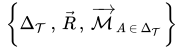
{
Δ
T
,
R
→
,
M
→
A
∈
Δ
T
}
{\displaystyle \;\left\lbrace \Delta _{\mathcal {T}}\,,\,{\vec {R}}\,,\,{\overrightarrow {\mathcal {M}}}_{A\,\in \,\Delta _{\mathcal {T}}}\right\rbrace \;}
[ 109] Remarque : C'est la raison pour laquelle cette décomposition est appelée « décomposition centrale », les trois éléments indispensables encore appelés « éléments centraux de
T
{\displaystyle \;{\mathcal {T}}\;}
».
Définition
Le
produit
(
{\displaystyle \;{\big (}}
ou
comoment
)
{\displaystyle {\big )}\;}
des deux
torseurs
T
1
{\displaystyle \;{\mathcal {T}}_{1}\;}
et
T
2
{\displaystyle \;{\mathcal {T}}_{2}\;}
dont les
éléments de réduction en un même point quelconque
A
∈
E
{\displaystyle \;A\;\in \;{\mathcal {E}}\;}
sont
Le produit
(
{\displaystyle \;\color {transparent}{\big (}}
ou comoment
)
{\displaystyle \color {transparent}{\big )}\;}
des deux torseurs
T
1
=
{
R
→
1
M
→
1
,
A
}
A
{\displaystyle \;{\mathcal {T}}_{1}=\left\lbrace \!{\begin{array}{c}{\vec {R}}_{1}\\{\overrightarrow {\mathcal {M}}}_{1,\,A}\end{array}}\!\right\rbrace _{\!A}}
et
T
2
=
{
R
→
2
M
→
2
,
A
}
A
{\displaystyle \;{\mathcal {T}}_{2}=\left\lbrace \!{\begin{array}{c}{\vec {R}}_{2}\\{\overrightarrow {\mathcal {M}}}_{2,\,A}\end{array}}\!\right\rbrace _{\!A}}
est la grandeur
T
1
⊗
T
2
∈
R
{\displaystyle \;{\mathcal {T}}_{1}\otimes {\mathcal {T}}_{2}\in \mathbb {R} \;}
telle que
«
T
1
⊗
T
2
=
{
R
→
1
M
→
1
,
A
}
A
⊗
{
R
→
2
M
→
2
,
A
}
A
=
R
→
1
⋅
M
→
2
,
A
+
R
→
2
⋅
M
→
1
,
A
{\displaystyle \;{\mathcal {T}}_{1}\otimes {\mathcal {T}}_{2}=\left\lbrace \!{\begin{array}{c}{\vec {R}}_{1}\\{\overrightarrow {\mathcal {M}}}_{1,\,A}\end{array}}\!\right\rbrace _{\!A}\otimes \left\lbrace \!{\begin{array}{c}{\vec {R}}_{2}\\{\overrightarrow {\mathcal {M}}}_{2,\,A}\end{array}}\!\right\rbrace _{\!A}={\vec {R}}_{1}\cdot {\overrightarrow {\mathcal {M}}}_{2,\,A}+{\vec {R}}_{2}\cdot {\overrightarrow {\mathcal {M}}}_{1,\,A}\;}
».
Le produit
(
{\displaystyle \;{\big (}}
ou comoment
)
{\displaystyle {\big )}\;}
de deux torseurs
T
1
{\displaystyle \;{\mathcal {T}}_{1}\;}
et
T
2
{\displaystyle \;{\mathcal {T}}_{2}\;}
est commutatif c'est-à-dire
T
1
⊗
T
2
=
T
2
⊗
T
1
{\displaystyle \;{\mathcal {T}}_{1}\otimes {\mathcal {T}}_{2}={\mathcal {T}}_{2}\otimes {\mathcal {T}}_{1}\;}
[ 110] ;
le produit
(
{\displaystyle \;{\big (}}
ou comoment
)
{\displaystyle {\big )}\;}
de deux torseurs
T
1
{\displaystyle \;{\mathcal {T}}_{1}\;}
et
T
2
{\displaystyle \;{\mathcal {T}}_{2}\;}
est indépendant du point
A
{\displaystyle \;A\;}
en lequel sont définis les éléments de réduction des torseurs en effet, le produit
(
{\displaystyle \;\color {transparent}{\big (}}
ou comoment
)
{\displaystyle \color {transparent}{\big )}\;}
de deux torseurs
T
1
{\displaystyle \;\color {transparent}{{\mathcal {T}}_{1}}\;}
et
T
2
{\displaystyle \;\color {transparent}{{\mathcal {T}}_{2}}\;}
est indépendant du point
A
{\displaystyle \;\color {transparent}{A}\;}
avec un point
B
∈
E
{\displaystyle \;B\;\in \;{\mathcal {E}}\;}
≠
A
{\displaystyle \;\neq A}
, seul le moment des torseurs est modifié selon la relation de Varignon [ 14] le produit
(
{\displaystyle \;\color {transparent}{\big (}}
ou comoment
)
{\displaystyle \color {transparent}{\big )}\;}
de deux torseurs
T
1
{\displaystyle \;\color {transparent}{{\mathcal {T}}_{1}}\;}
et
T
2
{\displaystyle \;\color {transparent}{{\mathcal {T}}_{2}}\;}
est indépendant du point
A
{\displaystyle \;\color {transparent}{A}\;}
avec un point
B
∈
E
{\displaystyle \;\color {transparent}{B\;\in \;{\mathcal {E}}}\;}
≠
A
{\displaystyle \;\color {transparent}{\neq A}}
, seul le moment des torseurs est modifié selon
[
M
→
1
,
B
=
M
→
1
,
A
+
R
→
1
∧
A
B
→
M
→
2
,
B
=
M
→
2
,
A
+
R
→
2
∧
A
B
→
]
{\displaystyle \left[\!{\begin{array}{c}{\overrightarrow {\mathcal {M}}}_{1,\,B}={\overrightarrow {\mathcal {M}}}_{1,\,A}+{\vec {R}}_{1}\wedge {\overrightarrow {AB}}\\{\overrightarrow {\mathcal {M}}}_{2,\,B}={\overrightarrow {\mathcal {M}}}_{2,\,A}+{\vec {R}}_{2}\wedge {\overrightarrow {AB}}\end{array}}\!\right]\;}
⇒
{\displaystyle \Rightarrow }
le produit
(
{\displaystyle \;\color {transparent}{\big (}}
ou comoment
)
{\displaystyle \color {transparent}{\big )}\;}
de deux torseurs
T
1
{\displaystyle \;\color {transparent}{{\mathcal {T}}_{1}}\;}
et
T
2
{\displaystyle \;\color {transparent}{{\mathcal {T}}_{2}}\;}
est indépendant du point
A
{\displaystyle \;\color {transparent}{A}\;}
{
R
→
1
M
→
1
,
B
}
B
⊗
{
R
→
2
M
→
2
,
B
}
B
=
R
→
1
⋅
M
→
2
,
B
+
R
→
2
⋅
M
→
1
,
B
{\displaystyle \left\lbrace \!{\begin{array}{c}{\vec {R}}_{1}\\{\overrightarrow {\mathcal {M}}}_{1,\,B}\end{array}}\!\right\rbrace _{\!B}\otimes \left\lbrace \!{\begin{array}{c}{\vec {R}}_{2}\\{\overrightarrow {\mathcal {M}}}_{2,\,B}\end{array}}\!\right\rbrace _{\!B}={\vec {R}}_{1}\cdot {\overrightarrow {\mathcal {M}}}_{2,\,B}+{\vec {R}}_{2}\cdot {\overrightarrow {\mathcal {M}}}_{1,\,B}}
le produit
(
{\displaystyle \;\color {transparent}{\big (}}
ou comoment
)
{\displaystyle \color {transparent}{\big )}\;}
de deux torseurs
T
1
{\displaystyle \;\color {transparent}{{\mathcal {T}}_{1}}\;}
et
T
2
{\displaystyle \;\color {transparent}{{\mathcal {T}}_{2}}\;}
est indépendant du point
A
{\displaystyle \;\color {transparent}{A}\;}
=
R
→
1
⋅
[
M
→
2
,
A
+
R
→
2
∧
A
B
→
]
+
R
→
2
⋅
[
M
→
1
,
A
+
R
→
1
∧
A
B
→
]
{\displaystyle ={\vec {R}}_{1}\cdot \left[{\overrightarrow {\mathcal {M}}}_{2,\,A}+{\vec {R}}_{2}\wedge {\overrightarrow {AB}}\right]+{\vec {R}}_{2}\cdot \left[{\overrightarrow {\mathcal {M}}}_{1,\,A}+{\vec {R}}_{1}\wedge {\overrightarrow {AB}}\right]}
le produit
(
{\displaystyle \;\color {transparent}{\big (}}
ou comoment
)
{\displaystyle \color {transparent}{\big )}\;}
de deux torseurs
T
1
{\displaystyle \;\color {transparent}{{\mathcal {T}}_{1}}\;}
et
T
2
{\displaystyle \;\color {transparent}{{\mathcal {T}}_{2}}\;}
est indépendant du point
A
{\displaystyle \;\color {transparent}{A}\;}
=
R
→
1
⋅
M
→
2
,
A
+
R
→
2
⋅
M
→
1
,
A
+
R
→
1
⋅
[
R
→
2
∧
A
B
→
]
+
R
→
2
⋅
[
R
→
1
∧
A
B
→
]
{\displaystyle ={\vec {R}}_{1}\cdot {\overrightarrow {\mathcal {M}}}_{2,\,A}+{\vec {R}}_{2}\cdot {\overrightarrow {\mathcal {M}}}_{1,\,A}\;{\cancel {+\;{\vec {R}}_{1}\cdot \left[{\vec {R}}_{2}\wedge {\overrightarrow {AB}}\right]+{\vec {R}}_{2}\cdot \left[{\vec {R}}_{1}\wedge {\overrightarrow {AB}}\right]}}\;}
[ 111] , [ 112] le produit
(
{\displaystyle \;\color {transparent}{\big (}}
ou comoment
)
{\displaystyle \color {transparent}{\big )}\;}
de deux torseurs
T
1
{\displaystyle \;\color {transparent}{{\mathcal {T}}_{1}}\;}
et
T
2
{\displaystyle \;\color {transparent}{{\mathcal {T}}_{2}}\;}
est indépendant du point
A
{\displaystyle \;\color {transparent}{A}\;}
=
R
→
1
⋅
M
→
2
,
A
+
R
→
2
⋅
M
→
1
,
A
=
{
R
→
1
M
→
1
,
A
}
A
⊗
{
R
→
2
M
→
2
,
A
}
A
{\displaystyle ={\vec {R}}_{1}\cdot {\overrightarrow {\mathcal {M}}}_{2,\,A}+{\vec {R}}_{2}\cdot {\overrightarrow {\mathcal {M}}}_{1,\,A}=\left\lbrace {\begin{array}{c}\!{\vec {R}}_{1}\\{\overrightarrow {\mathcal {M}}}_{1,\,A}\end{array}}\!\right\rbrace _{\!A}\otimes \left\lbrace \!{\begin{array}{c}{\vec {R}}_{2}\\{\overrightarrow {\mathcal {M}}}_{2,\,A}\end{array}}\!\right\rbrace _{\!A}\;}
soit finalement le produit
(
{\displaystyle \;\color {transparent}{\big (}}
ou comoment
)
{\displaystyle \color {transparent}{\big )}\;}
de deux torseurs
T
1
{\displaystyle \;\color {transparent}{{\mathcal {T}}_{1}}\;}
et
T
2
{\displaystyle \;\color {transparent}{{\mathcal {T}}_{2}}\;}
est indépendant du point
A
{\displaystyle \;\color {transparent}{A}\;}
{
R
→
1
M
→
1
,
B
}
B
⊗
{
R
→
2
M
→
2
,
B
}
B
=
{
R
→
1
M
→
1
,
A
}
A
⊗
{
R
→
2
M
→
2
,
A
}
A
{\displaystyle \left\lbrace \!{\begin{array}{c}{\vec {R}}_{1}\\{\overrightarrow {\mathcal {M}}}_{1,\,B}\end{array}}\!\right\rbrace _{\!B}\otimes \left\lbrace \!{\begin{array}{c}{\vec {R}}_{2}\\{\overrightarrow {\mathcal {M}}}_{2,\,B}\end{array}}\!\right\rbrace _{\!B}=\left\lbrace \!{\begin{array}{c}{\vec {R}}_{1}\\{\overrightarrow {\mathcal {M}}}_{1,\,A}\end{array}}\!\right\rbrace _{\!A}\otimes \left\lbrace \!{\begin{array}{c}{\vec {R}}_{2}\\{\overrightarrow {\mathcal {M}}}_{2,\,A}\end{array}}\!\right\rbrace _{\!A}\;}
C.Q.F.D.[ 59] .
Le produit
(
{\displaystyle \;{\big (}}
ou comoment
)
{\displaystyle {\big )}\;}
de deux torseurs couples
C
1
{\displaystyle \;{\mathcal {C}}_{1}\;}
et
C
2
{\displaystyle \;{\mathcal {C}}_{2}\;}
est identiquement nul en effet
C
1
⊗
C
2
=
{
0
→
M
→
1
}
⊗
{
0
→
M
→
2
}
{\displaystyle \;{\mathcal {C}}_{1}\otimes {\mathcal {C}}_{2}=\left\lbrace \!{\begin{array}{c}{\vec {0}}\\{\overrightarrow {\mathcal {M}}}_{1}\end{array}}\!\right\rbrace \otimes \left\lbrace \!{\begin{array}{c}{\vec {0}}\\{\overrightarrow {\mathcal {M}}}_{2}\end{array}}\!\right\rbrace \;}
[ 113]
=
0
→
(
1
)
⋅
M
→
2
+
0
→
(
2
)
⋅
M
→
1
=
0
{\displaystyle \;={\vec {0}}_{\,(1)}\cdot {\overrightarrow {\mathcal {M}}}_{2}+{\vec {0}}_{\,(2)}\cdot {\overrightarrow {\mathcal {M}}}_{1}=0\;}
[ 114] C.Q.F.D.[ 59] ;
le produit
(
{\displaystyle \;{\big (}}
ou comoment
)
{\displaystyle {\big )}\;}
d'un torseur couple et d'un glisseur
C
1
{\displaystyle \;{\mathcal {C}}_{1}\;}
et
G
2
{\displaystyle \;{\mathcal {G}}_{2}\;}
n'est quasi jamais nul car
C
1
⊗
G
2
=
{
0
→
M
→
1
≠
0
→
}
⊗
{
R
→
2
≠
0
→
M
→
2
,
A
=
0
→
}
A
{\displaystyle \;{\mathcal {C}}_{1}\otimes {\mathcal {G}}_{2}=\left\lbrace \!{\begin{array}{c}{\vec {0}}\\{\overrightarrow {\mathcal {M}}}_{1}\neq {\overrightarrow {0}}\end{array}}\!\right\rbrace \otimes \left\lbrace \!{\begin{array}{c}{\vec {R}}_{2}\neq {\vec {0}}\\{\overrightarrow {\mathcal {M}}}_{2,\,A}={\overrightarrow {0}}\end{array}}\!\right\rbrace _{\!A}\;}
[ 115]
=
0
→
(
1
)
⋅
0
→
(
2
)
,
A
+
R
→
2
⋅
M
→
1
{\displaystyle \;={\cancel {{\vec {0}}_{\,(1)}\cdot {\overrightarrow {0}}_{\,(2),\,A}\;+}}\;{\vec {R}}_{2}\cdot {\overrightarrow {\mathcal {M}}}_{1}\;}
[ 116] , [ 117] en général
≠
0
{\displaystyle \;\neq 0\;}
[ 118] ;
le produit
(
{\displaystyle \;{\big (}}
ou comoment
)
{\displaystyle {\big )}\;}
de deux torseurs glisseurs
G
1
{\displaystyle \;{\mathcal {G}}_{1}\;}
et
G
2
{\displaystyle \;{\mathcal {G}}_{2}\;}
est nul
≻
{\displaystyle \;\succ \;}
si leurs axes centraux
Δ
G
1
{\displaystyle \;\Delta _{{\mathcal {G}}_{1}}\;}
et
Δ
G
2
{\displaystyle \;\Delta _{{\mathcal {G}}_{2}}\;}
sont concourants en effet, en notant
A
0
{\displaystyle \;A_{0}}
le point d'intersection des axes centraux , le produit
(
{\displaystyle \;\color {transparent}{\big (}}
ou comoment
)
{\displaystyle \color {transparent}{\big )}\;}
de deux torseurs glisseurs
G
1
{\displaystyle \;\color {transparent}{{\mathcal {G}}_{1}}\;}
et
G
2
{\displaystyle \;\color {transparent}{{\mathcal {G}}_{2}}\;}
est nul
≻
{\displaystyle \;\color {transparent}{\succ }\;}
si leurs axes centraux
Δ
G
1
{\displaystyle \;\color {transparent}{\Delta _{{\mathcal {G}}_{1}}}\;}
et
Δ
G
2
{\displaystyle \;\color {transparent}{\Delta _{{\mathcal {G}}_{2}}}\;}
sont concourants
G
1
⊗
G
2
=
{
R
1
→
≠
0
M
→
1
,
A
0
=
0
→
}
A
0
⊗
{
R
→
2
≠
0
→
M
→
2
,
A
0
=
0
→
}
A
0
{\displaystyle {\mathcal {G}}_{1}\otimes {\mathcal {G}}_{2}=\left\lbrace \!{\begin{array}{c}{\vec {R_{1}}}\neq 0\\{\overrightarrow {\mathcal {M}}}_{1,\,A_{0}}={\overrightarrow {0}}\end{array}}\!\right\rbrace _{\!A_{0}}\otimes \left\lbrace \!{\begin{array}{c}{\vec {R}}_{2}\neq {\vec {0}}\\{\overrightarrow {\mathcal {M}}}_{2,\,A_{0}}={\overrightarrow {0}}\end{array}}\!\right\rbrace _{\!A_{0}}\;}
[ 84] le produit
(
{\displaystyle \;\color {transparent}{\big (}}
ou comoment
)
{\displaystyle \color {transparent}{\big )}\;}
de deux torseurs glisseurs
G
1
{\displaystyle \;\color {transparent}{{\mathcal {G}}_{1}}\;}
et
G
2
{\displaystyle \;\color {transparent}{{\mathcal {G}}_{2}}\;}
est nul
≻
{\displaystyle \;\color {transparent}{\succ }\;}
si leurs axes centraux
Δ
G
1
{\displaystyle \;\color {transparent}{\Delta _{{\mathcal {G}}_{1}}}\;}
et
Δ
G
2
{\displaystyle \;\color {transparent}{\Delta _{{\mathcal {G}}_{2}}}\;}
sont concourants
G
1
⊗
G
2
{\displaystyle \color {transparent}{{\mathcal {G}}_{1}\otimes {\mathcal {G}}_{2}}}
=
R
→
1
⋅
0
→
(
2
)
,
A
0
+
R
→
2
⋅
0
→
(
1
)
,
A
0
{\displaystyle \,={\cancel {{\vec {R}}_{1}\cdot {\overrightarrow {0}}_{(2),\,A_{0}}}}\;+\;{\cancel {{\vec {R}}_{2}\cdot {\overrightarrow {0}}_{(1),\,A_{0}}}}\;}
[ 116]
=
0
{\displaystyle =0\;}
[ 119] ou le produit
(
{\displaystyle \;\color {transparent}{\big (}}
ou comoment
)
{\displaystyle \color {transparent}{\big )}\;}
de deux torseurs glisseurs
G
1
{\displaystyle \;\color {transparent}{{\mathcal {G}}_{1}}\;}
et
G
2
{\displaystyle \;\color {transparent}{{\mathcal {G}}_{2}}\;}
est nul
≻
{\displaystyle \;\succ \;}
si leurs axes centraux
Δ
G
1
{\displaystyle \;\Delta _{{\mathcal {G}}_{1}}\;}
et
Δ
G
2
{\displaystyle \;\Delta _{{\mathcal {G}}_{2}}\;}
sont confondus , en effet le cas des axes centraux confondus peut être considéré comme le produit
(
{\displaystyle \;\color {transparent}{\big (}}
ou comoment
)
{\displaystyle \color {transparent}{\big )}\;}
de deux torseurs glisseurs
G
1
{\displaystyle \;\color {transparent}{{\mathcal {G}}_{1}}\;}
et
G
2
{\displaystyle \;\color {transparent}{{\mathcal {G}}_{2}}\;}
est nul
≻
{\displaystyle \;\color {transparent}{\succ }\;}
si leurs axes centraux
Δ
G
1
{\displaystyle \;\color {transparent}{\Delta _{{\mathcal {G}}_{1}}}\;}
et
Δ
G
2
{\displaystyle \;\color {transparent}{\Delta _{{\mathcal {G}}_{2}}}\;}
sont confondus, en effet le cas particulier d'axes centraux concourants en tous leurs points ou le produit
(
{\displaystyle \;\color {transparent}{\big (}}
ou comoment
)
{\displaystyle \color {transparent}{\big )}\;}
de deux torseurs glisseurs
G
1
{\displaystyle \;\color {transparent}{{\mathcal {G}}_{1}}\;}
et
G
2
{\displaystyle \;\color {transparent}{{\mathcal {G}}_{2}}\;}
est nul
≻
{\displaystyle \;\succ \;}
si leurs axes centraux
Δ
G
1
{\displaystyle \;\Delta _{{\mathcal {G}}_{1}}\;}
et
Δ
G
2
{\displaystyle \;\Delta _{{\mathcal {G}}_{2}}\;}
sont parallèles en effet, avec
A
1
∈
Δ
G
1
{\displaystyle \;A_{1}\in \Delta _{{\mathcal {G}}_{1}}}
(
{\displaystyle \;{\big (}}
donc hors
Δ
G
2
)
{\displaystyle \;\Delta _{{\mathcal {G}}_{2}}{\big )}}
,
G
1
=
{
R
1
→
≠
0
M
→
1
,
A
1
=
0
→
}
A
1
{\displaystyle \;{\mathcal {G}}_{1}=\left\lbrace \!{\begin{array}{c}{\vec {R_{1}}}\neq 0\\{\overrightarrow {\mathcal {M}}}_{1,\,A_{1}}={\overrightarrow {0}}\end{array}}\!\right\rbrace _{\!A_{1}}\;}
et le produit
(
{\displaystyle \;\color {transparent}{\big (}}
ou comoment
)
{\displaystyle \color {transparent}{\big )}\;}
de deux torseurs glisseurs
G
1
{\displaystyle \;\color {transparent}{{\mathcal {G}}_{1}}\;}
et
G
2
{\displaystyle \;\color {transparent}{{\mathcal {G}}_{2}}\;}
est nul
≻
{\displaystyle \;\color {transparent}{\succ }\;}
si leursaxes centraux
Δ
G
1
{\displaystyle \;\color {transparent}{\Delta _{{\mathcal {G}}_{1}}}\;}
et
Δ
G
2
{\displaystyle \;\color {transparent}{\Delta _{{\mathcal {G}}_{2}}}\;}
sont parallèles en effet, avec
A
1
∉
Δ
G
2
{\displaystyle \;A_{1}\notin \Delta _{{\mathcal {G}}_{2}}}
,
G
2
=
{
R
2
→
≠
0
M
→
2
,
A
1
≠
0
→
}
A
1
{\displaystyle \;{\mathcal {G}}_{2}=\left\lbrace \!{\begin{array}{c}{\vec {R_{2}}}\neq 0\\{\overrightarrow {\mathcal {M}}}_{2,\,A_{1}}\neq {\overrightarrow {0}}\end{array}}\!\right\rbrace _{\!A_{1}}\;}
où
M
→
2
,
A
1
{\displaystyle \;{\overrightarrow {\mathcal {M}}}_{2,\,A_{1}}\;}
s'obtient le produit
(
{\displaystyle \;\color {transparent}{\big (}}
ou comoment
)
{\displaystyle \color {transparent}{\big )}\;}
de deux torseurs glisseurs
G
1
{\displaystyle \;\color {transparent}{{\mathcal {G}}_{1}}\;}
et
G
2
{\displaystyle \;\color {transparent}{{\mathcal {G}}_{2}}\;}
est nul
≻
{\displaystyle \;\color {transparent}{\succ }\;}
si leurs axes centraux
Δ
G
1
{\displaystyle \;\color {transparent}{\Delta _{{\mathcal {G}}_{1}}}\;}
et
Δ
G
2
{\displaystyle \;\color {transparent}{\Delta _{{\mathcal {G}}_{2}}}\;}
sont parallèles en effet, avec par relation de Varignon [ 14] appliquée en
A
1
{\displaystyle \;A_{1}\;}
avec
A
2
∈
Δ
G
2
{\displaystyle \;A_{2}\in \Delta _{{\mathcal {G}}_{2}}}
, le produit
(
{\displaystyle \;\color {transparent}{\big (}}
ou comoment
)
{\displaystyle \color {transparent}{\big )}\;}
de deux torseurs glisseurs
G
1
{\displaystyle \;\color {transparent}{{\mathcal {G}}_{1}}\;}
et
G
2
{\displaystyle \;\color {transparent}{{\mathcal {G}}_{2}}\;}
est nul
≻
{\displaystyle \;\color {transparent}{\succ }\;}
si leurs axes centraux
Δ
G
1
{\displaystyle \;\color {transparent}{\Delta _{{\mathcal {G}}_{1}}}\;}
et
Δ
G
2
{\displaystyle \;\color {transparent}{\Delta _{{\mathcal {G}}_{2}}}\;}
sont parallèles en effet, avec
M
→
2
,
A
1
=
M
→
2
,
A
2
+
R
→
2
∧
A
2
A
1
→
{\displaystyle {\overrightarrow {\mathcal {M}}}_{2,\,A_{1}}={\cancel {{\overrightarrow {\mathcal {M}}}_{2,\,A_{2}}\;+}}\;{\vec {R}}_{2}\wedge {\overrightarrow {A_{2}A_{1}}}\;}
car
M
→
2
,
A
2
∈
Δ
G
2
=
0
→
{\displaystyle \;{\overrightarrow {\mathcal {M}}}_{2,\,A_{2}\,\in \,\Delta _{{\mathcal {G}}_{2}}}={\overrightarrow {0}}}
, le produit
(
{\displaystyle \;\color {transparent}{\big (}}
ou comoment
)
{\displaystyle \color {transparent}{\big )}\;}
de deux torseurs glisseurs
G
1
{\displaystyle \;\color {transparent}{{\mathcal {G}}_{1}}\;}
et
G
2
{\displaystyle \;\color {transparent}{{\mathcal {G}}_{2}}\;}
est nul
≻
{\displaystyle \;\color {transparent}{\succ }\;}
si leurs axes centraux
Δ
G
1
{\displaystyle \;\color {transparent}{\Delta _{{\mathcal {G}}_{1}}}\;}
et
Δ
G
2
{\displaystyle \;\color {transparent}{\Delta _{{\mathcal {G}}_{2}}}\;}
sont parallèles en effet, avec soit
G
2
=
{
R
2
→
≠
0
R
→
2
∧
A
2
A
1
→
≠
0
→
}
A
1
{\displaystyle \;{\mathcal {G}}_{2}=\left\lbrace \!{\begin{array}{c}{\vec {R_{2}}}\neq 0\\{\vec {R}}_{2}\wedge {\overrightarrow {A_{2}A_{1}}}\neq {\overrightarrow {0}}\end{array}}\!\right\rbrace _{\!A_{1}}\;}
dont on déduit le produit
(
{\displaystyle \;\color {transparent}{\big (}}
ou comoment
)
{\displaystyle \color {transparent}{\big )}\;}
de deux torseurs glisseurs
G
1
{\displaystyle \;\color {transparent}{{\mathcal {G}}_{1}}\;}
et
G
2
{\displaystyle \;\color {transparent}{{\mathcal {G}}_{2}}\;}
est nul
≻
{\displaystyle \;\color {transparent}{\succ }\;}
si leurs axes centraux
Δ
G
1
{\displaystyle \;\color {transparent}{\Delta _{{\mathcal {G}}_{1}}}\;}
et
Δ
G
2
{\displaystyle \;\color {transparent}{\Delta _{{\mathcal {G}}_{2}}}\;}
sont parallèles en effet, avec
G
1
⊗
G
2
=
{
R
1
→
≠
0
M
→
1
,
A
1
=
0
→
}
A
1
⊗
{
R
→
2
≠
0
→
R
→
2
∧
A
2
A
1
→
≠
0
→
}
A
1
{\displaystyle {\mathcal {G}}_{1}\otimes {\mathcal {G}}_{2}=\left\lbrace \!{\begin{array}{c}{\vec {R_{1}}}\neq 0\\{\overrightarrow {\mathcal {M}}}_{1,\,A_{1}}={\overrightarrow {0}}\end{array}}\!\right\rbrace _{\!A_{1}}\otimes \left\lbrace \!{\begin{array}{c}{\vec {R}}_{2}\neq {\vec {0}}\\{\vec {R}}_{2}\wedge {\overrightarrow {A_{2}A_{1}}}\neq {\overrightarrow {0}}\end{array}}\!\right\rbrace _{\!A_{1}}}
le produit
(
{\displaystyle \;\color {transparent}{\big (}}
ou comoment
)
{\displaystyle \color {transparent}{\big )}\;}
de deux torseurs glisseurs
G
1
{\displaystyle \;\color {transparent}{{\mathcal {G}}_{1}}\;}
et
G
2
{\displaystyle \;\color {transparent}{{\mathcal {G}}_{2}}\;}
est nul
≻
{\displaystyle \;\color {transparent}{\succ }\;}
si leurs axes centraux
Δ
G
1
{\displaystyle \;\color {transparent}{\Delta _{{\mathcal {G}}_{1}}}\;}
et
Δ
G
2
{\displaystyle \;\color {transparent}{\Delta _{{\mathcal {G}}_{2}}}\;}
sont parallèles en effet, avec
G
1
⊗
G
2
{\displaystyle \color {transparent}{{\mathcal {G}}_{1}\otimes {\mathcal {G}}_{2}}}
=
R
→
1
⋅
[
R
→
2
∧
A
2
A
1
→
]
+
R
→
2
⋅
0
→
(
1
)
,
A
1
{\displaystyle ={\vec {R}}_{1}\cdot \left[{\vec {R}}_{2}\wedge {\overrightarrow {A_{2}A_{1}}}\right]\;{\cancel {+\;{\vec {R}}_{2}\cdot {\overrightarrow {0}}_{(1),\,A_{1}}}}\;}
[ 116]
=
0
{\displaystyle =0}
, le produit
(
{\displaystyle \;\color {transparent}{\big (}}
ou comoment
)
{\displaystyle \color {transparent}{\big )}\;}
de deux torseurs glisseurs
G
1
{\displaystyle \;\color {transparent}{{\mathcal {G}}_{1}}\;}
et
G
2
{\displaystyle \;\color {transparent}{{\mathcal {G}}_{2}}\;}
est nul
≻
{\displaystyle \;\color {transparent}{\succ }\;}
si leurs axes centraux
Δ
G
1
{\displaystyle \;\color {transparent}{\Delta _{{\mathcal {G}}_{1}}}\;}
et
Δ
G
2
{\displaystyle \;\color {transparent}{\Delta _{{\mathcal {G}}_{2}}}\;}
sont parallèles en effet, avec les trois vecteurs
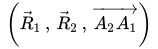
(
R
→
1
,
R
→
2
,
A
2
A
1
→
)
{\displaystyle \;\left({\vec {R}}_{1}\,,\,{\vec {R}}_{2}\,,\,{\overrightarrow {A_{2}A_{1}}}\right)\;}
étant coplanaires[ 120] le produit
(
{\displaystyle \;\color {transparent}{\big (}}
ou comoment
)
{\displaystyle \color {transparent}{\big )}\;}
de deux torseurs glisseurs
G
1
{\displaystyle \;\color {transparent}{{\mathcal {G}}_{1}}\;}
et
G
2
{\displaystyle \;\color {transparent}{{\mathcal {G}}_{2}}\;}
est nul
≻
{\displaystyle \;\color {transparent}{\succ }\;}
si leurs axes centraux
Δ
G
1
{\displaystyle \;\color {transparent}{\Delta _{{\mathcal {G}}_{1}}}\;}
et
Δ
G
2
{\displaystyle \;\color {transparent}{\Delta _{{\mathcal {G}}_{2}}}\;}
sont parallèles en effet, avec les trois vecteurs leur produit mixte est nul[ 50] ;
le produit
(
{\displaystyle \;{\big (}}
ou comoment
)
{\displaystyle {\big )}\;}
de deux torseurs glisseurs
G
1
{\displaystyle \;{\mathcal {G}}_{1}\;}
et
G
2
{\displaystyle \;{\mathcal {G}}_{2}\;}
est non nul si leurs axes centraux
Δ
G
1
{\displaystyle \;\Delta _{{\mathcal {G}}_{1}}\;}
et
Δ
G
2
{\displaystyle \;\Delta _{{\mathcal {G}}_{2}}\;}
ne sont pas concourants, parallèles ou confondus , en effet le produit
(
{\displaystyle \;\color {transparent}{\big (}}
ou comoment
)
{\displaystyle \color {transparent}{\big )}\;}
de deux torseurs glisseurs
G
1
{\displaystyle \;\color {transparent}{{\mathcal {G}}_{1}}\;}
et
G
2
{\displaystyle \;\color {transparent}{{\mathcal {G}}_{2}}\;}
est non nul comme il n'existe aucun point commun des axes centraux
Δ
G
1
{\displaystyle \;\Delta _{{\mathcal {G}}_{1}}\;}
et
Δ
G
2
{\displaystyle \;\Delta _{{\mathcal {G}}_{2}}}
, on choisit un point
A
1
∈
Δ
G
1
{\displaystyle \;A_{1}\;\in \;\Delta _{{\mathcal {G}}_{1}}\;}
le produit
(
{\displaystyle \;\color {transparent}{\big (}}
ou comoment
)
{\displaystyle \color {transparent}{\big )}\;}
de deux torseurs glisseurs
G
1
{\displaystyle \;\color {transparent}{{\mathcal {G}}_{1}}\;}
et
G
2
{\displaystyle \;\color {transparent}{{\mathcal {G}}_{2}}\;}
est non nul pour évaluer les éléments de réduction des torseurs
⇒
{\displaystyle \Rightarrow }
M
→
1
,
A
1
=
0
→
{\displaystyle \;{\overrightarrow {\mathcal {M}}}_{1,\,A_{1}}={\overrightarrow {0}}\!}
,
[
M
→
2
,
A
1
=
M
→
2
,
A
2
+
R
→
2
∧
A
2
A
1
→
≠
0
→
A
2
∈
Δ
G
2
⇒
M
→
2
,
A
2
=
0
→
]
{\displaystyle \left[\!{\begin{array}{c}{\overrightarrow {\mathcal {M}}}_{2,\,A_{1}}={\cancel {{\overrightarrow {\mathcal {M}}}_{2,\,A_{2}}\;+}}\;{\vec {R}}_{2}\wedge {\overrightarrow {A_{2}A_{1}}}\neq {\overrightarrow {0}}\\A_{2}\;\in \;\Delta _{{\mathcal {G}}_{2}}\Rightarrow {\overrightarrow {\mathcal {M}}}_{2,\,A_{2}}={\overrightarrow {0}}\end{array}}\!\right]\,}
[ 121] d'où le produit
(
{\displaystyle \;\color {transparent}{\big (}}
ou comoment
)
{\displaystyle \color {transparent}{\big )}\;}
de deux torseurs glisseurs
G
1
{\displaystyle \;\color {transparent}{{\mathcal {G}}_{1}}\;}
et
G
2
{\displaystyle \;\color {transparent}{{\mathcal {G}}_{2}}\;}
est non nul
G
1
⊗
G
2
=
{
R
1
→
≠
0
M
→
1
,
A
1
=
0
→
}
A
1
⊗
{
R
→
2
≠
0
→
M
→
2
,
A
1
≠
0
→
}
A
1
=
R
→
1
⋅
[
R
→
2
∧
A
2
A
1
→
]
+
R
→
2
⋅
0
→
(
1
)
,
A
1
{\displaystyle \;{\mathcal {G}}_{1}\otimes {\mathcal {G}}_{2}=\left\lbrace \!{\begin{array}{c}{\vec {R_{1}}}\neq 0\\{\overrightarrow {\mathcal {M}}}_{1,\,A_{1}}={\overrightarrow {0}}\end{array}}\!\right\rbrace _{\!A_{1}}\otimes \left\lbrace \!{\begin{array}{c}{\vec {R}}_{2}\neq {\vec {0}}\\{\overrightarrow {\mathcal {M}}}_{2,\,A_{1}}\neq {\overrightarrow {0}}\end{array}}\!\right\rbrace _{\!A_{1}}={\vec {R}}_{1}\cdot \left[{\vec {R}}_{2}\wedge {\overrightarrow {A_{2}A_{1}}}\right]\;{\cancel {+\;{\vec {R}}_{2}\cdot {\overrightarrow {0}}_{(1),\,A_{1}}}}\;}
[ 116]
≠
0
{\displaystyle \neq 0}
, le produit
(
{\displaystyle \;\color {transparent}{\big (}}
ou comoment
)
{\displaystyle \color {transparent}{\big )}\;}
de deux torseurs glisseurs
G
1
{\displaystyle \;\color {transparent}{{\mathcal {G}}_{1}}\;}
et
G
2
{\displaystyle \;\color {transparent}{{\mathcal {G}}_{2}}\;}
est non nul les trois vecteurs
(
R
→
1
,
R
→
2
,
A
2
A
1
→
)
{\displaystyle \;\left({\vec {R}}_{1}\,,\,{\vec {R}}_{2}\,,\,{\overrightarrow {A_{2}A_{1}}}\right)\;}
n'étant pas coplanaires leur produit mixte[ 50] est non nul[ 50] .
Le torseur statique
(
{\displaystyle \;{\big (}}
ou torseur des actions mécaniques
)
{\displaystyle {\big )}\;}
sert à modéliser les actions mécaniques lors de la résolution d'un problème de statique tridimensionnel[ 122] .
Une action mécanique exercée sur un système de points matériels
{
A
k
}
(
k
∈
[
[
1
,
n
]
]
,
n
∈
N
∗
∖
{
1
}
)
{\displaystyle \;\left\lbrace A_{k}\right\rbrace _{\left(k\in \left[\left[1\,,\,n\right]\right],\,n\in \mathbb {N} ^{*}\backslash \left\lbrace 1\right\rbrace \right)}\;}
peut être représentée par une force
F
→
k
{\displaystyle \;{\vec {F}}_{k}\;}
s'exerçant sur le point
A
k
{\displaystyle \;A_{k}\;}
ou Une action mécanique exercée sur un système de points matériels
{
A
k
}
(
k
∈
[
[
1
,
n
]
]
,
n
∈
N
∗
∖
{
1
}
)
{\displaystyle \;\color {transparent}{\left\lbrace A_{k}\right\rbrace _{\left(k\in \left[\left[1\,,\,n\right]\right],\,n\in \mathbb {N} ^{*}\backslash \left\lbrace 1\right\rbrace \right)}}\;}
peut être représentée par une répartition de forces de somme nulle
C
→
(
l
∈
[
[
i
…
j
]
]
)
=
{
F
→
l
,
∑
l
[
[
i
…
j
]
]
F
→
l
=
0
→
}
{\displaystyle \;{\vec {C}}_{\left(l\,\in \left[\left[i\,\ldots \,j\right]\right]\right)}=\left\lbrace {\vec {F}}_{l},\;\sum \limits _{l}^{\left[\left[i\,\ldots \,j\right]\right]}{\vec {F}}_{l}={\vec {0}}\right\rbrace \;}
Une action mécanique exercée sur un système de points matériels
{
A
k
}
(
k
∈
[
[
1
,
n
]
]
,
n
∈
N
∗
∖
{
1
}
)
{\displaystyle \;\color {transparent}{\left\lbrace A_{k}\right\rbrace _{\left(k\in \left[\left[1\,,\,n\right]\right],\,n\in \mathbb {N} ^{*}\backslash \left\lbrace 1\right\rbrace \right)}}\;}
peut être représentée par une répartition définissant un couple au sens de la mécanique s'appliquant au moins Une action mécanique exercée sur un système de points matériels
{
A
k
}
(
k
∈
[
[
1
,
n
]
]
,
n
∈
N
∗
∖
{
1
}
)
{\displaystyle \;\color {transparent}{\left\lbrace A_{k}\right\rbrace _{\left(k\in \left[\left[1\,,\,n\right]\right],\,n\in \mathbb {N} ^{*}\backslash \left\lbrace 1\right\rbrace \right)}}\;}
peut être représentée par une répartition définissant un couple en deux points distincts «
A
l
,
l
∈
[
[
i
…
j
]
]
{\displaystyle \;A_{l},\,l\in \left[\left[i\,\ldots \,j\right]\right]\;}
» ;
Une action mécanique exercée sur un système de points matériels
{
A
k
}
(
k
∈
[
[
1
,
n
]
]
,
n
∈
N
∗
∖
{
1
}
)
{\displaystyle \;\color {transparent}{\left\lbrace A_{k}\right\rbrace _{\left(k\in \left[\left[1\,,\,n\right]\right],\,n\in \mathbb {N} ^{*}\backslash \left\lbrace 1\right\rbrace \right)}}\;}
≻
{\displaystyle \succ \;}
chaque force
F
→
k
{\displaystyle \;{\vec {F}}_{k}\;}
s'exerçant sur le point
A
k
{\displaystyle \;A_{k}\;}
est un torseur glisseur
G
k
{\displaystyle \;{\mathcal {G}}_{k}\;}
de support
Δ
G
k
{\displaystyle \;\Delta _{{\mathcal {G}}_{k}}\;}
défini par Une action mécanique exercée sur un système de points matériels
{
A
k
}
(
k
∈
[
[
1
,
n
]
]
,
n
∈
N
∗
∖
{
1
}
)
{\displaystyle \;\color {transparent}{\left\lbrace A_{k}\right\rbrace _{\left(k\in \left[\left[1\,,\,n\right]\right],\,n\in \mathbb {N} ^{*}\backslash \left\lbrace 1\right\rbrace \right)}}\;}
≻
{\displaystyle \color {transparent}{\succ }\;}
chaque force
F
→
k
{\displaystyle \;\color {transparent}{{\vec {F}}_{k}}\;}
s'exerçant sur le point
A
k
{\displaystyle \;\color {transparent}{A_{k}}\;}
est la droite issue de
A
k
{\displaystyle \;A_{k}\;}
de vecteur directeur
F
→
k
{\displaystyle \;{\vec {F}}_{k}}
, Une action mécanique exercée sur un système de points matériels
{
A
k
}
(
k
∈
[
[
1
,
n
]
]
,
n
∈
N
∗
∖
{
1
}
)
{\displaystyle \;\color {transparent}{\left\lbrace A_{k}\right\rbrace _{\left(k\in \left[\left[1\,,\,n\right]\right],\,n\in \mathbb {N} ^{*}\backslash \left\lbrace 1\right\rbrace \right)}}\;}
≻
{\displaystyle \color {transparent}{\succ }\;}
chaque force
F
→
k
{\displaystyle \;\color {transparent}{{\vec {F}}_{k}}\;}
s'exerçant sur le point
A
k
{\displaystyle \;\color {transparent}{A_{k}}\;}
est ses éléments de réduction en un point
O
{\displaystyle \;O\;}
quelconque Une action mécanique exercée sur un système de points matériels
{
A
k
}
(
k
∈
[
[
1
,
n
]
]
,
n
∈
N
∗
∖
{
1
}
)
{\displaystyle \;\color {transparent}{\left\lbrace A_{k}\right\rbrace _{\left(k\in \left[\left[1\,,\,n\right]\right],\,n\in \mathbb {N} ^{*}\backslash \left\lbrace 1\right\rbrace \right)}}\;}
≻
{\displaystyle \color {transparent}{\succ }\;}
chaque force
F
→
k
{\displaystyle \;\color {transparent}{{\vec {F}}_{k}}\;}
s'exerçant sur le point
A
k
{\displaystyle \;\color {transparent}{A_{k}}\;}
est étant
{
F
→
k
M
→
O
,
F
→
k
=
F
→
k
∧
A
k
O
→
}
O
{\displaystyle \;\left\lbrace {\begin{array}{c}{\vec {F}}_{k}\\{\overrightarrow {\mathcal {M}}}_{O,\,{\vec {F}}_{k}}={\vec {F}}_{k}\wedge {\overrightarrow {A_{k}O}}\end{array}}\right\rbrace _{O}\;}
[ 123] ,
Une action mécanique exercée sur un système de points matériels
{
A
k
}
(
k
∈
[
[
1
,
n
]
]
,
n
∈
N
∗
∖
{
1
}
)
{\displaystyle \;\color {transparent}{\left\lbrace A_{k}\right\rbrace _{\left(k\in \left[\left[1\,,\,n\right]\right],\,n\in \mathbb {N} ^{*}\backslash \left\lbrace 1\right\rbrace \right)}}\;}
≻
{\displaystyle \succ \;}
chaque répartition de forces de somme nulle
C
→
(
l
∈
[
[
i
…
j
]
]
)
=
{
F
→
l
,
∑
l
[
[
i
…
j
]
]
F
→
l
=
0
→
}
{\displaystyle \;{\vec {C}}_{\left(l\,\in \left[\left[i\,\ldots \,j\right]\right]\right)}=\left\lbrace {\vec {F}}_{l},\;\sum \limits _{l}^{\left[\left[i\,\ldots \,j\right]\right]}{\vec {F}}_{l}={\vec {0}}\right\rbrace \;}
Une action mécanique exercée sur un système de points matériels
{
A
k
}
(
k
∈
[
[
1
,
n
]
]
,
n
∈
N
∗
∖
{
1
}
)
{\displaystyle \;\color {transparent}{\left\lbrace A_{k}\right\rbrace _{\left(k\in \left[\left[1\,,\,n\right]\right],\,n\in \mathbb {N} ^{*}\backslash \left\lbrace 1\right\rbrace \right)}}\;}
≻
{\displaystyle \color {transparent}{\succ }\;}
chaque répartition de forces de somme nulle est un torseur couple
C
(
l
∈
[
[
i
…
j
]
]
)
{\displaystyle \;{\mathcal {C}}_{\left(l\,\in \left[\left[i\,\ldots \,j\right]\right]\right)}}
, Une action mécanique exercée sur un système de points matériels
{
A
k
}
(
k
∈
[
[
1
,
n
]
]
,
n
∈
N
∗
∖
{
1
}
)
{\displaystyle \;\color {transparent}{\left\lbrace A_{k}\right\rbrace _{\left(k\in \left[\left[1\,,\,n\right]\right],\,n\in \mathbb {N} ^{*}\backslash \left\lbrace 1\right\rbrace \right)}}\;}
≻
{\displaystyle \color {transparent}{\succ }\;}
chaque répartition de forces de somme nulle est ses éléments de réduction en un point
O
{\displaystyle \;O\;}
quelconque étant Une action mécanique exercée sur un système de points matériels
{
A
k
}
(
k
∈
[
[
1
,
n
]
]
,
n
∈
N
∗
∖
{
1
}
)
{\displaystyle \;\color {transparent}{\left\lbrace A_{k}\right\rbrace _{\left(k\in \left[\left[1\,,\,n\right]\right],\,n\in \mathbb {N} ^{*}\backslash \left\lbrace 1\right\rbrace \right)}}\;}
≻
{\displaystyle \color {transparent}{\succ }\;}
chaque répartition de forces de somme nulle est
{
0
→
M
→
O
,
C
→
(
l
∈
[
[
i
…
j
]
]
)
=
∑
l
[
[
i
…
j
]
]
F
→
l
∧
A
l
O
→
}
{\displaystyle \;\left\lbrace {\begin{array}{c}{\vec {0}}\\{\overrightarrow {\mathcal {M}}}_{O,\,{\vec {C}}_{\left(l\,\in \left[\left[i\,\ldots \,j\right]\right]\right)}}=\sum \limits _{l}^{\left[\left[i\,\ldots \,j\right]\right]}{\vec {F}}_{l}\wedge {\overrightarrow {A_{l}O}}\end{array}}\right\rbrace \;}
[ 124] , [ 125]
⇒
{\displaystyle \Rightarrow }
Une action mécanique exercée sur un système de points matériels
{
A
k
}
(
k
∈
[
[
1
,
n
]
]
,
n
∈
N
∗
∖
{
1
}
)
{\displaystyle \;\color {transparent}{\left\lbrace A_{k}\right\rbrace _{\left(k\in \left[\left[1\,,\,n\right]\right],\,n\in \mathbb {N} ^{*}\backslash \left\lbrace 1\right\rbrace \right)}}\;}
≻
{\displaystyle \succ \;}
les actions mécaniques s'exerçant sur le système de points matériels
{
A
k
}
(
k
∈
[
[
1
,
n
]
]
,
n
∈
N
∗
∖
{
1
}
)
{\displaystyle \;\left\lbrace A_{k}\right\rbrace _{\left(k\in \left[\left[1\,,\,n\right]\right],\,n\in \mathbb {N} ^{*}\backslash \left\lbrace 1\right\rbrace \right)}\;}
Une action mécanique exercée sur un système de points matériels
{
A
k
}
(
k
∈
[
[
1
,
n
]
]
,
n
∈
N
∗
∖
{
1
}
)
{\displaystyle \;\color {transparent}{\left\lbrace A_{k}\right\rbrace _{\left(k\in \left[\left[1\,,\,n\right]\right],\,n\in \mathbb {N} ^{*}\backslash \left\lbrace 1\right\rbrace \right)}}\;}
≻
{\displaystyle \color {transparent}{\succ }\;}
les actions mécaniques sont représentées par un torseur
T
stat.
{\displaystyle \;{\mathcal {T}}_{\text{stat.}}\;}
nommé « torseur statique [ 126] » dont Une action mécanique exercée sur un système de points matériels
{
A
k
}
(
k
∈
[
[
1
,
n
]
]
,
n
∈
N
∗
∖
{
1
}
)
{\displaystyle \;\color {transparent}{\left\lbrace A_{k}\right\rbrace _{\left(k\in \left[\left[1\,,\,n\right]\right],\,n\in \mathbb {N} ^{*}\backslash \left\lbrace 1\right\rbrace \right)}}\;}
≻
{\displaystyle \color {transparent}{\succ }\;}
les actions mécaniques les éléments de réduction en un point
O
{\displaystyle \;O\;}
quelconque sont Une action mécanique exercée sur un système de points matériels
{
A
k
}
(
k
∈
[
[
1
,
n
]
]
,
n
∈
N
∗
∖
{
1
}
)
{\displaystyle \;\color {transparent}{\left\lbrace A_{k}\right\rbrace _{\left(k\in \left[\left[1\,,\,n\right]\right],\,n\in \mathbb {N} ^{*}\backslash \left\lbrace 1\right\rbrace \right)}}\;}
≻
{\displaystyle \color {transparent}{\succ }\;}
les actions mécaniques
T
stat.
=
∑
k
G
k
+
∑
q
,
indexant
[
[
i
…
j
]
]
C
q
{\displaystyle \;{\mathcal {T}}_{\text{stat.}}=\sum _{k}{\mathcal {G}}_{k}+\sum \limits _{q,\,{\text{indexant}}}^{\left[\left[i\,\ldots \,j\right]\right]}{\mathcal {C}}_{q}\;}
[ 127] Une action mécanique exercée sur un système de points matériels
{
A
k
}
(
k
∈
[
[
1
,
n
]
]
,
n
∈
N
∗
∖
{
1
}
)
{\displaystyle \;\color {transparent}{\left\lbrace A_{k}\right\rbrace _{\left(k\in \left[\left[1\,,\,n\right]\right],\,n\in \mathbb {N} ^{*}\backslash \left\lbrace 1\right\rbrace \right)}}\;}
≻
{\displaystyle \color {transparent}{\succ }\;}
les actions mécaniques
T
stat.
{\displaystyle \;\color {transparent}{{\mathcal {T}}_{\text{stat.}}}}
=
{
∑
k
F
→
k
∑
k
M
→
O
,
F
→
k
+
∑
q
,
indexant
[
[
i
…
j
]
]
M
→
C
→
(
l
∈
[
[
i
…
j
]
]
q
)
}
O
{\displaystyle =\left\lbrace {\begin{array}{c}\sum _{k}{\vec {F}}_{k}\\\sum _{k}{\overrightarrow {\mathcal {M}}}_{O,\,{\vec {F}}_{k}}+\sum \limits _{q,\,{\text{indexant}}}^{\left[\left[i\,\ldots \,j\right]\right]}{\overrightarrow {\mathcal {M}}}_{{\vec {C}}_{\left(l\,\in \left[\left[i\,\ldots \,j\right]\right]_{q}\right)}}\end{array}}\right\rbrace _{O}\;}
[ 128] .
Le torseur cinématique sert à représenter pratiquement les comportements de translation et de rotation d'un solide
(
{\displaystyle \;{\big (}}
ou système indéformable de points matériels
)
{\displaystyle {\big )}\;}
mais Le torseur cinématique ne peut pas être utilisé pour un système déformable
(
{\displaystyle \;{\big (}}
ce qui limite son introduction dans le domaine de la physique
)
{\displaystyle {\big )}\;}
[ 129] .
On établit en effet que le champ de vitesse des points d'un solide
(
S
)
=
{
A
k
}
(
k
∈
[
[
1
,
n
]
]
,
n
∈
N
∗
∖
{
1
}
)
,
A
i
A
j
=
c
s
t
e
∀
(
i
,
j
)
{\displaystyle \;\left({\mathcal {S}}\right)=\left\lbrace A_{k}\right\rbrace _{\left(k\in \left[\left[1\,,\,n\right]\right],\,n\in \mathbb {N} ^{*}\backslash \left\lbrace 1\right\rbrace \right),\,A_{i}A_{j}\,=\,cste\;\forall (i,\,j)}\;}
dans un référentiel donné
V
→
A
k
(
t
)
{\displaystyle \;{\vec {V}}_{A_{k}}(t)\;}
On établit en effet que le champ de vitesse des points d'un solide
(
S
)
{\displaystyle \;\color {transparent}{\left({\mathcal {S}}\right)}}
est équiprojectif donc représentable par un torseur en effet On établit en effet que le champ de vitesse des points d'un solide
(
S
)
{\displaystyle \;\color {transparent}{\left({\mathcal {S}}\right)}}
∀
(
A
i
,
A
j
)
∈
(
S
)
,
A
i
A
j
=
c
s
t
e
{\displaystyle \forall \;\left(A_{i}\,,\,A_{j}\right)\in \left({\mathcal {S}}\right),\;A_{i}A_{j}=cste\;}
⇒
{\displaystyle \Rightarrow }
‖
A
i
A
j
→
(
t
)
‖
2
=
c
s
t
e
′
{\displaystyle \;\Vert {\overrightarrow {A_{i}A_{j}}}(t)\Vert ^{2}=cste'\;}
⇒
{\displaystyle \Rightarrow }
2
A
i
A
j
→
(
t
)
⋅
d
A
i
A
j
→
d
t
(
t
)
=
0
(
a
)
{\displaystyle \;2\;{\overrightarrow {A_{i}A_{j}}}(t)\cdot {\dfrac {d{\overrightarrow {A_{i}A_{j}}}}{dt}}(t)=0\;\;\left({\mathfrak {a}}\right)\;}
d'où, On établit en effet que le champ de vitesse des points d'un solide
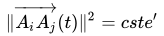
(
S
)
{\displaystyle \;\color {transparent}{\left({\mathcal {S}}\right)}}
en repérant les positions du solide dans le référentiel d'étude relativement à un point
O
{\displaystyle \;O\;}
lié au référentiel , On établit en effet que le champ de vitesse des points d'un solide
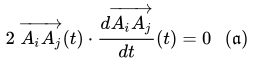
(
S
)
{\displaystyle \;\color {transparent}{\left({\mathcal {S}}\right)}}
d
A
i
A
j
→
d
t
(
t
)
=
d
O
A
j
→
d
t
(
t
)
−
d
O
A
i
→
d
t
(
t
)
=
V
→
A
j
(
t
)
−
V
→
A
i
(
t
)
{\displaystyle {\dfrac {d{\overrightarrow {A_{i}A_{j}}}}{dt}}(t)={\dfrac {d{\overrightarrow {OA_{j}}}}{dt}}(t)-{\dfrac {d{\overrightarrow {OA_{i}}}}{dt}}(t)={\vec {V}}_{A_{j}}(t)-{\vec {V}}_{A_{i}}(t)}
, d'où
(
a
)
{\displaystyle \;\left({\mathfrak {a}}\right)\;}
⇒
{\displaystyle \Rightarrow }
A
i
A
j
→
(
t
)
⋅
[
V
→
A
j
(
t
)
−
V
→
A
i
(
t
)
]
=
0
{\displaystyle \;{\overrightarrow {A_{i}A_{j}}}(t)\cdot \left[{\vec {V}}_{A_{j}}(t)-{\vec {V}}_{A_{i}}(t)\right]=0\;}
ou On établit en effet que le champ de vitesse des points d'un solide
(
S
)
{\displaystyle \;\color {transparent}{\left({\mathcal {S}}\right)}}
A
i
A
j
→
(
t
)
⋅
V
→
A
j
(
t
)
=
A
i
A
j
→
(
t
)
⋅
V
→
A
i
(
t
)
{\displaystyle {\overrightarrow {A_{i}A_{j}}}(t)\cdot {\vec {V}}_{A_{j}}(t)={\overrightarrow {A_{i}A_{j}}}(t)\cdot {\vec {V}}_{A_{i}}(t)\;}
établissant le caractère équiprojectif [ 130] du champ de vitesse d'un solide [ 131] ;
d'après la forme directe de la relation de Varignon [ 14] , [ 132] on peut définir, pour le torseur du champ de vitesse d'un solide nommé « torseur cinématique », d'après la forme directe de la relation de Varignon on peut définir, un vecteur unique
Ω
→
(
t
)
{\displaystyle \;{\overrightarrow {\Omega }}(t)\;}
vérifiant
V
→
A
j
(
t
)
=
V
→
A
i
(
t
)
+
Ω
→
(
t
)
∧
A
i
A
j
→
(
t
)
{\displaystyle \;{\vec {V}}_{A_{j}}(t)={\vec {V}}_{A_{i}}(t)+{\overrightarrow {\Omega }}(t)\wedge {\overrightarrow {A_{i}A_{j}}}(t)}
, d'après la forme directe de la relation de Varignon on peut définir, un vecteur unique
Ω
→
(
t
)
{\displaystyle \;{\overrightarrow {\Omega }}(t)\;}
définissant la résultante du torseur cinématique [ 133] ;
les éléments de réduction du torseur cinématique du solide
(
S
)
{\displaystyle \;\left({\mathcal {S}}\right)\;}
en un point
A
{\displaystyle \;A\;}
de
(
S
)
{\displaystyle \;\left({\mathcal {S}}\right)\;}
sont
T
cinémat. de
(
S
)
=
{
Ω
→
(
t
)
V
→
A
(
t
)
}
A
{\displaystyle \;{\mathcal {T}}_{{\text{cinémat. de}}\,({\mathcal {S}})}=\left\lbrace \!{\begin{array}{c}{\overrightarrow {\Omega }}(t)\\{\vec {V}}_{A}(t)\end{array}}\!\right\rbrace _{\!A}\!}
, le mouvement de
(
S
)
{\displaystyle \;\left({\mathcal {S}}\right)\;}
dépendant de la nature de son torseur cinématique :
le torseur cinématique est un torseur couple si
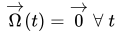
Ω
→
(
t
)
=
0
→
∀
t
{\displaystyle \;{\overrightarrow {\Omega }}(t)={\overrightarrow {0}}\;\forall \;t\;}
traduisant une translation du solide , la relation de Varignon [ 14] s'écrivant
V
→
B
(
t
)
=
V
→
A
(
t
)
{\displaystyle \;{\vec {V}}_{B}(t)={\vec {V}}_{A}(t)\;}
pour
(
A
,
B
)
∈
(
S
)
2
{\displaystyle \;\left(A,\,B\right)\in ({\mathcal {S}})^{2}}
, dans ce cas le torseur cinématique n'a pas d'axe central ,
le torseur cinématique est un torseur glisseur si
Ω
→
(
t
)
≠
0
→
{\displaystyle \;{\overrightarrow {\Omega }}(t)\neq {\overrightarrow {0}}\;}
avec l'existence d'un point
A
∈
(
S
)
{\displaystyle \;A\in ({\mathcal {S}})\;}
tel que
V
→
A
(
t
)
=
0
→
{\displaystyle \;{\vec {V}}_{A}(t)={\vec {0}}}
(
{\displaystyle \;{\big (}}
point central[ 56] du glisseur
)
{\displaystyle {\big )}}
, le torseur glisseur ayant pour support « la droite issue de
A
{\displaystyle \;A\;}
de vecteur directeur
Ω
→
(
t
)
{\displaystyle \;{\overrightarrow {\Omega }}(t)\;}
»[ 134] , les autres points
B
∈
(
S
)
{\displaystyle \;B\in ({\mathcal {S}})\;}
et
≠
A
{\displaystyle \;\neq A\;}
de vecteurs vitesse
V
→
B
(
t
)
=
Ω
→
(
t
)
∧
A
B
→
(
t
)
{\displaystyle \;{\vec {V}}_{B}(t)={\overrightarrow {\Omega }}(t)\wedge {\overrightarrow {AB}}(t)\;}
selon la relation de Varignon [ 14] établissent que le solide a un mouvement de rotation de vecteur rotation instantanée
Ω
→
(
t
)
{\displaystyle \;{\overrightarrow {\Omega }}(t)\;}
autour du point fixe
A
{\displaystyle \;A\;}
du solide [ 135] ,
le torseur cinématique est un torseur non particulier si
Ω
→
(
t
)
≠
0
→
{\displaystyle \;{\overrightarrow {\Omega }}(t)\neq {\overrightarrow {0}}\;}
avec l'existence d'un point
A
∈
(
S
)
{\displaystyle \;A\in ({\mathcal {S}})\;}
tel que
V
→
A
(
t
)
∥
{\displaystyle \;{\vec {V}}_{A}(t)\;\parallel \;}
à
Ω
→
(
t
)
{\displaystyle \;{\overrightarrow {\Omega }}(t)}
(
{\displaystyle \;{\big (}}
point central[ 56] du torseur [ 136]
)
{\displaystyle {\big )}}
, le torseur ayant pour axe central
Δ
T
cinémat. de
(
S
)
(
t
)
{\displaystyle \;\Delta _{{\mathcal {T}}_{{\text{cinémat. de}}\,({\mathcal {S}})}}(t)\;}
« la droite issue de
A
{\displaystyle \;A\;}
[ 136] de vecteur directeur
Ω
→
(
t
)
{\displaystyle \;{\overrightarrow {\Omega }}(t)\;}
», les autres points
B
∉
Δ
T
cinémat. de
(
S
)
(
t
)
{\displaystyle \;B\notin \Delta _{{\mathcal {T}}_{{\text{cinémat. de}}\,({\mathcal {S}})}}(t)\;}
de vecteurs vitesse
V
→
B
(
t
)
=
V
→
A
(
t
)
+
Ω
→
(
t
)
∧
A
B
→
(
t
)
{\displaystyle \;{\vec {V}}_{B}(t)={\vec {V}}_{A}(t)+{\overrightarrow {\Omega }}(t)\wedge {\overrightarrow {AB}}(t)\;}
selon la relation de Varignon [ 14] établissent que le mouvement du solide résulte de la composition d'une rotation de vecteur rotation instantanée
Ω
→
(
t
)
{\displaystyle \;{\overrightarrow {\Omega }}(t)\;}
autour l'axe central
Δ
T
cinémat. de
(
S
)
(
t
)
{\displaystyle \;\Delta _{{\mathcal {T}}_{{\text{cinémat. de}}\,({\mathcal {S}})}}(t)\;}
et d'une translation de vecteur vitesse
V
→
A
(
t
)
{\displaystyle \;{\vec {V}}_{A}(t)\;}
∥
{\displaystyle \parallel \;}
à
Ω
→
(
t
)
{\displaystyle \;{\overrightarrow {\Omega }}(t)\;}
et
le torseur cinématique est un torseur non particulier si
Ω
→
(
t
)
≠
0
→
{\displaystyle \;{\overrightarrow {\Omega }}(t)\neq {\overrightarrow {0}}\;}
avec absence de point
A
∈
(
S
)
{\displaystyle \;A\in ({\mathcal {S}})\;}
tel que
V
→
A
(
t
)
∥
{\displaystyle \;{\vec {V}}_{A}(t)\;\parallel \;}
à
Ω
→
(
t
)
{\displaystyle \;{\overrightarrow {\Omega }}(t)}
(
{\displaystyle \;{\big (}}
absence de point central[ 56] du torseur
)
{\displaystyle {\big )}}
, le torseur n'ayant donc pas d'axe central ; le choix d'un point quelconque
P
∈
(
S
)
{\displaystyle \;P\in ({\mathcal {S}})\;}
de vecteur vitesse
V
→
P
(
t
)
{\displaystyle \;{\vec {V}}_{P}(t)\;}
et d'un autre point
Q
∈
(
S
)
{\displaystyle \;Q\in ({\mathcal {S}})\;}
mais
≠
P
{\displaystyle \;\neq P\;}
de vecteurs vitesse
V
→
Q
(
t
)
=
V
→
P
(
t
)
+
Ω
→
(
t
)
∧
P
Q
→
(
t
)
{\displaystyle \;{\vec {V}}_{Q}(t)={\vec {V}}_{P}(t)+{\overrightarrow {\Omega }}(t)\wedge {\overrightarrow {PQ}}(t)\;}
selon la relation de Varignon [ 14] établit que le mouvement du solide résulte de la composition d'une rotation de vecteur rotation instantanée
Ω
→
(
t
)
{\displaystyle \;{\overrightarrow {\Omega }}(t)\;}
autour d'un axe
∥
{\displaystyle \;\parallel \;}
à
Ω
→
(
t
)
{\displaystyle \;{\overrightarrow {\Omega }}(t)\;}
passant par
P
{\displaystyle \;P\;}
et d'une translation de vecteur vitesse
V
→
P
(
t
)
∦
{\displaystyle \;{\vec {V}}_{P}(t)\;\not \parallel \;}
à
Ω
→
(
t
)
{\displaystyle \;{\overrightarrow {\Omega }}(t)}
.
Cette introduction n'est valable que dans le domaine de la cinétique newtonienne .
Le torseur cinétique sert à représenter pratiquement les comportements de « mouvement inertiel »[ 137] d'un système de points matériels
(
{\displaystyle \;{\big (}}
déformable ou indéformable
)
{\displaystyle {\big )}\;}
[ 138] .
La grandeur cinétique d'un système de points matériels
{
A
k
}
(
k
∈
[
[
1
,
n
]
]
,
n
∈
N
∗
∖
{
1
}
)
{\displaystyle \;\left\lbrace A_{k}\right\rbrace _{\left(k\in \left[\left[1\,,\,n\right]\right],\,n\in \mathbb {N} ^{*}\backslash \left\lbrace 1\right\rbrace \right)}\;}
dans le référentiel d'étude La grandeur cinétique est représentée, à l'instant
t
{\displaystyle \;t}
, par son vecteur quantité de mouvement

p
→
k
(
t
)
=
m
k
V
→
A
k
(
t
)
{\displaystyle \;{\vec {p}}_{k}(t)=m_{k}\;{\vec {V}}_{A_{k}}(t)\;}
du point
A
k
{\displaystyle \;A_{k}\;}
avec
m
k
{\displaystyle \;m_{k}\;}
masse du point et
V
→
A
k
(
t
)
{\displaystyle \;{\vec {V}}_{A_{k}}(t)\;}
son vecteur vitesse à l'instant
t
{\displaystyle \;t}
;
la quantité de mouvement
p
→
k
(
t
)
{\displaystyle \;{\vec {p}}_{k}(t)\;}
du point
A
k
{\displaystyle \;A_{k}\;}
est un torseur glisseur
G
k
{\displaystyle \;{\mathcal {G}}_{k}\;}
dont le support
Δ
G
k
(
t
)
{\displaystyle \;\Delta _{{\mathcal {G}}_{k}}(t)\;}
est la droite issue de
A
k
{\displaystyle \;A_{k}\;}
de vecteur directeur
p
→
k
(
t
)
{\displaystyle \;{\vec {p}}_{k}(t)}
, la quantité de mouvement
p
→
k
(
t
)
{\displaystyle \;\color {transparent}{{\vec {p}}_{k}(t)}\;}
du point
A
k
{\displaystyle \;\color {transparent}{A_{k}}\;}
est un torseur glisseur
G
k
{\displaystyle \;\color {transparent}{{\mathcal {G}}_{k}}\;}
ses éléments de réduction en un point
O
{\displaystyle \;O\;}
quelconque sont
{
p
→
k
(
t
)
=
m
k
V
→
A
k
(
t
)
M
→
O
,
p
→
k
(
t
)
=
p
→
k
(
t
)
∧
A
k
O
→
(
t
)
}
O
{\displaystyle \;\left\lbrace \!{\begin{array}{c}{\vec {p}}_{k}(t)=m_{k}\;{\vec {V}}_{A_{k}}(t)\\{\overrightarrow {\mathcal {M}}}_{O,\,{\vec {p}}_{k}}(t)={\vec {p}}_{k}(t)\wedge {\overrightarrow {A_{k}O}}(t)\end{array}}\!\right\rbrace _{\!O}\;}
[ 139] ;
l'ensemble des quantités de mouvement des points du système de points matériels
{
A
k
}
(
k
∈
[
[
1
,
n
]
]
,
n
∈
N
∗
∖
{
1
}
)
{\displaystyle \;\left\lbrace A_{k}\right\rbrace _{\left(k\in \left[\left[1\,,\,n\right]\right],\,n\in \mathbb {N} ^{*}\backslash \left\lbrace 1\right\rbrace \right)}\;}
l'ensemble des quantités de mouvement des points du système est un torseur
T
cinét.
{\displaystyle \;{\mathcal {T}}_{\text{cinét.}}\;}
nommé « torseur cinétique » l'ensemble des quantités de mouvement des points du système est un torseur
T
cinét.
{\displaystyle \;\color {transparent}{{\mathcal {T}}_{\text{cinét.}}}\;}
dont les éléments de réduction en un point
O
{\displaystyle \;O\;}
quelconque sont
T
cinét.
=
∑
k
G
k
=
{
∑
k
p
→
k
(
t
)
∑
k
M
→
O
,
p
→
k
(
t
)
}
O
{\displaystyle \;{\mathcal {T}}_{\text{cinét.}}=\sum _{k}{\mathcal {G}}_{k}=\left\lbrace {\begin{array}{c}\sum _{k}{\vec {p}}_{k}(t)\\\sum _{k}{\overrightarrow {\mathcal {M}}}_{O,\,{\vec {p}}_{k}}(t)\end{array}}\right\rbrace _{O}\;}
[ 140] , l'ensemble des quantités de mouvement des points du système est un torseur
T
cinét.
{\displaystyle \;\color {transparent}{{\mathcal {T}}_{\text{cinét.}}}\;}
∙
{\displaystyle \bullet \;}
la résultante
∑
k
p
→
k
(
t
)
=
∑
k
m
k
V
→
k
(
t
)
{\displaystyle \;\sum _{k}{\vec {p}}_{k}(t)=\sum _{k}m_{k}\;{\vec {V}}_{k}(t)\;}
du torseur cinétique notée
P
→
(
t
)
{\displaystyle \;{\vec {P}}(t)\;}
est appelée « résultante cinétique » et l'ensemble des quantités de mouvement des points du système est un torseur
T
cinét.
{\displaystyle \;\color {transparent}{{\mathcal {T}}_{\text{cinét.}}}\;}
∙
{\displaystyle \bullet \;}
le moment
∑
k
M
→
O
,
p
→
k
(
t
)
=
∑
k
p
→
k
(
t
)
∧
A
k
O
→
(
t
)
{\displaystyle \;\sum _{k}{\overrightarrow {\mathcal {M}}}_{O,\,{\vec {p}}_{k}}(t)=\sum _{k}{\vec {p}}_{k}(t)\wedge {\overrightarrow {A_{k}O}}(t)\;}
du torseur cinétique noté, en physique, l'ensemble des quantités de mouvement des points du système est un torseur
T
cinét.
{\displaystyle \;\color {transparent}{{\mathcal {T}}_{\text{cinét.}}}\;}
∙
{\displaystyle \color {transparent}{\bullet }\;}
σ
→
O
,
{
A
k
}
(
k
∈
[
[
1
,
n
]
]
,
n
∈
N
∗
∖
{
1
}
)
(
t
)
{\displaystyle {\overrightarrow {\sigma }}_{O,\,\left\lbrace A_{k}\right\rbrace _{\left(k\in \left[\left[1\,,\,n\right]\right],\,n\in \mathbb {N} ^{*}\backslash \left\lbrace 1\right\rbrace \right)}}(t)\;}
[ 141] est appelé « moment résultant cinétique » au point
O
{\displaystyle \;O\;}
[ 142] , il s'écrit, en physique, l'ensemble des quantités de mouvement des points du système est un torseur
T
cinét.
{\displaystyle \;\color {transparent}{{\mathcal {T}}_{\text{cinét.}}}\;}
∙
{\displaystyle \color {transparent}{\bullet }\;}
σ
→
O
(
t
)
=
∑
k
O
A
k
→
(
t
)
∧
p
→
k
(
t
)
=
∑
k
O
A
k
→
(
t
)
∧
m
V
→
k
(
t
)
{\displaystyle {\overrightarrow {\sigma }}_{O}(t)=\sum _{k}{\overrightarrow {OA_{k}}}(t)\wedge {\vec {p}}_{k}(t)=\sum _{k}{\overrightarrow {OA_{k}}}(t)\wedge m\;{\vec {V}}_{k}(t)\;}
et la relation de Varignon [ 14] lui est applicable selon l'ensemble des quantités de mouvement des points du système est un torseur
T
cinét.
{\displaystyle \;\color {transparent}{{\mathcal {T}}_{\text{cinét.}}}\;}
∙
{\displaystyle \color {transparent}{\bullet }\;}
σ
→
O
′
(
t
)
=
σ
→
O
(
t
)
+
P
→
(
t
)
∧
O
O
′
→
{\displaystyle {\overrightarrow {\sigma }}_{O'}(t)={\overrightarrow {\sigma }}_{O}(t)+{\vec {P}}(t)\wedge {\overrightarrow {OO'}}\;}
ou encore
σ
→
O
′
(
t
)
=
{\displaystyle \;{\overrightarrow {\sigma }}_{O'}(t)=}
σ
→
O
(
t
)
+
O
′
O
→
∧
P
→
(
t
)
{\displaystyle {\overrightarrow {\sigma }}_{O}(t)+{\overrightarrow {O'O}}\wedge {\vec {P}}(t)}
.
Le torseur cinétique du système de points matériels
{
A
k
}
(
k
∈
[
[
1
,
n
]
]
,
n
∈
N
∗
∖
{
1
}
)
{\displaystyle \;\left\lbrace A_{k}\right\rbrace _{\left(k\in \left[\left[1\,,\,n\right]\right],\,n\in \mathbb {N} ^{*}\backslash \left\lbrace 1\right\rbrace \right)}\;}
dans le référentiel d'étude à l'instant
t
{\displaystyle \;t\;}
est :
un torseur couple si
P
→
(
t
)
=
0
→
∀
t
{\displaystyle \;{\vec {P}}(t)={\vec {0}}\;\forall \;t\;}
traduisant l'immobilité du C.D.I.[ 143]
G
{\displaystyle \;G\;}
du système quand celui-ci est fermé[ 144] , la relation de Varignon [ 14] s'écrivant
σ
→
O
′
(
t
)
=
σ
→
O
(
t
)
{\displaystyle \;{\overrightarrow {\sigma }}_{O'}(t)={\overrightarrow {\sigma }}_{O}(t)\;}
pour
(
O
,
O
′
)
∈
E
2
{\displaystyle \;\left(O,\,O'\right)\in {\mathcal {E}}^{2}\;}
quelconque, dans ce cas le torseur cinétique n'a pas d'axe central ,
un torseur glisseur si
P
→
(
t
)
≠
0
→
{\displaystyle \;{\vec {P}}(t)\neq {\vec {0}}\;}
avec l'existence d'un point
A
∈
E
{\displaystyle \;A\in {\mathcal {E}}\;}
tel que
σ
→
A
(
t
)
=
0
→
{\displaystyle \;{\overrightarrow {\sigma }}_{A}(t)={\vec {0}}}
(
{\displaystyle \;{\big (}}
point central[ 56] du glisseur
)
{\displaystyle {\big )}}
, le torseur glisseur ayant pour support « la droite issue de
A
{\displaystyle \;A\;}
de vecteur directeur
P
→
(
t
)
{\displaystyle \;{\vec {P}}(t)\;}
»[ 145] , en un autre point
B
∈
(
E
)
{\displaystyle \;B\in ({\mathcal {E}})\;}
et
≠
A
{\displaystyle \;\neq A\;}
le moment résultant cinétique s'écrit
σ
→
B
(
t
)
=
{\displaystyle \;{\overrightarrow {\sigma }}_{B}(t)=}
P
→
(
t
)
∧
A
B
→
{\displaystyle {\vec {P}}(t)\wedge {\overrightarrow {AB}}}
[
{\displaystyle \;{\Big [}}
ou
σ
→
B
(
t
)
=
B
A
→
∧
P
→
(
t
)
{\displaystyle \;{\overrightarrow {\sigma }}_{B}(t)={\overrightarrow {BA}}\wedge {\vec {P}}(t)\;}
comme on le note préférentiellement en physique
]
{\displaystyle {\Big ]}\;}
selon la relation de Varignon [ 14] établissant que le moment résultant cinétique du système en
B
{\displaystyle \;B\;}
est égal au moment cinétique en
B
{\displaystyle \;B\;}
du point
A
{\displaystyle \;A\;}
auquel on aurait affecté une quantité de mouvement égale à la résultante cinétique du système,
un torseur non particulier si
P
→
(
t
)
≠
0
→
{\displaystyle \;{\vec {P}}(t)\neq {\vec {0}}\;}
avec l'existence d'un point
A
∈
E
{\displaystyle \;A\in {\mathcal {E}}\;}
tel que
σ
→
A
(
t
)
∥
{\displaystyle \;{\overrightarrow {\sigma }}_{A}(t)\;\parallel \;}
à
P
→
(
t
)
{\displaystyle \;{\vec {P}}(t)}
(
{\displaystyle \;{\big (}}
point central[ 56] du torseur [ 146]
)
{\displaystyle {\big )}}
, le torseur ayant pour axe central
Δ
T
cinét.
(
t
)
{\displaystyle \;\Delta _{{\mathcal {T}}_{\text{cinét.}}}(t)\;}
« la droite issue de
A
{\displaystyle \;A\;}
[ 146] de vecteur directeur
P
→
(
t
)
{\displaystyle \;{\vec {P}}(t)\;}
», en un autre point
B
∈
(
E
)
{\displaystyle \;B\in ({\mathcal {E}})\;}
et
≠
A
{\displaystyle \;\neq A\;}
le moment résultant cinétique s'écrit
σ
→
B
(
t
)
=
{\displaystyle \;{\overrightarrow {\sigma }}_{B}(t)=}
σ
→
A
(
t
)
+
P
→
(
t
)
∧
A
B
→
{\displaystyle {\overrightarrow {\sigma }}_{A}(t)+{\vec {P}}(t)\wedge {\overrightarrow {AB}}}
[
{\displaystyle \;{\Big [}}
ou
σ
→
B
(
t
)
=
σ
→
A
(
t
)
+
B
A
→
∧
P
→
(
t
)
{\displaystyle \;{\overrightarrow {\sigma }}_{B}(t)={\overrightarrow {\sigma }}_{A}(t)+{\overrightarrow {BA}}\wedge {\vec {P}}(t)\;}
comme on le note préférentiellement en physique
]
{\displaystyle {\Big ]}\;}
selon la relation de Varignon [ 14] établissant que le moment résultant cinétique du système en
B
{\displaystyle \;B\;}
résulte de la composition du moment résultant cinétique en
A
{\displaystyle \;A\;}
et du moment cinétique en
B
{\displaystyle \;B\;}
du point
A
{\displaystyle \;A\;}
auquel on aurait affecté une quantité de mouvement égale à la résultante cinétique du système, ces deux moments résultants cinétiques étant
⊥
{\displaystyle \;\perp \;}
entre eux[ 147] et
un torseur non particulier si
P
→
(
t
)
≠
0
→
{\displaystyle \;{\vec {P}}(t)\neq {\vec {0}}\;}
avec absence de point
A
∈
E
{\displaystyle \;A\in {\mathcal {E}}\;}
tel que
σ
→
A
(
t
)
∥
{\displaystyle \;{\overrightarrow {\sigma }}_{A}(t)\;\parallel \;}
à
P
→
(
t
)
{\displaystyle \;{\vec {P}}(t)}
(
{\displaystyle \;{\big (}}
absence de point central[ 56] du torseur
)
{\displaystyle {\big )}}
, le torseur n'ayant pas d'axe central , considérant un point
D
∈
E
{\displaystyle \;D\in {\mathcal {E}}\;}
par rapport auquel le moment résultant cinétique est
σ
→
D
(
t
)
{\displaystyle \;{\overrightarrow {\sigma }}_{D}(t)\;}
et un autre point
B
∈
E
{\displaystyle \;B\in {\mathcal {E}}\;}
et
≠
D
{\displaystyle \;\neq D\;}
par rapport auquel le moment résultant cinétique s'écrit

σ
→
B
(
t
)
=
σ
→
D
(
t
)
+
P
→
(
t
)
∧
D
B
→
{\displaystyle {\overrightarrow {\sigma }}_{B}(t)={\overrightarrow {\sigma }}_{D}(t)+{\vec {P}}(t)\wedge {\overrightarrow {DB}}}
[
{\displaystyle \;{\Big [}}
ou
σ
→
B
(
t
)
=
{\displaystyle \;{\overrightarrow {\sigma }}_{B}(t)=}
σ
→
D
(
t
)
+
B
D
→
∧
P
→
(
t
)
{\displaystyle {\overrightarrow {\sigma }}_{D}(t)+{\overrightarrow {BD}}\wedge {\vec {P}}(t)\;}
comme on le note préférentiellement en physique
]
{\displaystyle {\Big ]}\;}
selon la relation de Varignon [ 14] établissant que le moment résultant cinétique du système en
B
{\displaystyle \;B\;}
résulte de la composition du moment résultant cinétique en
D
{\displaystyle \;D}
, point quelconque, et du moment cinétique en
B
{\displaystyle \;B\;}
du point
D
{\displaystyle \;D\;}
auquel on aurait affecté une quantité de mouvement égale à la résultante cinétique du système, ces deux moments résultants cinétiques étant a priori quelconques.
Cette introduction n'est valable que dans le domaine de la dynamique newtonienne .
Le torseur dynamique sert à représenter les variations de « mouvement inertiel »[ 137] d'un système de points matériels
(
{\displaystyle \;{\big (}}
déformable ou indéformable
)
{\displaystyle {\big )}\;}
[ 148] .
La grandeur dynamique d'un système de points matériels
{
A
k
}
(
k
∈
[
[
1
,
n
]
]
,
n
∈
N
∗
∖
{
1
}
)
{\displaystyle \;\left\lbrace A_{k}\right\rbrace _{\left(k\in \left[\left[1\,,\,n\right]\right],\,n\in \mathbb {N} ^{*}\backslash \left\lbrace 1\right\rbrace \right)}\;}
dans le référentiel d'étude La grandeur dynamique est représentée, à l'instant
t
{\displaystyle \;t}
, par la dérivée temporelle de son vecteur quantité de mouvement

d
p
→
k
d
t
(
t
)
=
p
→
k
˙
(
t
)
=
m
k
a
→
A
k
(
t
)
{\displaystyle \;{\dfrac {d{\vec {p}}_{k}}{dt}}(t)={\dot {{\vec {p}}_{k}}}(t)=m_{k}\;{\vec {a}}_{A_{k}}(t)\;}
du point
A
k
{\displaystyle \;A_{k}\;}
avec La grandeur dynamique est représentée, à l'instant
t
{\displaystyle \;\color {transparent}{t}}
, par la dérivée temporelle de son vecteur quantité de mouvement
m
k
{\displaystyle \;m_{k}\;}
masse du point et
a
→
A
k
(
t
)
=
V
→
k
˙
(
t
)
{\displaystyle \;{\vec {a}}_{A_{k}}(t)={\dot {{\vec {V}}_{k}}}(t)\;}
son vecteur accélération à l'instant
t
{\displaystyle \;t}
;
la dérivée temporelle du vecteur quantité de mouvement
p
→
k
˙
(
t
)
{\displaystyle \;{\dot {{\vec {p}}_{k}}}(t)\;}
du point
A
k
{\displaystyle \;A_{k}\;}
est un glisseur
G
k
{\displaystyle \;{\mathcal {G}}_{k}\;}
dont le support
Δ
G
k
(
t
)
{\displaystyle \;\Delta _{{\mathcal {G}}_{k}}(t)\;}
est la droite issue de
A
k
{\displaystyle \;A_{k}\;}
de vecteur directeur
p
→
k
˙
(
t
)
=
d
p
→
k
d
t
(
t
)
{\displaystyle \;{\dot {{\vec {p}}_{k}}}(t)={\dfrac {d{\vec {p}}_{k}}{dt}}(t)\;}
avec la dérivée temporellle du vecteur quantité de mouvement
p
→
k
˙
(
t
)
{\displaystyle \;\color {transparent}{{\dot {{\vec {p}}_{k}}}(t)}\;}
du point
A
k
{\displaystyle \;\color {transparent}{A_{k}}\;}
est un glisseur
G
k
{\displaystyle \;\color {transparent}{{\mathcal {G}}_{k}}\;}
pour éléments de réduction en un point
O
{\displaystyle \;O\;}
quelconque
{
d
p
→
k
d
t
(
t
)
=
m
k
a
→
A
k
(
t
)
M
→
O
,
p
→
k
˙
(
t
)
=
d
p
→
k
d
t
(
t
)
∧
A
k
O
→
(
t
)
}
O
{\displaystyle \;\left\lbrace \!{\begin{array}{c}{\dfrac {d{\vec {p}}_{k}}{dt}}(t)=m_{k}\;{\vec {a}}_{A_{k}}(t)\\{\overrightarrow {\mathcal {M}}}_{O,\,{\dot {{\vec {p}}_{k}}}}(t)={\dfrac {d{\vec {p}}_{k}}{dt}}(t)\wedge {\overrightarrow {A_{k}O}}(t)\end{array}}\!\right\rbrace _{\!O}\;}
[ 149] ;
l'ensemble des dérivées temporelles des quantités de mouvement des points du système de points matériels
{
A
k
}
(
k
∈
[
[
1
,
n
]
]
,
n
∈
N
∗
∖
{
1
}
)
{\displaystyle \;\left\lbrace A_{k}\right\rbrace _{\left(k\in \left[\left[1\,,\,n\right]\right],\,n\in \mathbb {N} ^{*}\backslash \left\lbrace 1\right\rbrace \right)}\;}
l'ensemble des dérivées temporelles des quantités de mouvement des points est un torseur
T
dynam.
{\displaystyle \;{\mathcal {T}}_{\text{dynam.}}\;}
nommé « torseur dynamique » avec l'ensemble des dérivées temporelles des quantités de mouvement des points est un torseur pour éléments de réduction en un point
O
∈
E
{\displaystyle \;O\in {\mathcal {E}}\;}
T
dynam.
=
∑
k
G
k
=
{
∑
k
d
p
→
k
d
t
(
t
)
∑
k
M
→
O
,
p
→
k
˙
(
t
)
}
O
{\displaystyle \;{\mathcal {T}}_{\text{dynam.}}=\sum _{k}{\mathcal {G}}_{k}=\left\lbrace \!{\begin{array}{c}\sum _{k}{\dfrac {d{\vec {p}}_{k}}{dt}}(t)\\\sum _{k}{\overrightarrow {\mathcal {M}}}_{O,\,{\dot {{\vec {p}}_{k}}}}(t)\end{array}}\!\right\rbrace _{\!O}\;}
[ 150] , l'ensemble des dérivées temporelles des quantités de mouvement des points est un torseur
∙
{\displaystyle \bullet \;}
la résultante
∑
k
d
p
→
k
d
t
(
t
)
=
∑
k
p
→
k
˙
(
t
)
=
∑
k
m
k
a
→
k
(
t
)
{\displaystyle \;\sum _{k}{\dfrac {d{\vec {p}}_{k}}{dt}}(t)=\sum _{k}{\dot {{\vec {p}}_{k}}}(t)=\sum _{k}m_{k}\;{\vec {a}}_{k}(t)\;}
du torseur dynamique l'ensemble des dérivées temporelles des quantités de mouvement des points est un torseur
∙
{\displaystyle \color {transparent}{\bullet }\;}
la résultante est appelée, par quelques uns, « quantité d'accélération »[ 36] , [ 37] et l'ensemble des dérivées temporelles des quantités de mouvement des points est un torseur
∙
{\displaystyle \bullet \;}
le moment
∑
k
M
→
O
,
p
→
k
˙
(
t
)
=
∑
k
d
p
→
k
d
t
(
t
)
∧
A
k
O
→
(
t
)
{\displaystyle \;\sum _{k}{\overrightarrow {\mathcal {M}}}_{O,\,{\dot {{\vec {p}}_{k}}}}(t)=\sum _{k}{\dfrac {d{\vec {p}}_{k}}{dt}}(t)\wedge {\overrightarrow {A_{k}O}}(t)\;}
du torseur dynamique noté, en physique, l'ensemble des dérivées temporelles des quantités de mouvement des points est un torseur
∙
{\displaystyle \color {transparent}{\bullet }\;}
M
→
O
,
{
A
k
,
p
k
→
˙
,
k
∈
[
[
1
,
n
]
]
,
n
∈
N
∗
∖
{
1
}
}
(
t
)
=
∑
k
O
A
k
→
(
t
)
∧
d
p
→
k
d
t
(
t
)
{\displaystyle {\overrightarrow {\mathcal {M}}}_{O,\,\left\lbrace A_{k}\,,\,{\dot {\vec {p_{k}}}}\,,\,k\in \left[\left[1\,,\,n\right]\right],\,n\in \mathbb {N} ^{*}\backslash \left\lbrace 1\right\rbrace \right\rbrace }(t)=\sum _{k}{\overrightarrow {OA_{k}}}(t)\wedge {\dfrac {d{\vec {p}}_{k}}{dt}}(t)\;}
[ 151] est appelé, par quelques uns, l'ensemble des dérivées temporelles des quantités de mouvement des points est un torseur
∙
{\displaystyle \color {transparent}{\bullet }\;}
« moment (résultant) dynamique » au point
O
{\displaystyle \;O\;}
[ 152] il s'écrit donc, en physique, l'ensemble des dérivées temporelles des quantités de mouvement des points est un torseur
∙
{\displaystyle \color {transparent}{\bullet }\;}
M
→
O
,
tors. dynam.
(
t
)
=
∑
k
O
A
k
→
(
t
)
∧
d
p
→
k
d
t
(
t
)
=
∑
k
O
A
k
→
(
t
)
∧
m
a
→
k
(
t
)
{\displaystyle {\overrightarrow {\mathcal {M}}}_{O,\,{\text{tors. dynam.}}}(t)=\sum _{k}{\overrightarrow {OA_{k}}}(t)\wedge {\dfrac {d{\vec {p}}_{k}}{dt}}(t)=\sum _{k}{\overrightarrow {OA_{k}}}(t)\wedge m\;{\vec {a}}_{k}(t)\;}
et l'ensemble des dérivées temporelles des quantités de mouvement des points est un torseur
∙
{\displaystyle \color {transparent}{\bullet }\;}
la relation de Varignon [ 14] lui est applicable selon l'ensemble des dérivées temporelles des quantités de mouvement des points est un torseur

∙
{\displaystyle \color {transparent}{\bullet }\;}
M
→
O
′
,
tors. dynam.
(
t
)
=
M
→
O
,
tors. dynam.
(
t
)
+
d
P
→
d
t
(
t
)
∧
O
O
′
→
{\displaystyle {\overrightarrow {\mathcal {M}}}_{O',\,{\text{tors. dynam.}}}(t)={\overrightarrow {\mathcal {M}}}_{O,\,{\text{tors. dynam.}}}(t)+{\dfrac {d{\vec {P}}}{dt}}(t)\wedge {\overrightarrow {OO'}}\;}
ou encore l'ensemble des dérivées temporelles des quantités de mouvement des points est un torseur

∙
{\displaystyle \color {transparent}{\bullet }\;}
M
→
O
′
,
tors. dynam.
(
t
)
=
M
→
O
,
tors. dynam.
(
t
)
+
O
′
O
→
∧
d
P
→
d
t
(
t
)
{\displaystyle {\overrightarrow {\mathcal {M}}}_{O',\,{\text{tors. dynam.}}}(t)={\overrightarrow {\mathcal {M}}}_{O,\,{\text{tors. dynam.}}}(t)+{\overrightarrow {O'O}}\wedge {\dfrac {d{\vec {P}}}{dt}}(t)}
.
Soient
T
stat. sur
(
S
)
=
{
∑
k
F
→
k
∑
k
M
→
O
,
F
→
k
+
∑
q
,
indexant
[
[
i
…
j
]
]
M
→
C
→
(
l
∈
[
[
i
…
j
]
]
q
)
}
O
{\displaystyle \;{\mathcal {T}}_{{\text{stat. sur}}\,({\mathcal {S}})}=\left\lbrace {\begin{array}{c}\sum _{k}{\vec {F}}_{k}\\\sum _{k}{\overrightarrow {\mathcal {M}}}_{O,\,{\vec {F}}_{k}}+\sum \limits _{q,\,{\text{indexant}}}^{\left[\left[i\,\ldots \,j\right]\right]}{\overrightarrow {\mathcal {M}}}_{{\vec {C}}_{\left(l\,\in \left[\left[i\,\ldots \,j\right]\right]_{q}\right)}}\end{array}}\right\rbrace _{O}\;}
[ 128] le torseur statique s'exerçant sur le solide
(
S
)
=
{
A
k
}
(
k
∈
[
[
1
,
n
]
]
,
n
∈
N
∗
∖
{
1
}
)
{\displaystyle \;\left({\mathcal {S}}\right)=\left\lbrace A_{k}\right\rbrace _{\left(k\in \left[\left[1\,,\,n\right]\right],\,n\in \mathbb {N} ^{*}\backslash \left\lbrace 1\right\rbrace \right)}\;}
ou
T
stat. sur
(
S
)
=
{
F
→
ext
M
→
O
,
ext
}
O
{\displaystyle \;{\mathcal {T}}_{{\text{stat. sur}}\,({\mathcal {S}})}=\left\lbrace {\begin{array}{c}{\vec {F}}_{\text{ext}}\\{\overrightarrow {\mathcal {M}}}_{O,\,{\text{ext}}}\end{array}}\right\rbrace _{O}\;}
[ 153] et Soient
T
cinémat. de
(
S
)
=
{
Ω
→
(
t
)
V
→
O
(
t
)
}
O
{\displaystyle \;{\mathcal {T}}_{{\text{cinémat. de}}\,({\mathcal {S}})}=\left\lbrace {\begin{array}{c}{\overrightarrow {\Omega }}(t)\\{\vec {V}}_{O}(t)\end{array}}\right\rbrace _{O}}
le torseur cinématique du solide pour lequel
O
{\displaystyle \;O\;}
doit être un point du solide , le produit
(
{\displaystyle \;{\big (}}
ou comoment
)
{\displaystyle {\big )}\;}
des torseurs statique et cinématique relatif au solide
(
S
)
{\displaystyle \;\left({\mathcal {S}}\right)}
, à savoir
T
stat. sur
(
S
)
⊗
T
cinémat. de
(
S
)
{\displaystyle \;{\mathcal {T}}_{{\text{stat. sur}}\,({\mathcal {S}})}\otimes {\mathcal {T}}_{{\text{cinémat. de}}\,({\mathcal {S}})}}
, nécessite de choisir
O
∈
(
S
)
{\displaystyle \;O\in \left({\mathcal {S}}\right)}
, le produit
(
{\displaystyle \;\color {transparent}{\big (}}
ou comoment
)
{\displaystyle \color {transparent}{\big )}\;}
des torseurs statique et cinématique relatif au solide
(
S
)
{\displaystyle \;\color {transparent}{\left({\mathcal {S}}\right)}}
, s'écrit
T
stat. sur
(
S
)
⊗
T
cinémat. de
(
S
)
=
{
F
→
ext
M
→
O
,
ext
}
O
⊗
{
Ω
→
(
t
)
V
→
O
(
t
)
}
O
{\displaystyle \;{\mathcal {T}}_{{\text{stat. sur}}\,({\mathcal {S}})}\otimes {\mathcal {T}}_{{\text{cinémat. de}}\,({\mathcal {S}})}=\left\lbrace {\begin{array}{c}{\vec {F}}_{\text{ext}}\\{\overrightarrow {\mathcal {M}}}_{O,\,{\text{ext}}}\end{array}}\right\rbrace _{O}\otimes \left\lbrace {\begin{array}{c}{\overrightarrow {\Omega }}(t)\\{\vec {V}}_{O}(t)\end{array}}\right\rbrace _{O}}
le produit
(
{\displaystyle \;\color {transparent}{\big (}}
ou comoment
)
{\displaystyle \color {transparent}{\big )}\;}
des torseurs statique et cinématique relatif au solide
(
S
)
{\displaystyle \;\color {transparent}{\left({\mathcal {S}}\right)}}
, s'écrit
T
stat. sur
(
S
)
⊗
T
cinémat. de
(
S
)
{\displaystyle \;\color {transparent}{{\mathcal {T}}_{{\text{stat. sur}}\,({\mathcal {S}})}\otimes {\mathcal {T}}_{{\text{cinémat. de}}\,({\mathcal {S}})}}}
=
F
→
ext
⋅
V
→
O
(
t
)
+
M
→
O
,
ext
⋅
Ω
→
(
t
)
{\displaystyle ={\vec {F}}_{\text{ext}}\cdot {\vec {V}}_{O}(t)+{\overrightarrow {\mathcal {M}}}_{O,\,{\text{ext}}}\cdot {\overrightarrow {\Omega }}(t)\;}
correspondant à le produit
(
{\displaystyle \;\color {transparent}{\big (}}
ou comoment
)
{\displaystyle \color {transparent}{\big )}\;}
des torseurs statique et cinématique relatif au solide
(
S
)
{\displaystyle \;\color {transparent}{\left({\mathcal {S}}\right)}}
,
∙
{\displaystyle \bullet \;}
la puissance développée par la résultante dynamique
F
→
ext
{\displaystyle \;{\vec {F}}_{\text{ext}}\;}
lors de la translation de vecteur vitesse
V
→
O
(
t
)
{\displaystyle \;{\vec {V}}_{O}(t)\;}
c'est-à-dire le produit
(
{\displaystyle \;\color {transparent}{\big (}}
ou comoment
)
{\displaystyle \color {transparent}{\big )}\;}
des torseurs statique et cinématique relatif au solide
(
S
)
{\displaystyle \;\color {transparent}{\left({\mathcal {S}}\right)}}
,
∙
{\displaystyle \color {transparent}{\bullet }\;}
la puissance développée par la résultante dynamique
F
→
ext
{\displaystyle \;\color {transparent}{{\vec {F}}_{\text{ext}}}\;}
F
→
ext
⋅
V
→
O
(
t
)
{\displaystyle {\vec {F}}_{\text{ext}}\cdot {\vec {V}}_{O}(t)\;}
augmentée de le produit
(
{\displaystyle \;\color {transparent}{\big (}}
ou comoment
)
{\displaystyle \color {transparent}{\big )}\;}
des torseurs statique et cinématique relatif au solide
(
S
)
{\displaystyle \;\color {transparent}{\left({\mathcal {S}}\right)}}
,
∙
{\displaystyle \bullet \;}
la puissance développée par le moment résultant dynamique
M
→
O
,
ext
{\displaystyle \;{\overrightarrow {\mathcal {M}}}_{O,\,{\text{ext}}}\;}
lors de la rotation autour du point
O
{\displaystyle \;O}
le produit
(
{\displaystyle \;\color {transparent}{\big (}}
ou comoment
)
{\displaystyle \color {transparent}{\big )}\;}
des torseurs statique et cinématique relatif au solide
(
S
)
{\displaystyle \;\color {transparent}{\left({\mathcal {S}}\right)}}
,
∙
{\displaystyle \color {transparent}{\bullet }\;}
la puissance développée par le moment résultant dynamique
M
→
O
,
ext
{\displaystyle \;\color {transparent}{{\overrightarrow {\mathcal {M}}}_{O,\,{\text{ext}}}}\;}
de vecteur rotation instantanée
Ω
→
(
t
)
{\displaystyle \;{\overrightarrow {\Omega }}(t)\;}
le produit
(
{\displaystyle \;\color {transparent}{\big (}}
ou comoment
)
{\displaystyle \color {transparent}{\big )}\;}
des torseurs statique et cinématique relatif au solide
(
S
)
{\displaystyle \;\color {transparent}{\left({\mathcal {S}}\right)}}
,
∙
{\displaystyle \color {transparent}{\bullet }\;}
la puissance développée par le moment résultant dynamique c'est-à-dire
M
→
O
,
ext
⋅
Ω
→
(
t
)
{\displaystyle \;{\overrightarrow {\mathcal {M}}}_{O,\,{\text{ext}}}\cdot {\overrightarrow {\Omega }}(t)\;}
soit finalement le produit
(
{\displaystyle \;\color {transparent}{\big (}}
ou comoment
)
{\displaystyle \color {transparent}{\big )}\;}
des torseurs statique et cinématique relatif au solide
(
S
)
{\displaystyle \;\color {transparent}{\left({\mathcal {S}}\right)}}
, s'écrit
T
stat. sur
(
S
)
⊗
T
cinémat. de
(
S
)
=
P
ext
(
t
)
{\displaystyle \;{\mathcal {T}}_{{\text{stat. sur}}\,({\mathcal {S}})}\otimes {\mathcal {T}}_{{\text{cinémat. de}}\,({\mathcal {S}})}={\mathcal {P}}_{\text{ext}}(t)\;}
c'est-à-dire la puissance développée par les actions extérieures le produit
(
{\displaystyle \;\color {transparent}{\big (}}
ou comoment
)
{\displaystyle \color {transparent}{\big )}\;}
des torseurs statique et cinématique relatif au solide
(
S
)
{\displaystyle \;\color {transparent}{\left({\mathcal {S}}\right)}}
, s'écrit
T
stat. sur
(
S
)
⊗
T
cinémat. de
(
S
)
=
P
ext
(
t
)
{\displaystyle \;\color {transparent}{{\mathcal {T}}_{{\text{stat. sur}}\,({\mathcal {S}})}\otimes {\mathcal {T}}_{{\text{cinémat. de}}\,({\mathcal {S}})}={\mathcal {P}}_{\text{ext}}(t)}\;}
c'est-à-dire la puissance s'exerçant sur le solide
(
S
)
{\displaystyle \;({\mathcal {S}})}
;
en conclusion le produit
(
{\displaystyle \;{\big (}}
ou comoment
)
{\displaystyle {\big )}\;}
des torseurs statique et cinématique relatif au solide
(
S
)
{\displaystyle \;\left({\mathcal {S}}\right)\;}
évalue la puissance développée par les actions extérieures s'exerçant sur le solide
(
S
)
{\displaystyle \;\left({\mathcal {S}}\right)\;}
en conclusion le produit
(
{\displaystyle \;\color {transparent}{\big (}}
ou comoment
)
{\displaystyle \color {transparent}{\big )}\;}
des torseurs statique et cinématique relatif au solide
(
S
)
{\displaystyle \;\color {transparent}{\left({\mathcal {S}}\right)}\;}
évalue la puissance développée dans le référentiel où le torseur cinématique est déterminé soit

T
stat. sur
(
S
)
⊗
T
cinémat. de
(
S
)
=
F
→
ext
⋅
V
→
O
(
t
)
+
M
→
O
,
ext
⋅
Ω
→
(
t
)
=
P
ext
(
t
)
{\displaystyle \;{\mathcal {T}}_{{\text{stat. sur}}\,({\mathcal {S}})}\otimes {\mathcal {T}}_{{\text{cinémat. de}}\,({\mathcal {S}})}={\vec {F}}_{\text{ext}}\cdot {\vec {V}}_{O}(t)+{\overrightarrow {\mathcal {M}}}_{O,\,{\text{ext}}}\cdot {\overrightarrow {\Omega }}(t)={\mathcal {P}}_{\text{ext}}(t)\;}
[ 154] .
↑ Voir le paragraphe « définition du barycentre d'un système de n points pondérés » du chap.
24
{\displaystyle 24}
de la leçon « Outils mathématiques pour la physique (PCSI) ».
↑ 2,00 2,01 2,02 2,03 2,04 2,05 2,06 2,07 2,08 et 2,09 Représentant l'espace vectoriel auquel on associe l'ensemble des bipoints de l'espace affine .
↑ Les notions élémentaires des vecteurs de l'espace sont suffisants, il n'est pas, pour l'instant, utile de définir un espace vectoriel .
↑ Voir le paragraphe « définition intrinsèque du produit scalaire de deux vecteurs » du chap.
7
{\displaystyle 7}
de la leçon « Outils mathématiques pour la physique (PCSI) ».
↑ Égale à la norme du vecteur associé au bipoint.
↑ Se déterminant à l'aide du produit scalaire des vecteurs associés aux bipoints, voir le paragraphe « calcul de l'angle entre deux vecteurs connaissant leurs composantes dans une même base orthonormée et par l'intermédiaire de leur produit scalaire » du chap.
7
{\displaystyle 7}
de la leçon « Outils mathématiques pour la physique (PCSI) ».
↑ 7,00 7,01 7,02 7,03 7,04 7,05 7,06 7,07 7,08 7,09 7,10 7,11 7,12 7,13 7,14 7,15 7,16 7,17 7,18 7,19 7,20 7,21 7,22 7,23 et 7,24 Ou sous-ensemble de
E
{\displaystyle \;{\mathcal {E}}}
, le sous-ensemble correspondant au domaine de définition.
↑ Ici application de
V
{\displaystyle \;{\mathcal {V}}}
[
{\displaystyle \;{\big [}}
direction de
E
]
{\displaystyle \;{\mathcal {E}}{\big ]}\;}
dans
V
{\displaystyle \;{\mathcal {V}}\;}
.
↑ L'adjoint d'un endomorphisme
a
{\displaystyle \;a\;}
de
V
{\displaystyle \;{\mathcal {V}}}
, direction de l'espace affine
E
{\displaystyle \;{\mathcal {E}}}
, est l'endomorphisme
a
∗
{\displaystyle \;a^{*}\;}
tel que
∀
(
x
,
y
)
∈
V
2
,
⟨
x
,
a
(
y
)
⟩
=
⟨
a
∗
(
x
)
,
y
⟩
{\displaystyle \;\forall \;\left(x\,,\,y\right)\in {\mathcal {V}}^{2},\;\left\langle x\,,\,a(y)\right\rangle =\left\langle a^{*}(x)\,,\,y\right\rangle \;}
dans laquelle
⟨
,
⟩
{\displaystyle \;\left\langle \;,\;\right\rangle \;}
représente la multiplication scalaire définie sur
V
{\displaystyle \;{\mathcal {V}}}
{
{\displaystyle \;{\big \{}}
ainsi
⟨
x
,
y
⟩
{\displaystyle \;\left\langle x\,,\,y\right\rangle \;}
est le produit scalaire de
x
∈
V
{\displaystyle \;x\in {\mathcal {V}}\;}
sur
y
∈
V
}
{\displaystyle \;y\in {\mathcal {V}}{\big \}}}
,
{
a
(
y
)
{\displaystyle \;{\big \{}a(y)\;}
étant l'élément de
V
{\displaystyle \;{\mathcal {V}}}
, image de
y
{\displaystyle \;y\;}
par l'endomorphisme
a
{\displaystyle \;a}
,
⟨
x
,
a
(
y
)
⟩
{\displaystyle \;\left\langle x\,,\,a(y)\right\rangle \;}
est le produit scalaire de
x
{\displaystyle \;x\;}
sur
a
(
y
)
}
{\displaystyle \;a(y){\big \}}\;}
et enfin ce produit scalaire devant être égal à
⟨
a
∗
(
x
)
,
y
⟩
{\displaystyle \;\left\langle a^{*}(x)\,,\,y\right\rangle }
{
{\displaystyle \;{\big \{}}
c.-à-d. au produit scalaire de
a
∗
(
x
)
{\displaystyle \;a^{*}(x)}
, image de
x
{\displaystyle \;x\;}
par l'endomorphisme adjoint
a
∗
{\displaystyle \;a^{*}}
, sur
y
}
{\displaystyle \;y{\big \}}}
définit l'endomorphisme adjoint de
a
{\displaystyle \;a}
; les endomorphismes égaux à leur adjoint sont dits « symétriques »
{
{\displaystyle \;{\big \{}}
exemple
a
=
λ
×
{\displaystyle \;a=\lambda \times \;}
avec
λ
∈
R
∗
{\displaystyle \;\lambda \in \mathbb {R} ^{*}\;}
car
⟨
x
,
λ
y
⟩
=
⟨
λ
x
,
y
⟩
}
{\displaystyle \;\left\langle x\,,\,\lambda \;y\right\rangle =\left\langle \lambda \;x\,,\,y\right\rangle {\big \}}\;}
et les endomorphi ceux opposés à leur adjoint sont dits « antisymétriques »
{
{\displaystyle \;{\Big \{}}
exemple
a
=
u
∧
{\displaystyle \;a=u\wedge \;}
avec
u
∈
V
∖
{
0
→
}
{\displaystyle \;u\in {\mathcal {V}}\,\backslash \!\left\lbrace {\vec {0}}\right\rbrace \;}
car
⟨
x
,
u
∧
y
⟩
=
⟨
−
u
∧
x
,
y
⟩
{\displaystyle \;\left\langle x\,,\,u\wedge y\right\rangle =\left\langle -u\wedge x\,,\,y\right\rangle }
, le produit scalaire
⟨
x
,
u
∧
y
⟩
{\displaystyle \;\left\langle x\,,\,u\wedge y\right\rangle \;}
étant le produit mixte
x
→
⋅
(
u
→
∧
y
→
)
{\displaystyle \;{\vec {x}}\cdot \left({\vec {u}}\wedge {\vec {y}}\right)}
[
{\displaystyle \;{\big [}}
en adoptant la notation usuelle de la multiplication scalaire ainsi que celle des vecteurs pour les éléments de
V
]
{\displaystyle \;{\mathcal {V}}{\big ]}\;}
égal à
y
→
⋅
(
x
→
∧
u
→
)
{\displaystyle \;{\vec {y}}\cdot \left({\vec {x}}\wedge {\vec {u}}\right)\;}
par permutation circulaire du produit mixte
[
{\displaystyle \;{\big [}}
voir le paragraphe « propriétés (1ère propriété) » du chap.
7
{\displaystyle 7}
de la leçon « Outils mathématiques pour la physique (PCSI) »
]
{\displaystyle {\big ]}\;}
ou à
(
x
→
∧
u
→
)
⋅
y
→
{\displaystyle \;\left({\vec {x}}\wedge {\vec {u}}\right)\cdot {\vec {y}}\;}
par commutativité du produit scalaire
[
{\displaystyle \;{\big [}}
voir le paragraphe « autres propriétés (1ère propriété) » du chap.
7
{\displaystyle 7}
de la leçon « Outils mathématiques pour la physique (PCSI) »
]
{\displaystyle {\big ]}\;}
et enfin à
(
−
u
→
∧
x
→
)
⋅
y
→
{\displaystyle \;\left(-{\vec {u}}\wedge {\vec {x}}\right)\cdot {\vec {y}}\;}
par anticommutativité du produit vectoriel
[
{\displaystyle {\big [}}
voir le paragraphe « propriétés (1ère propriété) » du chap.
7
{\displaystyle 7}
de la leçon « Outils mathématiques pour la physique (PCSI) »
]
}
{\displaystyle {\big ]}{\Big \}}}
.
↑ 10,0 et 10,1 On rappelle qu'au sens de la mécanique un solide est un système de points matériels indéformable .
↑ Par exemple, le moment des forces gravitationnelles crées par la Terre ou forces électrostatiques dues à un corps électrisé
…
{\displaystyle \;\ldots }
[
{\displaystyle \;{\big [}}
La notion de moment de force est introduite dans le paragraphe « définition (du moment vectoriel d'une force) » du chap.
4
{\displaystyle 4}
de la leçon « Mécanique 2 (PCSI) »
]
{\displaystyle {\big ]}}
.
↑ C'est un abus fréquemment utilisé, on devrait énoncer « l'image d'un torseur est un champ de vecteurs
…
{\displaystyle \ldots \;}
», le torseur étant une application d'un espace affine sur la direction de ce dernier.
↑ L'équiprojectivité du torseur
T
{\displaystyle \;{\mathcal {T}}\;}
peut encore être écrite selon
∀
(
M
,
N
)
∈
E
2
,
T
(
M
)
⋅
M
N
→
=
T
(
N
)
⋅
M
N
→
{\displaystyle \;\forall \;\left(M\,,\,N\right)\in {\mathcal {E}}^{2},\;{\mathcal {T}}(M)\cdot {\overrightarrow {MN}}={\mathcal {T}}(N)\cdot {\overrightarrow {MN}}}
.
↑ 14,00 14,01 14,02 14,03 14,04 14,05 14,06 14,07 14,08 14,09 14,10 14,11 14,12 14,13 14,14 14,15 14,16 14,17 14,18 14,19 14,20 14,21 14,22 14,23 14,24 14,25 14,26 14,27 et 14,28 Pierre Varignon (1654 - 1722) mathématicien français ayant fourni d'importantes contributions dans le domaine de la statique
…
{\displaystyle \;\ldots }
↑ Le torseur
T
{\displaystyle \;{\mathcal {T}}\;}
étant un champ de vecteurs équiprojectif et ayant admis qu'un tel champ équiprojectif vérifiait la propriété « il existe un endomorphisme antisymétrique
u
{\displaystyle \;u\;}
tel que
∀
(
M
,
N
)
∈
E
2
,
{\displaystyle \;\forall \;\left(M\,,\,N\right)\in {\mathcal {E}}^{2},\;}
T
(
N
)
=
T
(
M
)
+
u
(
M
N
→
)
{\displaystyle {\mathcal {T}}(N)={\mathcal {T}}(M)+u\!\left({\overrightarrow {MN}}\right)\;}
» nous en déduisons que l'endomorphisme antisymétrique
u
{\displaystyle \;u\;}
est tel que
u
(
)
=
R
→
∧
(
)
{\displaystyle \;u()={\vec {R}}\wedge ()}
.
↑ Cette affirmation résultant du fait qu'une multiplication vectorielle dépend de l'orientation de l'espace affine
[
{\displaystyle \;{\big [}}
voir les paragraphes « produit vectoriel de deux vecteurs (introduction sur l'orientation de l'espace affine) » et « définition intrinsèque du produit vectoriel de deux vecteurs » du chap.
7
{\displaystyle 7}
de la leçon « Outils mathématiques pour la physique (PCSI) »
]
{\displaystyle {\big ]}}
.
↑ 17,00 17,01 17,02 17,03 17,04 17,05 17,06 17,07 17,08 17,09 17,10 17,11 17,12 et 17,13 Voir le paragraphe « définition d'un vrai vecteur (ou vecteur polaire) » du chap.
20
{\displaystyle 20}
de la leçon « Outils mathématiques pour la physique (PCSI) ».
↑ Voir le paragraphe « produit vectoriel de deux vrais vecteurs (ou vecteurs polaires) » du chap.
20
{\displaystyle 20}
de la leçon « Outils mathématiques pour la physique (PCSI) ».
↑ 19,00 19,01 19,02 19,03 19,04 19,05 19,06 19,07 19,08 19,09 19,10 et 19,11 Voir le paragraphe « définition d'un pseudo-vecteur (ou vecteur axial) » du chap.
20
{\displaystyle 20}
de la leçon « Outils mathématiques pour la physique (PCSI) ».
↑ Voir le paragraphe « produit vectoriel d'un pseudo-vecteur et d'un vrai vecteur (ou d'un vecteur axial et d'un vrai vecteur) » du chap.
20
{\displaystyle 20}
de la leçon « Outils mathématiques pour la physique (PCSI) ».
↑ 21,0 et 21,1 Était noté
T
(
A
)
{\displaystyle \;{\mathcal {T}}(A)\;}
dans la « relation de Varignon (forme réciproque) du paragraphe notion de résultante d'un torseur » plus haut dans ce chapitre.
↑ 22,0 et 22,1 Ici la distinction entre vrai vecteur et pseudo-vecteur n'est pas faite, raison pour laquelle ils sont considérés comme appartenant au même espace vectoriel
V
{\displaystyle \;{\mathcal {V}}\;}
direction de
E
{\displaystyle \;{\mathcal {E}}}
.
↑ 23,0 et 23,1
R
→
{\displaystyle \;{\vec {R}}\;}
et
M
→
A
{\displaystyle \;{\overrightarrow {\mathcal {M}}}_{A}\;}
sont appelées « éléments de réduction du torseur
T
{\displaystyle \;{\mathcal {T}}\;}
»
(
{\displaystyle \;{\big (}}
ou coordonnées vectorielles du torseur
T
)
{\displaystyle \;{\mathcal {T}}{\big )}}
, seul le 2ème élément
(
{\displaystyle \;{\big (}}
ou la 2ème coordonnée
)
{\displaystyle {\big )}\;}
dépend du point
A
{\displaystyle \;A\;}
de la réduction.
↑ D'après la réciproque de la relation de Varignon , on voit que l'on peut construire un torseur
T
{\displaystyle \;{\mathcal {T}}\;}
à partir d'un 1er vrai vecteur
∈
V
{\displaystyle \;\in {\mathcal {V}}\;}
et un 2nd pseudo-vecteur
∈
T
(
E
)
⊂
V
{\displaystyle \;\in {\mathcal {T}}({\mathcal {E}})\subset {\mathcal {V}}}
, ceci établissant, à condition de discerner l'espace vectoriel
V
{\displaystyle \;{\mathcal {V}}\;}
direction de
E
{\displaystyle \;{\mathcal {E}}}
, de celui incluant l'image de
E
{\displaystyle \;{\mathcal {E}}\;}
par torseur noté
V
′
⊃
T
(
E
)
∀
T
{\displaystyle \;{\mathcal {V}}'\supset {\mathcal {T}}({\mathcal {E}})\;\forall \;{\mathcal {T}}\;}
pour concrétiser la différenciation
[
{\displaystyle \;{\big [}}
ceci permettant de distinguer l'espace des vrais vecteurs de celui des pseudo-vecteurs
]
{\displaystyle {\big ]}}
, ceci établissant que l'ensemble des torseurs forment un espace vectoriel de dimension six dont une base possible est la réunion d'une base de
V
{\displaystyle \;{\mathcal {V}}\;}
et d'une de
V
′
{\displaystyle \;{\mathcal {V}}'}
, considérées comme distinctes si on discerne
V
′
{\displaystyle \;{\mathcal {V}}'\;}
de
V
{\displaystyle \;{\mathcal {V}}}
[
{\displaystyle \;{\big [}}
attention il est impératif de discerner
V
′
{\displaystyle \;{\mathcal {V}}'\;}
de
V
{\displaystyle \;{\mathcal {V}}\;}
pour affirmer que la dimension est six, si on ne le fait pas elle n'est que de trois
…
]
{\displaystyle \;\ldots {\big ]}}
.
↑
(
u
→
x
,
u
→
y
,
u
→
z
)
{\displaystyle \;\left({\vec {u}}_{x}\,,\,{\vec {u}}_{y}\,,\,{\vec {u}}_{z}\right)\;}
étant une base de
V
{\displaystyle \;{\mathcal {V}}\;}
permettant de décomposer
R
→
{\displaystyle \;{\vec {R}}\;}
ainsi que tous les vecteurs du type
M
N
→
{\displaystyle \;{\overrightarrow {MN}}\;}
et
(
u
→
l
,
u
→
m
,
u
→
n
)
{\displaystyle \;\left({\vec {u}}_{l}\,,\,{\vec {u}}_{m}\,,\,{\vec {u}}_{n}\right)\;}
une base de
V
′
{\displaystyle \;{\mathcal {V}}'\;}
permettant de décomposer tous les moments de torseur
M
→
P
{\displaystyle \;{\overrightarrow {\mathcal {M}}}_{P}\;}
avec
u
→
x
{\displaystyle \;{\vec {u}}_{x}\;}
et
u
→
l
{\displaystyle \;{\vec {u}}_{l}\;}
de même direction et de même sens
[
{\displaystyle \;{\big [}}
respectivement
u
→
y
{\displaystyle \;{\vec {u}}_{y}\;}
et
u
→
m
{\displaystyle \;{\vec {u}}_{m}\;}
de même direction et de même sens ainsi que
u
→
z
{\displaystyle \;{\vec {u}}_{z}\;}
et
u
→
n
{\displaystyle \;{\vec {u}}_{n}\;}
de même direction et de même sens
]
{\displaystyle {\big ]}}
.
↑ 26,0 et 26,1 De Julius Plücker (1801 - 1868) mathématicien et physicien allemand, ayant obtenu des résultats fondamentaux en géométrie analytique dans le domaine des mathématiques et effectué des recherches sur les rayons cathodiques , entre autres, dans le domaine de la physique.
↑ Les vrais vecteurs constituent l'espace vectoriel
V
{\displaystyle \;{\mathcal {V}}\;}
direction de
E
{\displaystyle \;{\mathcal {E}}}
, alors que les pseudo-vecteurs forment l'espace vectoriel
V
′
⊃
T
(
E
)
∀
T
{\displaystyle \;{\mathcal {V}}'\supset {\mathcal {T}}({\mathcal {E}})\;\forall \;{\mathcal {T}}\;}
où
V
′
{\displaystyle \;{\mathcal {V}}'\;}
inclut
T
(
E
)
{\displaystyle \;{\mathcal {T}}({\mathcal {E}})}
, image de
E
{\displaystyle \;{\mathcal {E}}\;}
par torseur
T
{\displaystyle \;{\mathcal {T}}}
.
↑ Avec la distinction faite en note « 27 » plus haut dans ce chapitre, il faut écrire
{
R
→
,
M
→
A
}
∈
V
×
V
′
{\displaystyle \;\left\lbrace {\vec {R}}\,,\,{\overrightarrow {\mathcal {M}}}_{A}\right\rbrace \in {\mathcal {V}}\times {\mathcal {V}}'}
.
↑ 29,0 et 29,1 Ou
T
(
P
)
=
T
(
A
)
+
R
→
∧
A
M
→
{\displaystyle \;{\mathcal {T}}(P)={\mathcal {T}}(A)+{\vec {R}}\wedge {\overrightarrow {AM}}\;}
compte-tenu du fait que
M
→
P
{\displaystyle \;{\overrightarrow {\mathcal {M}}}_{P}\;}
n'est qu'une autre écriture de
T
(
P
)
{\displaystyle \;{\mathcal {T}}(P)}
.
↑ Si on explicite les composantes plückeriennes de cette relation de Varignon , il faut préciser que
M
→
P
{\displaystyle \;{\overrightarrow {\mathcal {M}}}_{P}\;}
et
M
→
A
{\displaystyle \;{\overrightarrow {\mathcal {M}}}_{A}\;}
étant décomposés sur
(
u
→
l
,
u
→
m
,
u
→
n
)
{\displaystyle \;\left({\vec {u}}_{l}\,,\,{\vec {u}}_{m}\,,\,{\vec {u}}_{n}\right)\;}
alors que
R
→
{\displaystyle \;{\vec {R}}\;}
et
A
M
→
{\displaystyle \;{\overrightarrow {AM}}\;}
le sont sur
(
u
→
x
,
u
→
y
,
u
→
z
)
{\displaystyle \;\left({\vec {u}}_{x}\,,\,{\vec {u}}_{y}\,,\,{\vec {u}}_{z}\right)}
, nous devons poser
{
u
→
x
∧
u
→
y
=
u
→
n
u
→
y
∧
u
→
z
=
u
→
l
u
→
z
∧
u
→
x
=
u
→
m
}
{\displaystyle \;\left\lbrace {\begin{array}{l}{\vec {u}}_{x}\wedge {\vec {u}}_{y}={\vec {u}}_{n}\\{\vec {u}}_{y}\wedge {\vec {u}}_{z}={\vec {u}}_{l}\\{\vec {u}}_{z}\wedge {\vec {u}}_{x}={\vec {u}}_{m}\end{array}}\right\rbrace \;}
en parfait accord avec les directions et sens respectifs des deux bases ainsi que la définition du produit vectoriel suivant l'orientation de l'espace
[
{\displaystyle \;{\big [}}
voir le paragraphe « propriété du produit vectoriel de deux vrais vecteurs, de deux pseudo-vecteurs ou d'un vrai vecteur et d'un pseudo-vecteur » du chap.
20
{\displaystyle 20}
de la leçon « Outils mathématiques pour la physique (PCSI) »
]
{\displaystyle {\big ]}}
.
↑ Voir le paragraphe « définition de la résultante dynamique s'exerçant sur un système de points matériels fermé » du chap.
6
{\displaystyle 6}
de la leçon « Mécanique 1 (PCSI) ».
↑ Voir le paragraphe « vecteur moment résultant dynamique appliqué à un système discret fermé de points matériels relativement à un point origine quelconque A » du chap.
4
{\displaystyle 4}
de la leçon « Mécanique 2 (PCSI) ».
↑ Voir le paragraphe « définition de la résultante cinétique d'un système de points matériels, 1ère grandeur cinétique associée au système » du chap.
7
{\displaystyle 7}
de la leçon « Mécanique 1 (PCSI) ».
↑ Voir le paragraphe « définition du vecteur moment cinétique d'un système discret (fermé) de points matériels dans le référentiel d'étude par rapport à un point origine A » du chap.
2
{\displaystyle 2}
de la leçon « Mécanique 2 (PCSI) ».
↑ Ou, si le point
A
{\displaystyle \;A\;}
est choisi au centre d'inertie
G
{\displaystyle \;G\;}
du système fermé,
σ
→
P
/
R
(
t
)
=
σ
→
G
/
R
(
t
)
+
P
→
/
R
(
t
)
∧
A
G
→
(
t
)
{\displaystyle \;{\vec {\sigma }}_{\!P\,/\,{\mathcal {R}}}(t)={\vec {\sigma }}_{\!G\,/\,{\mathcal {R}}}(t)+{\vec {P}}_{/\,{\mathcal {R}}}(t)\wedge {\overrightarrow {AG}}(t)\;}
ou encore, utilisant le lien entre résultante cinétique et vecteur vitesse du centre d'inertie d'un système de points matériels fermé à savoir
P
→
/
R
(
t
)
=
m
syst
V
→
G
/
R
(
t
)
{\displaystyle \;{\vec {P}}_{/\,{\mathcal {R}}}(t)=m_{\text{syst}}\;{\vec {V}}_{\!G\,/\,{\mathcal {R}}}(t)\;}
[
{\displaystyle {\big [}}
voir le paragraphe « énoncé du lien entre résultante cinétique et vecteur vitesse du centre d'inertie d'un système de points matériels fermé » du chap.
7
{\displaystyle 7}
de la leçon « Mécanique 1 (PCSI) »
]
{\displaystyle {\big ]}}
,
m
syst
{\displaystyle \;m_{\text{syst}}\;}
étant la masse du système,
σ
→
P
/
R
(
t
)
=
σ
→
G
/
R
(
t
)
+
m
syst
V
→
G
/
R
(
t
)
∧
A
G
→
(
t
)
=
σ
→
G
/
R
(
t
)
+
G
A
→
(
t
)
∧
m
syst
V
→
G
/
R
(
t
)
{\displaystyle \;{\vec {\sigma }}_{\!P\,/\,{\mathcal {R}}}(t)={\vec {\sigma }}_{\!G\,/\,{\mathcal {R}}}(t)+m_{\text{syst}}\;{\vec {V}}_{\!G\,/\,{\mathcal {R}}}(t)\wedge {\overrightarrow {AG}}(t)={\vec {\sigma }}_{\!G\,/\,{\mathcal {R}}}(t)+{\overrightarrow {GA}}(t)\wedge m_{\text{syst}}\;{\vec {V}}_{\!G\,/\,{\mathcal {R}}}(t)}
.
↑ 36,0 et 36,1 Ce que je désapprouve car cette appellation ne fait pas référence à l'aspect inertiel de la résultante .
↑ 37,0 et 37,1 Pourrait être appelée « résultante dynamique » mais je réserve déjà cette appellation à la résultante du torseur statique
{
{\displaystyle \;{\Big \{}}
en fait, si le système de points matériels est fermé, le théorème de la résultante cinétique appliquée au système
[
{\displaystyle \;{\big [}}
voir le paragraphe « énoncé du théorème de la résultante cinétique » du chap.
9
{\displaystyle 9}
de la leçon « Mécanique 1 (PCSI) »
]
{\displaystyle {\big ]}\;}
nous établit que la résultante du torseur statique est égale à la résultante du torseur dynamique et par suite la confusion pourrait être faite dans le cas d'un système fermé, toutefois, comme la confusion n'est plus possible pour un système ouvert, je préfère dire « résultante du torseur dynamique » pour nommer
∑
k
p
→
k
˙
(
t
)
}
{\displaystyle \sum _{k}{\dot {{\vec {p}}_{k}}}(t){\Big \}}}
.
↑ 38,0 et 38,1 A priori, quand on dérive temporellement une grandeur vectorielle, il faut préciser dans quel référentiel cette dérivation est effectuée car, suivant ce dernier, le résultat diffère
[
{\displaystyle \;{\big [}}
en effet les vecteurs de base du repère lié au référentiel peuvent être, suivant le cas, fixes ou mobiles
]
{\displaystyle {\big ]}}
; ici le repérage et la dérivation étant effectués dans le même référentiel , les vecteurs de base du repère lié au référentiel sont évidemment fixes dans le référentiel de dérivation et il serait inutile de le préciser d'où noter
d
P
→
/
R
d
t
(
t
)
{\displaystyle \;{\dfrac {d\,{\vec {P}}_{/\,{\mathcal {R}}}}{dt}}(t)\;}
ou
d
σ
→
A
/
R
d
t
(
t
)
{\displaystyle \;{\dfrac {d\,{\vec {\sigma }}_{\!A\,/\,{\mathcal {R}}}}{dt}}(t)\;}
est suffisant
(
{\displaystyle \;{\big (}}
ce que nous ferons ultérieurement
)
{\displaystyle {\big )}}
.
↑ La définition est en fait, pour un système de n points matériels fermé
{
M
k
}
k
∈
[
[
1
,
n
]
]
{\displaystyle \;\left\lbrace M_{k}\right\rbrace _{k\,\in \,\left[\left[1\,,\,n\right]\right]}}
, «
∑
k
1
,
,
n
A
M
k
→
(
t
)
∧
p
→
k
˙
(
t
)
{\displaystyle \;\sum _{k}^{1\,,,\,n}{\overrightarrow {AM_{k}}}(t)\wedge {\dot {{\vec {p}}_{k}}}(t)\;\;}
» avec «
σ
→
A
/
R
(
t
)
=
∑
k
1
,
,
n
A
M
k
→
(
t
)
∧
p
→
k
(
t
)
{\displaystyle \;{\vec {\sigma }}_{\!A\,/\,{\mathcal {R}}}(t)=\sum _{k}^{1\,,,\,n}{\overrightarrow {AM_{k}}}(t)\wedge {\vec {p}}_{k}(t)\;}
» mais si on dérive temporellement cette dernière relation on trouve «
d
σ
→
A
/
R
d
t
(
t
)
=
∑
k
1
,
,
n
d
A
M
k
→
d
t
(
t
)
∧
p
→
k
(
t
)
+
∑
k
1
,
,
n
A
M
k
→
(
t
)
∧
d
p
→
k
d
t
(
t
)
{\displaystyle \;{\dfrac {d\,{\vec {\sigma }}_{\!A\,/\,{\mathcal {R}}}}{dt}}(t)={\cancel {\sum _{k}^{1\,,,\,n}{\dfrac {d\,{\overrightarrow {AM_{k}}}}{dt}}(t)\wedge {\vec {p}}_{k}(t)\;+}}\;\sum _{k}^{1\,,,\,n}{\overrightarrow {AM_{k}}}(t)\wedge {\dfrac {d\,{\vec {p}}_{k}}{dt}}(t)\;}
» car,
A
{\displaystyle \;A\;}
étant fixe dans le référentiel ,
d
A
M
k
→
d
t
(
t
)
=
V
→
M
k
(
t
)
=
p
→
k
(
t
)
m
k
{\displaystyle \;{\dfrac {d\,{\overrightarrow {AM_{k}}}}{dt}}(t)={\vec {V}}_{M_{k}}(t)={\dfrac {{\vec {p}}_{k}(t)}{m_{k}}}\;}
où
m
k
{\displaystyle \;m_{k}\;}
est la masse du point matériel
M
k
{\displaystyle \;M_{k}\;}
⇒
{\displaystyle \Rightarrow }
d
A
M
k
→
d
t
(
t
)
∧
p
→
k
(
t
)
=
0
→
{\displaystyle \;{\dfrac {d\,{\overrightarrow {AM_{k}}}}{dt}}(t)\wedge {\vec {p}}_{k}(t)={\vec {0}}\;}
d'où l'identification.
↑ Ou, si le point
A
{\displaystyle \;A\;}
est choisi au centre d'inertie
G
{\displaystyle \;G\;}
du système fermé,
d
σ
→
P
/
R
d
t
(
t
)
=
d
σ
→
G
/
R
d
t
(
t
)
+
d
P
→
/
R
d
t
(
t
)
∧
A
G
→
(
t
)
{\displaystyle \;{\dfrac {d\,{\vec {\sigma }}_{\!P\,/\,{\mathcal {R}}}}{dt}}(t)={\dfrac {d\,{\vec {\sigma }}_{\!G\,/\,{\mathcal {R}}}}{dt}}(t)+{\dfrac {d\,{\vec {P}}_{/\,{\mathcal {R}}}}{dt}}(t)\wedge {\overrightarrow {AG}}(t)\;}
ou encore, utilisant le lien entre résultante cinétique et vecteur vitesse du centre d'inertie d'un système de points matériels fermé à savoir
P
→
/
R
(
t
)
=
m
syst
V
→
G
/
R
(
t
)
{\displaystyle \;{\vec {P}}_{/\,{\mathcal {R}}}(t)=m_{\text{syst}}\;{\vec {V}}_{\!G\,/\,{\mathcal {R}}}(t)\;}
[
{\displaystyle {\big [}}
voir le paragraphe « énoncé du lien entre résultante cinétique et vecteur vitesse du centre d'inertie d'un système de points matériels fermé » du chap.
7
{\displaystyle 7}
de la leçon « Mécanique 1 (PCSI) »
]
{\displaystyle {\big ]}}
,
m
syst
{\displaystyle \;m_{\text{syst}}\;}
étant la masse du système,
⇒
{\displaystyle \Rightarrow }
d
P
→
/
R
d
t
(
t
)
=
m
syst
d
V
→
G
/
R
d
t
(
t
)
=
m
syst
a
→
G
/
R
(
t
)
{\displaystyle \;{\dfrac {d\,{\vec {P}}_{/\,{\mathcal {R}}}}{dt}}(t)=m_{\text{syst}}\;{\dfrac {d\,{\vec {V}}_{\!G\,/\,{\mathcal {R}}}}{dt}}(t)=m_{\text{syst}}\;{\vec {a}}_{\!G\,/\,{\mathcal {R}}}(t)\;}
où
a
→
G
/
R
(
t
)
{\displaystyle \;{\vec {a}}_{\!G\,/\,{\mathcal {R}}}(t)\;}
est le vecteur accélération de
G
{\displaystyle \;G}
,
d
σ
→
P
/
R
d
t
(
t
)
=
d
σ
→
G
/
R
d
t
(
t
)
+
m
syst
a
→
G
/
R
(
t
)
∧
A
G
→
(
t
)
=
d
σ
→
G
/
R
d
t
(
t
)
+
G
A
→
(
t
)
∧
m
syst
a
→
G
/
R
(
t
)
{\displaystyle \;{\dfrac {d\,{\vec {\sigma }}_{\!P\,/\,{\mathcal {R}}}}{dt}}(t)={\dfrac {d\,{\vec {\sigma }}_{\!G\,/\,{\mathcal {R}}}}{dt}}(t)+m_{\text{syst}}\;{\vec {a}}_{\!G\,/\,{\mathcal {R}}}(t)\wedge {\overrightarrow {AG}}(t)={\dfrac {d\,{\vec {\sigma }}_{\!G\,/\,{\mathcal {R}}}}{dt}}(t)+{\overrightarrow {GA}}(t)\wedge m_{\text{syst}}\;{\vec {a}}_{\!G\,/\,{\mathcal {R}}}(t)}
.
↑ D'après la réciproque de la relation de Varignon , on voit que l'on peut construire un torseur
T
{\displaystyle \;{\mathcal {T}}\;}
à partir d'un 1er pseudo-vecteur
∈
V
′
{\displaystyle \;\in {\mathcal {V}}'\;}
et un 2nd vrai vecteur
∈
T
(
E
)
⊂
V
{\displaystyle \;\in {\mathcal {T}}({\mathcal {E}})\subset {\mathcal {V}}}
, ceci établissant, à condition de discerner l'espace vectoriel
V
{\displaystyle \;{\mathcal {V}}\;}
direction de
E
{\displaystyle \;{\mathcal {E}}\;}
et incluant l'image de
E
{\displaystyle \;{\mathcal {E}}\;}
par torseur , de
V
′
{\displaystyle \;{\mathcal {V}}'\;}
dans lequel la résultante
R
→
{\displaystyle \;{\vec {R}}\;}
du torseur est générée, pour concrétiser la différenciation
[
{\displaystyle \;{\big [}}
ceci permettant de distinguer l'espace des vrais vecteurs de celui des pseudo-vecteurs
]
{\displaystyle {\big ]}}
, ceci établissant que l'ensemble des torseurs forment un espace vectoriel de dimension six dont une base possible est la réunion d'une base de
V
{\displaystyle \;{\mathcal {V}}\;}
et d'une de
V
′
{\displaystyle \;{\mathcal {V}}'}
, considérées comme distinctes si on discerne
V
′
{\displaystyle \;{\mathcal {V}}'\;}
de
V
{\displaystyle \;{\mathcal {V}}}
[
{\displaystyle \;{\big [}}
attention il est impératif de discerner
V
′
{\displaystyle \;{\mathcal {V}}'\;}
de
V
{\displaystyle \;{\mathcal {V}}\;}
pour affirmer que la dimension est six, si on ne le fait pas elle n'est que de trois
…
]
{\displaystyle \;\ldots {\big ]}}
.
↑
(
u
→
x
,
u
→
y
,
u
→
z
)
{\displaystyle \;\left({\vec {u}}_{x}\,,\,{\vec {u}}_{y}\,,\,{\vec {u}}_{z}\right)\;}
étant une base de
V
{\displaystyle \;{\mathcal {V}}\;}
permettant de décomposer tous les vecteurs du type
M
N
→
{\displaystyle \;{\overrightarrow {MN}}\;}
ainsi que tous les moments de torseur
M
→
P
{\displaystyle \;{\overrightarrow {\mathcal {M}}}_{P}\;}
et
(
u
→
′
x
,
u
→
′
y
,
u
→
′
z
)
{\displaystyle \;\left({{\vec {u}}'}_{x}\,,\,{{\vec {u}}'}_{y}\,,\,{{\vec {u}}'}_{z}\right)\;}
une base de
V
′
{\displaystyle \;{\mathcal {V}}'\;}
permettant de décomposer
R
→
{\displaystyle \;{\vec {R}}\;}
avec
u
→
x
{\displaystyle \;{\vec {u}}_{x}\;}
et
u
→
′
x
{\displaystyle \;{{\vec {u}}'}_{x}\;}
de même direction et de même sens
[
{\displaystyle \;{\big [}}
respectivement
u
→
y
{\displaystyle \;{\vec {u}}_{y}\;}
et
u
→
′
y
{\displaystyle \;{{\vec {u}}'}_{y}\;}
de même direction et de même sens ainsi que
u
→
z
{\displaystyle \;{\vec {u}}_{z}\;}
et
u
→
′
z
{\displaystyle \;{{\vec {u}}'}_{z}\;}
de même direction et de même sens
]
{\displaystyle {\big ]}}
.
↑ Les vrais vecteurs constituent l'espace vectoriel
V
⊃
T
(
E
)
∀
T
{\displaystyle \;{\mathcal {V}}\;\supset {\mathcal {T}}({\mathcal {E}})\;\forall \;{\mathcal {T}}\;}
avec
V
{\displaystyle \;{\mathcal {V}}\;}
direction de
E
{\displaystyle \;{\mathcal {E}}\;}
et incluant l'image de
E
{\displaystyle \;{\mathcal {E}}\;}
par torseur , alors que les pseudo-vecteurs forment l'espace vectoriel
V
′
{\displaystyle \;{\mathcal {V}}'\;}
dans lequel la résultante des torseurs
T
{\displaystyle \;{\mathcal {T}}\;}
sont générées.
↑ Avec la distinction faite en note « 33 » plus haut dans ce chapitre, il faut écrire
{
R
→
,
M
→
A
}
∈
V
′
×
V
{\displaystyle \;\left\lbrace {\vec {R}}\,,\,{\overrightarrow {\mathcal {M}}}_{A}\right\rbrace \in {\mathcal {V}}'\times {\mathcal {V}}}
.
↑ Si on explicite les composantes plückeriennes de cette relation de Varignon , il faut préciser que
M
→
P
{\displaystyle \;{\overrightarrow {\mathcal {M}}}_{P}}
,
M
→
A
{\displaystyle \;{\overrightarrow {\mathcal {M}}}_{A}\;}
et
A
M
→
{\displaystyle \;{\overrightarrow {AM}}\;}
étant décomposés sur
(
u
→
x
,
u
→
y
,
u
→
z
)
{\displaystyle \;\left({\vec {u}}_{x}\,,\,{\vec {u}}_{y}\,,\,{\vec {u}}_{z}\right)\;}
alors que
R
→
{\displaystyle \;{\vec {R}}\;}
l'est sur
(
u
→
′
x
,
u
→
′
y
,
u
→
′
z
)
{\displaystyle \;\left({{\vec {u}}'}_{x}\,,\,{{\vec {u}}'}_{y}\,,\,{{\vec {u}}'}_{z}\right)}
, nous devons poser
{
u
→
′
x
∧
u
→
y
=
u
→
z
u
→
′
y
∧
u
→
z
=
u
→
x
u
→
′
z
∧
u
→
x
=
u
→
y
}
{\displaystyle \;\left\lbrace {\begin{array}{l}{{\vec {u}}'}_{x}\wedge {\vec {u}}_{y}={\vec {u}}_{z}\\{{\vec {u}}'}_{y}\wedge {\vec {u}}_{z}={\vec {u}}_{x}\\{{\vec {u}}'}_{z}\wedge {\vec {u}}_{x}={\vec {u}}_{y}\end{array}}\right\rbrace \;}
en parfait accord avec les directions et sens respectifs des deux bases ainsi que la définition du produit vectoriel suivant l'orientation de l'espace
[
{\displaystyle \;{\big [}}
voir le paragraphe « propriété du produit vectoriel de deux vrais vecteurs, de deux pseudo-vecteurs ou d'un vrai vecteur et d'un pseudo-vecteur » du chap.
20
{\displaystyle 20}
de la leçon « Outils mathématiques pour la physique (PCSI) »
]
{\displaystyle {\big ]}}
.
↑ On généralise la propriété développée dans le paragraphe « propriété de la vitesse angulaire d'un point quelconque d'un solide en rotation autour d'un axe fixe » du chap.
5
{\displaystyle 5}
de la leçon « Mécanique 1 (PCSI) » au cas d'un solide en mouvement quelconque, ce dernier étant la composition d'un mouvement de translation du solide identifié au mouvement d'un de ses points
A
{\displaystyle \;A\;}
et d'un mouvement de rotation autour de l'axe instantané de rotation
Δ
A
{\displaystyle \;\Delta _{A}\;}
du solide
[
Δ
A
{\displaystyle \;{\big [}\Delta _{A}\;}
étant l'axe passant par
A
{\displaystyle \;A}
, dont le support a pour direction celle du vecteur vitesse de
A
{\displaystyle \;A\;}
dans le référentiel
R
{\displaystyle \;{\mathcal {R}}}
, la direction de
Ω
→
(
t
)
{\displaystyle \;{\overrightarrow {\Omega }}(t)\;}
étant celle de
Δ
A
]
{\displaystyle \;\Delta _{A}{\big ]}}
. Souvent on choisit pour point
A
{\displaystyle \;A\;}
du solide son centre d'inertie
G
…
{\displaystyle \;G\;\ldots }
↑ Voir le paragraphe « définition (intrinsèque) du vecteur vitesse du point M dans le référentiel d'étude » du chap.
1
{\displaystyle 1}
de la leçon « Mécanique 1 (PCSI) ».
↑ Ou, si le point
A
{\displaystyle \;A\;}
du solide est choisi en son centre d'inertie
G
{\displaystyle \;G}
,
V
→
P
/
R
(
t
)
=
V
→
G
/
R
(
t
)
+
Ω
→
(
t
)
∧
A
G
→
(
t
)
{\displaystyle \;{\vec {V}}_{P\,/\,{\mathcal {R}}}(t)={\vec {V}}_{G\,/\,{\mathcal {R}}}(t)+{\overrightarrow {\Omega }}(t)\wedge {\overrightarrow {AG}}(t)}
.
↑ Il s'agit de l'élément neutre de l'addition des torseurs .
↑ 50,0 50,1 50,2 et 50,3 Voir le paragraphe « définition intrinsèque du produit mixte de trois vecteurs » du chap.
7
{\displaystyle 7}
de la leçon « Outils mathématiques pour la physique (PCSI) ».
↑ N'est donc pas à démontrer à partir de la relation de Varignon
[
{\displaystyle \;{\big [}}
c'est en fait la relation de Varignon que nous avons admise et qui peut être démontrée à partir de la relation d'équiprojectivité , démonstration non exposée
]
{\displaystyle {\big ]}}
; toutefois la relation de Varignon étant admise, nous pouvons vérifier aisément que la relation d'équiprojectivité en découle en effet
∀
(
P
,
Q
)
∈
E
2
,
M
→
Q
=
M
→
P
+
R
→
∧
P
Q
→
{\displaystyle \;\forall \;\left(P\,,\,Q\right)\in {\mathcal {E}}^{2},\;{\overrightarrow {\mathcal {M}}}_{Q}={\overrightarrow {\mathcal {M}}}_{P}+{\vec {R}}\wedge {\overrightarrow {PQ}}\;}
⇒
{\displaystyle \Rightarrow }
M
→
Q
⋅
P
Q
→
{\displaystyle \;{\overrightarrow {\mathcal {M}}}_{Q}\cdot {\overrightarrow {PQ}}}
=
M
→
P
⋅
P
Q
→
+
[
R
→
∧
P
Q
→
]
⋅
P
Q
→
{\displaystyle ={\overrightarrow {\mathcal {M}}}_{P}\cdot {\overrightarrow {PQ}}\;{\cancel {+\left[{\vec {R}}\wedge {\overrightarrow {PQ}}\right]\cdot {\overrightarrow {PQ}}}}}
[
{\displaystyle \;{\big [}}
voir le paragraphe « définition intrinsèque du produit mixte de trois vecteurs » du chap.
7
{\displaystyle 7}
de la leçon « Outils mathématiques pour la physique (PCSI) »
]
{\displaystyle {\big ]}}
.
↑ Si le moment du torseur en
A
{\displaystyle \;A\;}
ou si la résultante
R
→
{\displaystyle \;{\vec {R}}\;}
est nul(le), le caractère « même direction » est considéré comme assuré
…
{\displaystyle \;\ldots }
↑ 53,0 et 53,1 L'existence d'au moins un point de ce type étant admise.
↑ Ou
T
(
A
)
∧
R
→
=
0
→
{\displaystyle \;{\mathcal {T}}(A)\wedge {\vec {R}}={\vec {0}}}
.
↑ Ou
Δ
T
=
{
A
∈
E
,
T
(
A
)
∧
R
→
=
0
→
}
{\displaystyle \;\Delta _{\mathcal {T}}=\left\lbrace A\in {\mathcal {E}},\;{\mathcal {T}}(A)\wedge {\vec {R}}={\vec {0}}\right\rbrace }
.
↑ 56,00 56,01 56,02 56,03 56,04 56,05 56,06 56,07 56,08 56,09 56,10 56,11 56,12 56,13 56,14 et 56,15 Voir le paragraphe « définition de point central d'un torseur » plus haut dans ce chapitre.
↑ 57,0 et 57,1 Voir le paragraphe « formules du double produit vectoriel » du chap.
7
{\displaystyle 7}
de la leçon « Outils mathématiques pour la physique (PCSI) ».
↑ Car
A
Q
→
{\displaystyle \;{\overrightarrow {AQ}}\;}
est colinéaire à
R
→
{\displaystyle \;{\vec {R}}}
.
↑ 59,0 59,1 59,2 59,3 59,4 59,5 59,6 59,7 et 59,8 Ce Qu'il Fallait Démontrer.
↑ On utilise
R
→
∧
P
Q
→
{\displaystyle \;{\vec {R}}\wedge {\overrightarrow {PQ}}}
⊥
{\displaystyle \;\perp \;}
à
M
→
P
{\displaystyle \;{\overrightarrow {\mathcal {M}}}_{P}\;}
⇒
{\displaystyle \Rightarrow }
M
→
P
⋅
[
R
→
∧
P
Q
→
]
=
0
{\displaystyle \;{\overrightarrow {\mathcal {M}}}_{P}\cdot \left[{\vec {R}}\wedge {\overrightarrow {PQ}}\right]=0\;}
d'où
‖
M
→
Q
‖
2
=
‖
M
→
P
‖
2
+
‖
R
→
∧
P
Q
→
‖
2
+
2
M
→
P
⋅
[
R
→
∧
P
Q
→
]
{\displaystyle \Vert {\overrightarrow {\mathcal {M}}}_{Q}\Vert ^{2}=\Vert {\overrightarrow {\mathcal {M}}}_{P}\Vert ^{2}+\Vert {\vec {R}}\wedge {\overrightarrow {PQ}}\Vert ^{2}{\cancel {+\;2\;{\overrightarrow {\mathcal {M}}}_{P}\cdot \left[{\vec {R}}\wedge {\overrightarrow {PQ}}\right]}}}
.
↑ On vérifie que les éléments de réduction en un autre point
Q
∈
E
{\displaystyle \;Q\in {\mathcal {E}}\;}
différant de
P
{\displaystyle \;P\;}
sont aussi nuls en effet, la résultante étant invariante reste nulle en
Q
{\displaystyle \;Q\;}
et le moment du torseur en
Q
{\displaystyle \;Q\;}
s'obtenant par application de la relation de Varignon donne

M
→
Q
=
M
→
P
+
R
→
∧
P
Q
→
=
0
→
∧
P
Q
→
=
0
→
{\displaystyle \;{\overrightarrow {\mathcal {M}}}_{Q}={\cancel {{\overrightarrow {\mathcal {M}}}_{P}}}\;+{\vec {R}}\wedge {\overrightarrow {PQ}}={\vec {0}}\wedge {\overrightarrow {PQ}}={\overrightarrow {0}}}
.
↑ Sinon le torseur serait le torseur nul .
↑ Le moment de la somme des deux couples est non nul car les moments
M
→
1
{\displaystyle \;{\overrightarrow {\mathcal {M}}}_{1}\;}
et
M
→
1
{\displaystyle \;{\overrightarrow {\mathcal {M}}}_{1}\;}
ne sont pas opposés.
↑ Voir le paragraphe « définition d'axe central d'un torseur » plus haut dans ce chapitre.
↑ Voir le paragraphe « propriétés du torseur sur son axe central (3ème propriété) » plus haut dans ce chapitre.
↑ Voir le paragraphe « propriétés du torseur sur son axe central (2ème propriété) » plus haut dans ce chapitre.
↑
A
∈
Δ
G
{\displaystyle A\;\in \Delta _{\mathcal {G}}\;}
et
Q
∉
Δ
G
{\displaystyle \;Q\;\notin \Delta _{\mathcal {G}}\;}
⇒
{\displaystyle \Rightarrow }
A
Q
→
{\displaystyle \;{\overrightarrow {AQ}}\;}
non colinéaire à
Δ
G
{\displaystyle \;\Delta _{\mathcal {G}}\;}
donc non colinéaire à
R
→
{\displaystyle \;{\vec {R}}}
.
↑
M
→
B
{\displaystyle {\overrightarrow {\mathcal {M}}}_{B}\;}
et
R
→
{\displaystyle \;{\vec {R}}\;}
étant
⊥
{\displaystyle \;\perp \;}
d'où
R
→
⋅
M
→
B
=
0
{\displaystyle \;{\vec {R}}\cdot {\overrightarrow {\mathcal {M}}}_{B}=0}
.
↑ Condition Nécessaire.
↑ (Condition) Suffisante.
↑ 71,0 et 71,1 La condition «
B
P
0
→
⊂
{\displaystyle \;{\overrightarrow {BP_{0}}}\;\subset \;}
dans le plan
⊥
{\displaystyle \;\perp \;}
à
M
→
B
{\displaystyle \;{\overrightarrow {\mathcal {M}}}_{B}\;}
en
B
{\displaystyle \;B\;}
» correspond à deux degrés de liberté pour
B
P
0
→
{\displaystyle \;{\overrightarrow {BP_{0}}}}
, cette condition supplémentaire réduit le nombre de degré de liberté à un.
↑ 72,0 et 72,1 C.-à-d. deux à deux
⊥
{\displaystyle \;\perp }
,
(
R
→
{\displaystyle \;{\Big (}{\vec {R}}\;}
et
M
→
B
{\displaystyle \;{\overrightarrow {\mathcal {M}}}_{B}\;}
étant
⊥
{\displaystyle \;\perp \;}
par hypothèse
)
{\displaystyle {\Big )}}
.
↑ 73,0 et 73,1 S'obtenant à partir de
R
→
∧
B
P
0
→
=
−
M
→
B
{\displaystyle \;{\vec {R}}\wedge {\overrightarrow {BP_{0}}}=-{\overrightarrow {\mathcal {M}}}_{B}\;}
après utilisation de l'anticommutativité de la multiplication vectorielle, voir le paragraphe « propriétés (1ère propriété) » du chap.
7
{\displaystyle 7}
de la leçon « Outils mathématiques pour la physique (PCSI) ».
↑ Voir le paragraphe « base directe d'un espace orienté à droite » du chap.
7
{\displaystyle 7}
de la leçon « Outils mathématiques pour la physique (PCSI) ».
↑ Voir l'introduction du paragraphe « produit vectoriel de deux vecteurs (orienté à droite) » du chap.
7
{\displaystyle 7}
de la leçon « Outils mathématiques pour la physique (PCSI) ».
↑ Voir la note « 17 » du chap.
7
{\displaystyle 7}
de la leçon « Outils mathématiques pour la physique (PCSI) ».
↑ Voir le paragraphe « définition intrinsèque du produit vectoriel de deux vecteurs (norme) » du chap.
7
{\displaystyle 7}
de la leçon « Outils mathématiques pour la physique (PCSI) ».
↑ Autre démonstration en adoptant les coordonnées plückeriennes du torseur
{
{\displaystyle \;{\Big \{}}
sans faire de distinction entre vecteurs polaires et axiaux , ce qui revient à choisir la même base cartésienne pour la résultante et le moment du glisseur , les vecteurs de base
u
→
z
{\displaystyle \;{\vec {u}}_{z}\;}
étant colinéaire et de même sens que la résultante
R
→
{\displaystyle \;{\vec {R}}}
[
{\displaystyle \;{\big [}}
on pose
R
→
=
Z
u
→
z
]
{\displaystyle \;{\vec {R}}=Z\;{\vec {u}}_{z}{\big ]}\;}
et
u
→
x
{\displaystyle \;{\vec {u}}_{x}\;}
colinéaire et de même sens que le moment du glisseur en
B
{\displaystyle \;B\;}
c.-à-d.
M
→
B
{\displaystyle \;{\overrightarrow {\mathcal {M}}}_{B}}
[
{\displaystyle \;{\Big [}}
on pose
M
→
B
=
L
u
→
x
]
}
{\displaystyle \;{\overrightarrow {\mathcal {M}}}_{B}=L\;{\vec {u}}_{x}{\Big ]}{\Big \}}}
; Autre démonstration en choisissant
B
{\displaystyle \;B\;}
comme origine, avec
P
(
x
,
y
,
z
)
{\displaystyle \;P\;\left(x\,,\,y\,,\,z\right)}
, la relation de Varignon appliquée en
P
{\displaystyle \;P\;}
à partir de
B
{\displaystyle \;B\;}
à savoir
M
→
P
=
M
→
B
+
R
→
∧
B
P
→
{\displaystyle \;{\overrightarrow {\mathcal {M}}}_{P}={\overrightarrow {\mathcal {M}}}_{B}+{\vec {R}}\wedge {\overrightarrow {BP}}\;}
se réécrit suivant
M
→
P
=
{\displaystyle \;{\overrightarrow {\mathcal {M}}}_{P}=}
L
u
→
x
+
Z
u
→
z
∧
[
x
u
→
x
+
y
u
→
y
+
z
u
→
z
]
=
[
L
−
Z
y
]
u
→
x
+
Z
x
u
→
y
{\displaystyle L\;{\vec {u}}_{x}+Z\;{\vec {u}}_{z}\wedge \left[x\;{\vec {u}}_{x}+y\;{\vec {u}}_{y}+z\;{\vec {u}}_{z}\right]=\left[L-Z\;y\right]{\vec {u}}_{x}+Z\;x\;{\vec {u}}_{y}\;}
[
{\displaystyle {\big [}}
voir le paragraphe « définition du produit vectoriel de deux vecteurs à l'aide de leurs composantes sur une base de l'espace » du chap.
7
{\displaystyle 7}
de la leçon « Outils mathématiques pour la physique (PCSI) »
]
{\displaystyle {\big ]}\;}
qui s'annule pour
P
0
(
x
0
,
y
0
,
z
0
)
{\displaystyle \;P_{0}\;\left(x_{0}\,,\,y_{0}\,,\,z_{0}\right)\;}
telles que
{
x
0
=
0
y
0
=
L
Z
∀
z
0
∈
R
}
{\displaystyle \;\left\lbrace {\begin{array}{l}x_{0}=0\\y_{0}={\dfrac {L}{Z}}\\\forall \;z_{0}\in \mathbb {R} \end{array}}\right\rbrace }
.
↑ Voir le paragraphe « invariants d'un torseur (invariant scalaire) » plus haut dans ce chapitre.
↑ 80,0 et 80,1 Voir le paragraphe « propriétés d'un torseur glisseur (1ère propriété) » plus haut dans ce chapitre.
↑ Plus exactement pour
P
∉
Δ
T
{\displaystyle \;P\notin \Delta _{\mathcal {T}}}
,
M
→
P
=
R
→
∧
A
P
→
{\displaystyle \;{\overrightarrow {\mathcal {M}}}_{P}={\vec {R}}\wedge {\overrightarrow {AP}}\;}
avec
A
{\displaystyle \;A\;}
point particulier où le moment du glisseur est nul, voir le paragraphe « propriétés d'un torseur glisseur (3ème propriété) » plus haut dans ce chapitre.
↑
M
→
P
{\displaystyle {\overrightarrow {\mathcal {M}}}_{P}}
, pour
P
∉
Δ
T
{\displaystyle \;P\notin \Delta _{\mathcal {T}}}
, étant
⊥
{\displaystyle \;\perp \;}
à
R
→
{\displaystyle {\vec {R}}}
.
↑ En les autres points
Q
{\displaystyle \;Q\;}
(
{\displaystyle {\big (}}
où
M
→
Q
≠
0
→
)
{\displaystyle \;{\overrightarrow {\mathcal {M}}}_{Q}\neq {\overrightarrow {0}}{\big )}}
,
M
→
Q
{\displaystyle \;{\overrightarrow {\mathcal {M}}}_{Q}\;}
est
⊥
{\displaystyle \;\perp \;}
à
R
→
{\displaystyle \;{\vec {R}}}
.
↑ 84,0 84,1 84,2 84,3 84,4 et 84,5 Voir le paragraphe « définition d'un torseur glisseur » plus haut dans ce chapitre.
↑ 85,0 et 85,1 De ces choix on en déduit
R
→
∧
P
0
Q
→
{\displaystyle \;{\vec {R}}\wedge {\overrightarrow {P_{0}Q}}\;}
∥
{\displaystyle \parallel \;}
à
M
→
P
0
{\displaystyle \;{\overrightarrow {\mathcal {M}}}_{P_{0}}}
, le trièdre
(
R
→
,
P
0
Q
→
,
M
→
P
0
)
{\displaystyle \;\left({\vec {R}}\,,\,{\overrightarrow {P_{0}Q}}\,,\,{\overrightarrow {\mathcal {M}}}_{P_{0}}\right)\;}
étant orthogonal .
↑ Sens identiques sur la direction commune si le trièdre orthogonal
(
R
→
,
P
0
Q
→
,
M
→
P
0
)
{\displaystyle \;\left({\vec {R}}\,,\,{\overrightarrow {P_{0}Q}}\,,\,{\overrightarrow {\mathcal {M}}}_{P_{0}}\right)\;}
est direct dans l'espace
E
{\displaystyle \;{\mathcal {E}}\;}
orienté à droite
[
{\displaystyle \;{\big [}}
voir les notes « 74 » et « 75 » plus haut dans ce chapitre
]
{\displaystyle {\big ]}\;}
et sens contraires sur la direction commune si le trièdre orthogonal
(
R
→
,
P
0
Q
→
,
M
→
P
0
)
{\displaystyle \;\left({\vec {R}}\,,\,{\overrightarrow {P_{0}Q}}\,,\,{\overrightarrow {\mathcal {M}}}_{P_{0}}\right)\;}
est indirect dans l'espace
E
{\displaystyle \;{\mathcal {E}}\;}
orienté à droite
[
{\displaystyle \;{\big [}}
voir le paragraphe « base directe d'un espace orienté à droite (base indirecte) » du chap.
7
{\displaystyle 7}
de la leçon « Outils mathématiques pour la physique (PCSI) » et la note « 75 » plus haut dans ce chapitre
]
{\displaystyle {\big ]}}
.
↑ Signe
+
{\displaystyle \;+\;}
si
R
→
∧
P
0
Q
→
{\displaystyle \;{\vec {R}}\wedge {\overrightarrow {P_{0}Q}}\;}
et
M
→
P
0
{\displaystyle \;{\overrightarrow {\mathcal {M}}}_{P_{0}}\;}
sont de même sens
[
{\displaystyle \;{\big [}}
voir la note « 86 » plus haut dans ce chapitre
]
{\displaystyle {\big ]}\;}
et Signe
−
{\displaystyle \;-\;}
si
R
→
∧
P
0
Q
→
{\displaystyle \;{\vec {R}}\wedge {\overrightarrow {P_{0}Q}}\;}
et
M
→
P
0
{\displaystyle \;{\overrightarrow {\mathcal {M}}}_{P_{0}}\;}
sont de sens contraire
[
{\displaystyle \;{\big [}}
voir la note « 86 » plus haut dans ce chapitre
]
{\displaystyle {\big ]}}
.
↑ En effet
R
→
{\displaystyle \;{\vec {R}}\;}
étant
⊥
{\displaystyle \;\perp \;}
à
M
→
P
0
{\displaystyle \;{\overrightarrow {\mathcal {M}}}_{P_{0}}}
,
‖
R
→
∧
P
0
Q
→
‖
=
‖
R
→
‖
‖
P
0
Q
→
‖
{\displaystyle \;\Vert {\vec {R}}\wedge {\overrightarrow {P_{0}Q}}\Vert =\Vert {\vec {R}}\Vert \;\Vert {\overrightarrow {P_{0}Q}}\Vert }
, voir la note « 77 » plus haut dans ce chapitre.
↑ Correspondant à «
R
→
∧
P
0
Q
→
{\displaystyle \;{\vec {R}}\wedge {\overrightarrow {P_{0}Q}}\;}
et
M
→
P
0
{\displaystyle \;{\overrightarrow {\mathcal {M}}}_{P_{0}}\;}
de sens contraire » et «
‖
M
→
P
0
‖
=
‖
R
→
‖
‖
P
0
Q
→
‖
{\displaystyle \;\Vert {\overrightarrow {\mathcal {M}}}_{P_{0}}\Vert =\Vert {\vec {R}}\Vert \;\Vert {\overrightarrow {P_{0}Q}}\Vert \;}
» soit
‖
P
0
Q
→
‖
=
‖
M
→
P
0
‖
‖
R
→
‖
{\displaystyle \;\Vert {\overrightarrow {P_{0}Q}}\Vert ={\dfrac {\Vert {\overrightarrow {\mathcal {M}}}_{P_{0}}\Vert }{\Vert {\vec {R}}\Vert }}}
.
↑ Il n'existe aucun point
P
{\displaystyle \;P\;}
en lesquels
M
→
P
=
0
→
{\displaystyle \;{\overrightarrow {\mathcal {M}}}_{P}={\overrightarrow {0}}}
.
↑
P
0
{\displaystyle P_{0}\,}
étant unique.
↑ La résultante de la somme des deux glisseurs est non nulle car la direction de la résultante de chacun des glisseurs étant celle de son axe central et ces dernières étant différentes,
R
→
1
{\displaystyle \;{\vec {R}}_{1}\;}
et
R
→
2
{\displaystyle \;{\vec {R}}_{2}\;}
ont des directions différentes et ne peuvent avoir une somme nulle.
↑ 93,0 et 93,1 La résultante de la somme des deux glisseurs est non nulle car
R
→
1
{\displaystyle \;{\vec {R}}_{1}\;}
et
R
→
2
{\displaystyle \;{\vec {R}}_{2}\;}
ne sont pas opposées.
↑ Le cas du moment de
G
1
+
G
2
{\displaystyle \;{\mathcal {G}}_{1}+{\mathcal {G}}_{2}\;}
nul sera étudié en remarque plus loin dans ce paragraphe.
↑ Car chaque moment de glisseur étant
⊥
{\displaystyle \;\perp \;}
à la direction commune de
R
→
1
{\displaystyle \;{\vec {R}}_{1}\;}
et de
R
→
2
{\displaystyle \;{\vec {R}}_{2}}
, leur somme l'est aussi.
↑ Voir le paragraphe « autres caractérisations d'un torseur glisseur (1ère caractérisation) » plus haut dans ce chapitre.
↑ Le point
Q
0
{\displaystyle \;Q_{0}\;}
en lequel
M
→
1
,
Q
0
+
M
→
2
,
Q
0
=
0
→
{\displaystyle \;{\overrightarrow {\mathcal {M}}}_{1,\,Q_{0}}+{\overrightarrow {\mathcal {M}}}_{2,\,Q_{0}}={\overrightarrow {0}}\;}
est un point du plan
(
Δ
G
1
,
Δ
G
2
)
{\displaystyle \;\left(\Delta _{{\mathcal {G}}_{1}}\,,\,\Delta _{{\mathcal {G}}_{2}}\right)}
; pour mieux le définir on introduit les points
{
Q
0
,
1
∈
Δ
G
1
Q
0
,
2
∈
Δ
G
2
}
{\displaystyle \;\left\lbrace {\begin{array}{c}Q_{0,\,1}\;\in \Delta _{{\mathcal {G}}_{1}}\\Q_{0,\,2}\;\in \Delta _{{\mathcal {G}}_{2}}\end{array}}\right\rbrace \;}
projetés orthogonaux de
Q
0
{\displaystyle \;Q_{0}\;}
sur les axes centraux respectifs des glisseurs tels que
{
M
→
1
,
Q
0
,
1
=
0
→
M
→
2
,
Q
0
,
2
=
0
→
}
{\displaystyle \;\left\lbrace {\begin{array}{c}{\overrightarrow {\mathcal {M}}}_{1,\,Q_{0,\,1}}={\overrightarrow {0}}\\{\overrightarrow {\mathcal {M}}}_{2,\,Q_{0,\,2}}={\overrightarrow {0}}\end{array}}\right\rbrace \;}
⇒
{\displaystyle \Rightarrow }
, par application de la relation de Varignon à
G
1
{\displaystyle \;{\mathcal {G}}_{1}\;}
et
G
2
{\displaystyle \;{\mathcal {G}}_{2}\;}
en
Q
0
{\displaystyle \;Q_{0}}
,
{
M
→
1
,
Q
0
=
M
→
1
,
Q
0
,
1
+
R
→
1
∧
Q
1
,
0
Q
0
→
M
→
2
,
Q
0
=
M
→
2
,
Q
0
,
2
+
R
→
2
∧
Q
2
,
0
Q
0
→
}
{\displaystyle \;\left\lbrace {\begin{array}{c}{\overrightarrow {\mathcal {M}}}_{1,\,Q_{0}}={\cancel {{\overrightarrow {\mathcal {M}}}_{1,\,Q_{0,\,1}}\;+}}\;{\vec {R}}_{1}\wedge {\overrightarrow {Q_{1,\,0}Q_{0}}}\\{\overrightarrow {\mathcal {M}}}_{2,\,Q_{0}}={\cancel {{\overrightarrow {\mathcal {M}}}_{2,\,Q_{0,\,2}}\;+}}\;{\vec {R}}_{2}\wedge {\overrightarrow {Q_{2,\,0}Q_{0}}}\end{array}}\right\rbrace \;}
d'où la condition finale de définition de
Q
0
{\displaystyle \;Q_{0}}
, «
R
→
1
∧
Q
1
,
0
Q
0
→
+
R
→
2
∧
Q
2
,
0
Q
0
→
=
0
→
{\displaystyle \;{\vec {R}}_{1}\wedge {\overrightarrow {Q_{1,\,0}Q_{0}}}+{\vec {R}}_{2}\wedge {\overrightarrow {Q_{2,\,0}Q_{0}}}={\overrightarrow {0}}\;}
» ; en résumé : on choisit un
Q
0
,
1
{\displaystyle \;Q_{0,\,1}\;}
quelconque sur
Δ
G
1
{\displaystyle \;\Delta _{{\mathcal {G}}_{1}}}
, en résumé : on projette orthogonalement
Q
0
,
1
{\displaystyle \;Q_{0,\,1}\;}
sur
Δ
G
2
{\displaystyle \;\Delta _{{\mathcal {G}}_{2}}\;}
en
Q
0
,
2
{\displaystyle \;Q_{0,\,2}\;}
et en résumé : on définit
Q
0
{\displaystyle \;Q_{0}\;}
sur la droite
(
Q
0
,
1
Q
0
,
2
)
{\displaystyle \;\left(Q_{0,\,1}\,Q_{0,\,2}\right)\;}
tel que
R
→
1
∧
Q
1
,
0
Q
0
→
+
R
→
2
∧
Q
2
,
0
Q
0
→
=
0
→
{\displaystyle \;{\vec {R}}_{1}\wedge {\overrightarrow {Q_{1,\,0}Q_{0}}}+{\vec {R}}_{2}\wedge {\overrightarrow {Q_{2,\,0}Q_{0}}}={\overrightarrow {0}}}
{
{\displaystyle \;{\big \{}}
si
R
→
1
{\displaystyle \;{\vec {R}}_{1}\;}
et
R
→
2
{\displaystyle \;{\vec {R}}_{2}\;}
sont de même sens,
Q
0
∈
{\displaystyle \;Q_{0}\;\in \;}
au segment
[
Q
0
,
1
Q
0
,
2
]
{\displaystyle \;\left[Q_{0,\,1}\,Q_{0,\,2}\right]}
, en résumé : on définit
Q
0
{\displaystyle \;\color {transparent}{Q_{0}}\;}
sur la droite
(
Q
0
,
1
Q
0
,
2
)
{\displaystyle \;\color {transparent}{\left(Q_{0,\,1}\,Q_{0,\,2}\right)}\;}
tel que
R
→
1
∧
Q
1
,
0
Q
0
→
+
R
→
2
∧
Q
2
,
0
Q
0
→
=
0
→
{\displaystyle \;\color {transparent}{{\vec {R}}_{1}\wedge {\overrightarrow {Q_{1,\,0}Q_{0}}}+{\vec {R}}_{2}\wedge {\overrightarrow {Q_{2,\,0}Q_{0}}}={\overrightarrow {0}}}}
{
{\displaystyle \;\color {transparent}{\big \{}}
si
R
→
1
{\displaystyle \;{\vec {R}}_{1}\;}
et
R
→
2
{\displaystyle \;{\vec {R}}_{2}\;}
sont de sens contraire,
Q
0
∈
(
Q
0
,
1
Q
0
,
2
)
{\displaystyle \;Q_{0}\;\in \;\left(Q_{0,\,1}\,Q_{0,\,2}\right)\;}
hors segment
[
Q
0
,
1
Q
0
,
2
]
}
{\displaystyle \;\left[Q_{0,\,1}\,Q_{0,\,2}\right]{\big \}}}
.
↑ Autre démonstration en adoptant les coordonnées plückeriennes des glisseurs
{
{\displaystyle \;{\Big \{}}
sans faire de distinction entre vecteurs polaires et axiaux , ce qui revient à choisir la même base cartésienne pour la résultante et le moment des glisseurs , les vecteurs de base
u
→
z
{\displaystyle \;{\vec {u}}_{z}\;}
étant colinéaire aux résultantes
R
→
1
{\displaystyle \;{\vec {R}}_{1}\;}
et
R
→
2
{\displaystyle \;{\vec {R}}_{2}}
[
{\displaystyle \;{\big [}}
on pose
R
→
1
=
Z
1
u
→
z
{\displaystyle \;{\vec {R}}_{1}=Z_{1}\;{\vec {u}}_{z}\;}
et
R
→
2
=
Z
2
u
→
z
]
{\displaystyle \;{\vec {R}}_{2}=Z_{2}\;{\vec {u}}_{z}{\big ]}\;}
et
u
→
x
{\displaystyle \;{\vec {u}}_{x}\;}
colinéaire et de même sens que
Q
1
,
0
Q
2
,
0
→
{\displaystyle \;{\overrightarrow {Q_{1,\,0}Q_{2,\,0}}}}
(
Q
0
,
1
{\displaystyle \;{\big (}Q_{0,\,1}\;}
étant quelconque sur
Δ
G
1
{\displaystyle \;\Delta _{{\mathcal {G}}_{1}}}
,
Q
0
,
2
{\displaystyle \;Q_{0,\,2}\;}
est le projeté orthogonal de
Q
0
,
1
{\displaystyle \;Q_{0,\,1}\;}
sur
Δ
G
2
)
{\displaystyle \;\Delta _{{\mathcal {G}}_{2}}{\big )}}
,
[
{\displaystyle \;{\Big [}}
on pose
Q
1
,
0
Q
2
,
0
→
=
d
u
→
x
]
}
{\displaystyle \;{\overrightarrow {Q_{1,\,0}Q_{2,\,0}}}=d\;{\vec {u}}_{x}{\Big ]}{\Big \}}}
; Autre démonstration en choisissant
Q
1
,
0
{\displaystyle \;Q_{1,\,0}\;}
comme origine, avec
Q
0
(
x
,
0
,
0
)
{\displaystyle \;Q_{0}\;\left(x\,,\,0\,,\,0\right)}
, la relation de définition de
Q
0
{\displaystyle \;Q_{0}\;}
à savoir
R
→
1
∧
Q
1
,
0
Q
0
→
+
R
→
2
∧
Q
2
,
0
Q
0
→
{\displaystyle \;{\vec {R}}_{1}\wedge {\overrightarrow {Q_{1,\,0}Q_{0}}}+{\vec {R}}_{2}\wedge {\overrightarrow {Q_{2,\,0}Q_{0}}}\;}
[
{\displaystyle {\big [}}
voir la note « 97 » plus haut dans ce chapitre
]
{\displaystyle {\big ]}\;}
se réécrit
Z
1
u
→
z
∧
[
x
u
→
x
]
+
Z
2
u
→
z
∧
[
−
(
d
−
x
)
u
→
x
]
=
[
Z
1
x
−
Z
2
(
d
−
x
)
]
u
→
y
{\displaystyle \;Z_{1}\;{\vec {u}}_{z}\wedge \left[x\;{\vec {u}}_{x}\right]+Z_{2}\;{\vec {u}}_{z}\wedge \left[-\left(d-x\right){\vec {u}}_{x}\right]=\left[Z_{1}\;x-Z_{2}\left(d-x\right)\right]{\vec {u}}_{y}\;}
[
{\displaystyle {\big [}}
voir le paragraphe « définition du produit vectoriel de deux vecteurs à l'aide de leurs composantes sur une base de l'espace » du chap.
7
{\displaystyle 7}
de la leçon « Outils mathématiques pour la physique (PCSI) »
]
{\displaystyle {\big ]}\;}
qui s'annule pour
x
0
=
{\displaystyle \;x_{0}=}
Z
2
Z
2
+
Z
1
d
{\displaystyle {\dfrac {Z_{2}}{Z_{2}+Z_{1}}}\;d}
.
↑ 99,0 et 99,1 La résultante de la somme des deux glisseurs est nulle car
R
→
1
{\displaystyle \;{\vec {R}}_{1}\;}
et
R
→
2
{\displaystyle \;{\vec {R}}_{2}\;}
sont opposées.
↑ Le cas du moment de
G
1
+
G
2
{\displaystyle \;{\mathcal {G}}_{1}+{\mathcal {G}}_{2}\;}
nul est, a priori, à rejeter, en effet il n'y a pas de point d'intersection des axes centraux
⇒
{\displaystyle \Rightarrow }
M
→
1
,
Q
{\displaystyle \;{\overrightarrow {\mathcal {M}}}_{1,\,Q}\;}
et
M
→
2
,
Q
{\displaystyle \;{\overrightarrow {\mathcal {M}}}_{2,\,Q}\;}
ne peuvent pas être individuellement nuls en un même point, la seule possibilité serait donc qu'ils soient opposés en tout point
Q
{\displaystyle \;Q}
, or si
Q
1
∈
Δ
G
1
{\displaystyle \;Q_{1}\;\in \Delta _{{\mathcal {G}}_{1}}}
M
→
1
,
Q
1
=
0
→
{\displaystyle \;{\overrightarrow {\mathcal {M}}}_{1,\,Q_{1}}={\overrightarrow {0}}\;}
[
{\displaystyle {\big [}}
voir le paragraphe « propriétés d'un torseur glisseur (1ère propriété) » plus haut dans ce chapitre
]
{\displaystyle {\big ]}\;}
et son opposé
M
→
2
,
Q
1
{\displaystyle \;{\overrightarrow {\mathcal {M}}}_{2,\,Q_{1}}\;}
devrait être nul aussi alors que
Q
1
∉
Δ
G
2
{\displaystyle \;Q_{1}\;\notin \Delta _{{\mathcal {G}}_{2}}\;}
d'où l'impossibilité.
↑ Autre démonstration en adoptant les coordonnées plückeriennes des glisseurs
{
{\displaystyle \;{\Big \{}}
sans faire de distinction entre vecteurs polaires et axiaux , ce qui revient à choisir la même base cartésienne pour la résultante et le moment des glisseurs , les vecteurs de base
u
→
z
{\displaystyle \;{\vec {u}}_{z}\;}
étant colinéaire aux résultantes
R
→
1
{\displaystyle \;{\vec {R}}_{1}\;}
et
R
→
2
{\displaystyle \;{\vec {R}}_{2}}
[
{\displaystyle \;{\big [}}
on pose
R
→
1
=
Z
1
u
→
z
{\displaystyle \;{\vec {R}}_{1}=Z_{1}\;{\vec {u}}_{z}\;}
et
R
→
2
=
Z
2
u
→
z
{\displaystyle \;{\vec {R}}_{2}=Z_{2}\;{\vec {u}}_{z}\;}
avec
Z
2
=
−
Z
1
]
{\displaystyle \;Z_{2}=-Z_{1}{\big ]}\;}
et et
u
→
x
{\displaystyle \;{\vec {u}}_{x}\;}
colinéaire à la
⊥
{\displaystyle \;\perp \;}
aux axes centraux dans le plan commun de ces derniers, orienté de
Δ
G
1
{\displaystyle \;\Delta _{{\mathcal {G}}_{1}}\;}
vers
Δ
G
2
{\displaystyle \;\Delta _{{\mathcal {G}}_{2}}}
,
[
{\displaystyle \;{\Big [}}
on pose
d
{\displaystyle \;d\;}
la distance orthogonale entre les deux axes centraux
]
}
{\displaystyle {\Big ]}{\Big \}}}
; Autre démonstration en notant
Q
1
,
0
{\displaystyle \;Q_{1,\,0}\;}
et
Q
2
,
0
{\displaystyle \;Q_{2,\,0}\;}
les points respectifs de
Δ
G
1
{\displaystyle \;\Delta _{{\mathcal {G}}_{1}}\;}
et
Δ
G
2
{\displaystyle \;\Delta _{{\mathcal {G}}_{2}}\;}
de même cote que le point
Q
{\displaystyle \;Q\;}
où les éléments de réduction sont évalués, en prenant le milieu de
[
Q
1
,
0
Q
2
,
0
]
{\displaystyle \;\left[Q_{1,\,0}Q_{2,\,0}\right]\;}
comme origine et en posant
Q
(
x
,
y
,
z
=
0
)
{\displaystyle \;Q\;\left(x\,,\,y\,,\,z=0\right)}
[
{\displaystyle \;{\big [}}
l'origine ayant été choisie à la même cote que le point
Q
]
{\displaystyle \;Q{\big ]}}
,
M
→
1
,
Q
+
M
→
2
,
Q
=
R
→
1
∧
Q
1
,
0
Q
→
+
R
→
2
∧
Q
2
,
0
Q
→
{\displaystyle \;{\overrightarrow {\mathcal {M}}}_{1,\,Q}+{\overrightarrow {\mathcal {M}}}_{2,\,Q}={\vec {R}}_{1}\wedge {\overrightarrow {Q_{1,\,0}Q}}+{\vec {R}}_{2}\wedge {\overrightarrow {Q_{2,\,0}Q}}\;}
[
{\displaystyle {\big [}}
voir la note « 97 » plus haut dans ce chapitre
]
{\displaystyle {\big ]}\;}
se réécrit
Z
1
u
→
z
∧
[
(
x
−
d
2
)
u
→
x
+
y
u
→
y
]
−
Z
1
u
→
z
∧
[
(
x
+
d
2
)
u
→
x
+
y
u
→
y
]
=
Z
1
d
u
→
y
{\displaystyle \;Z_{1}\;{\vec {u}}_{z}\wedge \left[\left(x-{\dfrac {d}{2}}\right)\,{\vec {u}}_{x}+y\;{\vec {u}}_{y}\right]-Z_{1}\;{\vec {u}}_{z}\wedge \left[\left(x+{\dfrac {d}{2}}\right){\vec {u}}_{x}+y\;{\vec {u}}_{y}\right]=Z_{1}\;d\;{\vec {u}}_{y}\;}
[
{\displaystyle {\big [}}
voir le paragraphe « définition du produit vectoriel de deux vecteurs à l'aide de leurs composantes sur une base de l'espace » du chap.
7
{\displaystyle 7}
de la leçon « Outils mathématiques pour la physique (PCSI) »
]
{\displaystyle {\big ]}\;}
qui est toujours
≠
0
→
{\displaystyle \;\neq {\overrightarrow {0}}}
.
↑ Voir le paragraphe « définition d'un torseur couple » plus haut dans ce chapitre.
↑ En effet l'application de la relation de Varignon à
G
1
{\displaystyle \;{\mathcal {G}}_{1}\;}
et
G
2
{\displaystyle \;{\mathcal {G}}_{2}\;}
en
Q
′
≠
Q
{\displaystyle \;Q'\,\neq \,Q\;}
⇒
{\displaystyle \Rightarrow }
{
M
→
1
,
Q
′
=
M
→
1
,
Q
+
R
→
1
∧
Q
Q
′
→
M
→
2
,
Q
′
=
M
→
2
,
Q
+
R
→
2
∧
Q
Q
′
→
}
{\displaystyle \;\left\lbrace \!{\begin{array}{c}{\overrightarrow {\mathcal {M}}}_{1,\,Q'}={\overrightarrow {\mathcal {M}}}_{1,\,Q}+{\vec {R}}_{1}\wedge {\overrightarrow {QQ'}}\\{\overrightarrow {\mathcal {M}}}_{2,\,Q'}={\overrightarrow {\mathcal {M}}}_{2,\,Q}+{\vec {R}}_{2}\wedge {\overrightarrow {QQ'}}\end{array}}\!\right\rbrace \;}
dont on déduit le moment de
G
1
+
G
2
{\displaystyle \;{\mathcal {G}}_{1}+{\mathcal {G}}_{2}\;}
en
Q
′
{\displaystyle \;Q'\;}
en fonction de celui en
Q
{\displaystyle \;Q\;}
soit
M
→
1
,
Q
′
+
M
→
2
,
Q
′
=
[
M
→
1
,
Q
+
R
→
1
∧
Q
Q
′
→
]
+
[
M
→
2
,
Q
+
R
→
2
∧
Q
Q
′
→
]
=
M
→
1
,
Q
+
M
→
2
,
Q
+
[
R
→
1
+
R
→
2
]
∧
Q
Q
′
→
{\displaystyle \;{\overrightarrow {\mathcal {M}}}_{1,\,Q'}+{\overrightarrow {\mathcal {M}}}_{2,\,Q'}=\left[{\overrightarrow {\mathcal {M}}}_{1,\,Q}+{\vec {R}}_{1}\wedge {\overrightarrow {QQ'}}\right]+\left[{\overrightarrow {\mathcal {M}}}_{2,\,Q}+{\vec {R}}_{2}\wedge {\overrightarrow {QQ'}}\right]={\overrightarrow {\mathcal {M}}}_{1,\,Q}+{\overrightarrow {\mathcal {M}}}_{2,\,Q}+\left[{\vec {R}}_{1}+{\vec {R}}_{2}\right]\wedge {\overrightarrow {QQ'}}\;}
par factorisation vectorielle à droite par
Q
Q
′
→
{\displaystyle \;{\overrightarrow {QQ'}}\;}
dans la somme des deux produits vectoriels
{
{\displaystyle \;{\big \{}}
la factorisation vectorielle à gauche ou à droite dans une somme de produits vectoriels étant l'opération inverse de la distributivité de la multiplication vectorielle relativement à l'addition vectorielle
[
{\displaystyle \;{\big [}}
voir le paragraphe « propriétés (2ème propriété) » du chap.
7
{\displaystyle 7}
de la leçon « Outils mathématiques pour la physique (PCSI) »
]
}
{\displaystyle {\big ]}{\big \}}\;}
soit,
R
→
1
+
R
→
2
{\displaystyle \;{\vec {R}}_{1}+{\vec {R}}_{2}\;}
étant nul,
M
→
1
,
Q
′
+
M
→
2
,
Q
′
=
{\displaystyle \;{\overrightarrow {\mathcal {M}}}_{1,\,Q'}+{\overrightarrow {\mathcal {M}}}_{2,\,Q'}=}
M
→
1
,
Q
+
M
→
2
,
Q
{\displaystyle {\overrightarrow {\mathcal {M}}}_{1,\,Q}+{\overrightarrow {\mathcal {M}}}_{2,\,Q}\;}
c.-à-d. constant.
↑ 104,0 et 104,1 Voir le paragraphe « propriétés d'un torseur couple (1ère propriété) » plus haut dans ce chapitre.
↑ Nous supposons que le torseur
T
{\displaystyle \;{\mathcal {T}}\;}
n'est ni un couple
[
{\displaystyle \;{\big [}}
interdisant
R
→
=
0
→
]
{\displaystyle \;{\vec {R}}={\vec {0}}{\big ]}}
, ni un glisseur
[
{\displaystyle \;{\Big [}}
interdisant
M
→
A
=
0
→
]
{\displaystyle \;{\overrightarrow {\mathcal {M}}}_{A}={\overrightarrow {0}}{\Big ]}}
, ni le torseur nul
[
{\displaystyle \;{\Big [}}
interdisant
R
→
=
0
→
{\displaystyle \;{\vec {R}}={\vec {0}}\;}
et
M
→
A
=
0
→
]
{\displaystyle \;{\overrightarrow {\mathcal {M}}}_{A}={\overrightarrow {0}}{\Big ]}}
, car Nous supposons
∙
{\displaystyle \bullet \;}
si
R
→
=
0
→
{\displaystyle \;{\vec {R}}={\vec {0}}}
, le torseur
T
{\displaystyle \;{\mathcal {T}}\;}
est un couple
⇒
{\displaystyle \Rightarrow }
validité du théorème sans autre démonstration, Nous supposons
∙
{\displaystyle \bullet \;}
si
M
→
A
=
0
→
{\displaystyle \;{\overrightarrow {\mathcal {M}}}_{A}={\overrightarrow {0}}}
, le torseur
T
{\displaystyle \;{\mathcal {T}}\;}
est un glisseur
⇒
{\displaystyle \Rightarrow }
validité du théorème sans autre démonstration et Nous supposons
∙
{\displaystyle \bullet \;}
si
R
→
=
0
→
{\displaystyle \;{\vec {R}}={\vec {0}}\;}
et
M
→
A
=
0
→
{\displaystyle \;{\overrightarrow {\mathcal {M}}}_{A}={\overrightarrow {0}}}
, le torseur
T
{\displaystyle \;{\mathcal {T}}\;}
est le torseur nul
⇒
{\displaystyle \Rightarrow }
validité du théorème sans autre démonstration.
↑ En effet
{
R
→
≠
0
→
0
→
}
A
{\displaystyle \;\left\lbrace \!{\begin{array}{c}{\vec {R}}\neq {\vec {0}}\\{\overrightarrow {0}}\end{array}}\!\right\rbrace _{\!A}\;}
sont les éléments de réduction d'un glisseur , voir le paragraphe « définition d'un torseur glisseur » plus haut dans ce chapitre.
↑ Droite qui est aussi l'axe central
Δ
T
{\displaystyle \;\Delta _{\mathcal {T}}\;}
du torseur
T
{\displaystyle \;{\mathcal {T}}}
.
↑ En effet
{
0
→
M
→
A
≠
0
→
}
A
{\displaystyle \;\left\lbrace \!{\begin{array}{c}{\vec {0}}\\{\overrightarrow {\mathcal {M}}}_{A}\neq {\overrightarrow {0}}\end{array}}\!\right\rbrace _{\!A}\;}
sont les éléments de réduction d'un couple , voir le paragraphe « définition d'un torseur couple » plus haut dans ce chapitre.
↑ On rappelle que le moment d'un torseur est constant sur son axe central , il est donc indépendant du point
A
{\displaystyle \;A\;}
choisi.
↑ Cela résultant de la commutativité de la multiplication scalaire, voir le paragraphe « autres propriétés (1ère propriété de la multiplication scalaire) » du chap.
7
{\displaystyle 7}
de la leçon « Outils mathématiques pour la physique (PCSI) ».
↑ Par distributivité de la multiplication vectorielle relativement à l'addition vectorielle, voir le paragraphe « propriétés (2ème propriété) de la multiplication vectorielle » du chap.
7
{\displaystyle 7}
de la leçon « Outils mathématiques pour la physique (PCSI) ».
↑ Une permutation entre deux vecteurs d'un produit mixte de trois vecteurs change ce dernier en son opposé, voir le paragraphe « propriétés (2ème propriété) d'un produit mixte » du chap.
7
{\displaystyle 7}
de la leçon « Outils mathématiques pour la physique (PCSI) ».
↑ On rappelle que le moment d'un torseur couple est indépendant du point où l'élément de réduction est évalué d'où l'absence d'indication du point dans les éléments de réduction
…
{\displaystyle \;\ldots }
↑ Les indices
(
1
)
{\displaystyle \;_{(1)}\;}
et
(
2
)
{\displaystyle \;_{(2)}\;}
de
0
→
{\displaystyle \;{\vec {0}}\;}
sont précisés pour rappeler l'origine du couple mais mis entre parenthèses pour rappeler leur inutilité
…
{\displaystyle \;\ldots }
↑ On rappelle que le moment d'un torseur couple est indépendant du point où l'élément de réduction est évalué d'où l'absence d'indication du point dans les éléments de réduction de ce dernier, les éléments de réduction du glisseur étant indiqués évalués en un point
A
{\displaystyle \;A\;}
de son axe central
Δ
G
2
{\displaystyle \;\Delta _{{\mathcal {G}}_{2}}\;}
d'où
M
→
2
,
A
=
0
→
{\displaystyle \;{\overrightarrow {\mathcal {M}}}_{2,\,A}={\overrightarrow {0}}}
.
↑ 116,0 116,1 116,2 et 116,3 Les indices chiffrés
(
1
)
{\displaystyle \;_{(1)}\;}
et
(
2
)
{\displaystyle \;_{(2)}\;}
de
0
→
{\displaystyle \;{\vec {0}}\;}
sont précisés pour rappeler l'origine du torseur mais mis entre parenthèses pour rappeler leur inutilité
…
{\displaystyle \;\ldots }
↑ Les éléments de réduction du glisseur pourraient être évalués en un point
B
{\displaystyle \;B\;}
hors de axe central sans que le résultat de
C
1
⊗
G
2
{\displaystyle {\mathcal {C}}_{1}\otimes {\mathcal {G}}_{2}\;}
ne soit modifié d’après la 2ème propriété du produit
(
{\displaystyle \;{\big (}}
ou comoment
)
{\displaystyle {\big )}\;}
de deux torseurs établie dans ce paragraphe, de plus le développement du produit
(
{\displaystyle \;{\big (}}
ou comoment
)
{\displaystyle {\big )}\;}
s’écrivant
{
0
→
M
→
1
≠
0
→
}
⊗
{
R
→
2
≠
0
→
M
→
2
,
B
≠
0
→
}
B
=
0
→
(
1
)
⋅
M
→
2
,
B
+
R
→
2
⋅
M
→
1
{\displaystyle \;\left\lbrace \!{\begin{array}{c}{\vec {0}}\\{\overrightarrow {\mathcal {M}}}_{1}\neq {\overrightarrow {0}}\end{array}}\!\right\rbrace \otimes \left\lbrace \!{\begin{array}{c}{\vec {R}}_{2}\neq {\vec {0}}\\{\overrightarrow {\mathcal {M}}}_{2,\,B}\neq {\overrightarrow {0}}\end{array}}\!\right\rbrace _{\!B}={\cancel {{\vec {0}}_{\,(1)}\cdot {\overrightarrow {\mathcal {M}}}_{2,\,B}\;+}}\;{\vec {R}}_{2}\cdot {\overrightarrow {\mathcal {M}}}_{1}\;}
donne effectivement le même résultat.
↑ Sauf dans le cas où la résultante
R
→
2
{\displaystyle \;{\vec {R}}_{2}\;}
du glisseur est
⊥
{\displaystyle \;\perp \;}
au moment
M
→
1
{\displaystyle \;{\overrightarrow {\mathcal {M}}}_{1}\;}
du couple
…
{\displaystyle \;\ldots }
↑ Si les éléments de réduction du 1er glisseur sont pris en un point
A
1
{\displaystyle \;A_{1}\;}
de son axe central
Δ
G
1
{\displaystyle \;\Delta _{{\mathcal {G}}_{1}}\,}
[
⇒
{\displaystyle \;{\Big [}\!\Rightarrow }
M
→
1
,
A
1
=
0
→
]
{\displaystyle \;{\overrightarrow {\mathcal {M}}}_{1,\,A_{1}}={\overrightarrow {0}}{\Big ]}\;}
mais Si les éléments de réduction du 1er glisseur sont pris en un point
A
1
{\displaystyle \;\color {transparent}{A_{1}}\;}
hors de l'axe central
Δ
G
2
{\displaystyle \;\Delta _{{\mathcal {G}}_{2}}\;}
du 2ème glisseur
[
M
→
2
,
A
1
=
M
→
2
,
A
1
+
R
→
2
∧
A
0
A
1
→
≠
0
→
{\displaystyle \;{\Big [}{\overrightarrow {\mathcal {M}}}_{2,\,A_{1}}={\cancel {{\overrightarrow {\mathcal {M}}}_{2,\,A_{1}}\;+}}\;{\vec {R}}_{2}\wedge {\overrightarrow {A_{0}A_{1}}}\neq {\overrightarrow {0}}\;}
par relation de Varignon
]
{\displaystyle {\Big ]}}
, Si les éléments de réduction du 1er glisseur sont pris en un point
A
1
{\displaystyle \;\color {transparent}{A_{1}}\;}
on en déduit
G
1
⊗
G
2
=
{
R
1
→
≠
0
M
→
1
,
A
1
=
0
→
}
A
1
⊗
{
R
→
2
≠
0
→
M
→
2
,
A
1
≠
0
→
}
A
1
=
R
→
1
⋅
[
R
→
2
∧
A
0
A
1
→
]
+
R
→
2
⋅
0
→
(
1
)
,
A
1
=
0
{\displaystyle \;{\mathcal {G}}_{1}\otimes {\mathcal {G}}_{2}=\left\lbrace \!{\begin{array}{c}{\vec {R_{1}}}\neq 0\\{\overrightarrow {\mathcal {M}}}_{1,\,A_{1}}={\overrightarrow {0}}\end{array}}\!\right\rbrace _{\!A_{1}}\!\otimes \left\lbrace \!{\begin{array}{c}{\vec {R}}_{2}\neq {\vec {0}}\\{\overrightarrow {\mathcal {M}}}_{2,\,A_{1}}\neq {\overrightarrow {0}}\end{array}}\!\right\rbrace _{\!A_{1}}={\vec {R}}_{1}\cdot \left[{\vec {R}}_{2}\wedge {\overrightarrow {A_{0}A_{1}}}\right]\;{\cancel {+\;{\vec {R}}_{2}\cdot {\overrightarrow {0}}_{(1),\,A_{1}}}}=0\;}
Si les éléments de réduction du 1er glisseur sont pris en un point
A
1
{\displaystyle \;\color {transparent}{A_{1}}\;}
on en déduit
{
{\displaystyle {\Big \{}}
les trois vecteurs du produit mixte
R
→
1
⋅
[
R
→
2
∧
A
0
A
1
→
]
{\displaystyle \;{\vec {R}}_{1}\cdot \left[{\vec {R}}_{2}\wedge {\overrightarrow {A_{0}A_{1}}}\right]\;}
étant coplanaires ce dernier est nul, voir le paragraphe Si les éléments de réduction du 1er glisseur sont pris en un point
A
1
{\displaystyle \;\color {transparent}{A_{1}}\;}
on en déduit
{
{\displaystyle \color {transparent}{\Big \{}}
« définition intrinsèque du produit mixte de trois vecteurs » du chap.
7
{\displaystyle 7}
de la leçon Si les éléments de réduction du 1er glisseur sont pris en un point
A
1
{\displaystyle \;\color {transparent}{A_{1}}\;}
on en déduit
{
{\displaystyle \color {transparent}{\Big \{}}
« définition intrinsèque du produit mixte de trois vecteurs » « Outils mathématiques pour la physique (PCSI) »
}
{\displaystyle {\Big \}}}
; si les éléments de réduction du 1er et du 2ème glisseur sont pris en un point
P
{\displaystyle \;P\;}
hors des deux axes centraux
Δ
G
1
{\displaystyle \;\Delta _{{\mathcal {G}}_{1}}\;}
et
Δ
G
2
{\displaystyle \;\Delta _{{\mathcal {G}}_{2}}}
, aucun des moments de glisseur n'est nul, ces derniers s'écrivant si les éléments de réduction du 1er et du 2ème glisseur sont pris en un point
P
{\displaystyle \;\color {transparent}{P}\;}
[
M
→
1
,
P
=
M
→
1
,
A
0
+
R
→
1
∧
A
0
P
→
≠
0
→
M
→
2
,
P
=
M
→
2
,
A
0
+
R
→
2
∧
A
0
P
→
≠
0
→
]
{\displaystyle \!\left[{\begin{array}{c}{\overrightarrow {\mathcal {M}}}_{1,\,P}={\cancel {{\overrightarrow {\mathcal {M}}}_{1,\,A_{0}}\;+}}\;{\vec {R}}_{1}\wedge {\overrightarrow {A_{0}P}}\neq {\overrightarrow {0}}\\{\overrightarrow {\mathcal {M}}}_{2,\,P}={\cancel {{\overrightarrow {\mathcal {M}}}_{2,\,A_{0}}\;+}}\;{\vec {R}}_{2}\wedge {\overrightarrow {A_{0}P}}\neq {\overrightarrow {0}}\end{array}}\right]\!}
par relation de Varignon avec
Δ
G
1
∩
Δ
G
2
=
A
0
{\displaystyle \;\Delta _{{\mathcal {G}}_{1}}\cap \Delta _{{\mathcal {G}}_{2}}=A_{0}}
, on en déduit si les éléments de réduction du 1er et du 2ème glisseur sont pris en un point
P
{\displaystyle \;\color {transparent}{P}\;}
G
1
⊗
G
2
=
{
R
1
→
≠
0
M
→
1
,
P
≠
0
→
}
P
⊗
{
R
→
2
≠
0
→
M
→
2
,
P
≠
0
→
}
P
=
R
→
1
⋅
[
R
→
2
∧
A
0
P
→
]
+
R
→
2
⋅
[
R
→
1
∧
A
0
P
→
]
=
0
{\displaystyle {\mathcal {G}}_{1}\otimes {\mathcal {G}}_{2}=\left\lbrace \!{\begin{array}{c}{\vec {R_{1}}}\neq 0\\{\overrightarrow {\mathcal {M}}}_{1,\,P}\neq {\overrightarrow {0}}\end{array}}\!\right\rbrace _{\!P}\otimes \left\lbrace \!{\begin{array}{c}{\vec {R}}_{2}\neq {\vec {0}}\\{\overrightarrow {\mathcal {M}}}_{2,\,P}\neq {\overrightarrow {0}}\end{array}}\!\right\rbrace _{\!P}={\vec {R}}_{1}\cdot \left[{\vec {R}}_{2}\wedge {\overrightarrow {A_{0}P}}\right]+{\vec {R}}_{2}\cdot \left[{\vec {R}}_{1}\wedge {\overrightarrow {A_{0}P}}\right]=0\;}
car si les éléments de réduction du 1er et du 2ème glisseur sont pris en un point
P
{\displaystyle \;\color {transparent}{P}\;}
une permutation entre deux vecteurs d'un produit mixte de trois vecteurs change ce dernier en son opposé, si les éléments de réduction du 1er et du 2ème glisseur sont pris en un point
P
{\displaystyle \;\color {transparent}{P}\;}
voir le paragraphe « propriétés (2ème propriété) d'un produit mixte » du chap.
7
{\displaystyle 7}
de la leçon si les éléments de réduction du 1er et du 2ème glisseur sont pris en un point
P
{\displaystyle \;\color {transparent}{P}\;}
voir le paragraphe « propriétés (2ème propriété) d'un produit mixte » « Outils mathématiques pour la physique (PCSI) » ; en fait ces justifications étaient inutiles car nous avons établi que le produit
(
{\displaystyle \;{\big (}}
ou comoment
)
{\displaystyle {\big )}\;}
de deux torseurs est indépendant du point en lequel sont définis leurs éléments de réduction , voir la 2ème propriété établie plus haut dans ce paragraphe.
↑ Si on applique
R
1
{\displaystyle \;R_{1}\;}
en
A
1
{\displaystyle \;A_{1}\;}
et
R
2
{\displaystyle \;R_{2}\;}
en
A
2
{\displaystyle \;A_{2}}
…
{\displaystyle \;\ldots }
↑ Par application de la relation de Varignon en
A
1
{\displaystyle \;A_{1}\;}
à partir de
A
2
∈
Δ
G
2
{\displaystyle \;A_{2}\in \Delta _{{\mathcal {G}}_{2}}}
.
↑ Voir le 1er exemple du paragraphe « cas d'un torseur dont la résultante est un vecteur polaire (ou vrai vecteur) » plus haut dans ce chapitre.
↑ Le moment de ce torseur glisseur sera écrit, en physique, sous la forme
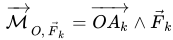
M
→
O
,
F
→
k
=
O
A
k
→
∧
F
→
k
{\displaystyle \;{\overrightarrow {\mathcal {M}}}_{O,\,{\vec {F}}_{k}}={\overrightarrow {OA_{k}}}\wedge {\vec {F}}_{k}}
{
{\displaystyle \;{\Big \{}}
égale à la forme donnée dans l'éléments de réduction du torseur glisseur par
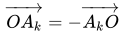
O
A
k
→
=
−
A
k
O
→
{\displaystyle \;{\overrightarrow {OA_{k}}}=-{\overrightarrow {A_{k}O}}\;}
et anticommutativité de la multiplication vectorielle
[
{\displaystyle \;{\big [}}
voir le paragraphe « propriétés de la multiplication vectorielle » du chap.
7
{\displaystyle 7}
de la leçon « Outils mathématiques pour la physique (PCSI) »
]
}
{\displaystyle {\big ]}{\Big \}}}
, la raison de ce choix reposant sur la volonté de faire apparaître
O
A
k
→
{\displaystyle \;{\overrightarrow {OA_{k}}}\;}
le vecteur position du point
A
k
{\displaystyle \;A_{k}}
.
↑ Le point
O
{\displaystyle \;O\;}
en lequel est effectué la réduction n'est pas indiqué en indice des accolades car les éléments de réduction d'un torseur couple ne dépendent pas de ce point.
↑ Le moment de ce torseur couple sera écrit, en physique, sous la forme
Γ
→
(
l
∈
[
[
i
…
j
]
]
)
=
∑
l
[
[
i
…
j
]
]
O
A
l
→
∧
F
→
l
{\displaystyle \;{\overrightarrow {\Gamma }}_{\left(l\,\in \left[\left[i\,\ldots \,j\right]\right]\right)}=\sum \limits _{l}^{\left[\left[i\,\ldots \,j\right]\right]}{\overrightarrow {OA_{l}}}\wedge {\vec {F}}_{l}}
{
{\displaystyle \;{\Big \{}}
égale à la forme donnée dans l'élément de réduction du torseur couple par
O
A
k
→
=
{\displaystyle \;{\overrightarrow {OA_{k}}}=}
−
A
k
O
→
{\displaystyle -{\overrightarrow {A_{k}O}}\;}
et anticommutativité de la multiplication vectorielle
[
{\displaystyle \;{\big [}}
voir le paragraphe « propriétés (1ère propriété) de la multiplication vectorielle » du chap.
7
{\displaystyle 7}
de la leçon « Outils mathématiques pour la physique (PCSI) »
]
}
{\displaystyle {\big ]}{\Big \}}}
; nous pouvons vérifier aisément, sous la forme utilisée en physique, l'indépendance du moment du couple relativement au point de réduction, en effet, si nous prenons un autre point
O
′
≠
O
{\displaystyle \;O'\neq O}
, le moment du couple évalué en
O
′
{\displaystyle \;O'\;}
se calcule par
∑
l
[
[
i
…
j
]
]
O
′
A
l
→
∧
F
→
l
=
∑
l
[
[
i
…
j
]
]
[
O
′
O
→
+
O
A
l
→
]
∧
F
→
l
{\displaystyle \;\sum \limits _{l}^{\left[\left[i\,\ldots \,j\right]\right]}{\overrightarrow {O'A_{l}}}\wedge {\vec {F}}_{l}=\sum \limits _{l}^{\left[\left[i\,\ldots \,j\right]\right]}\left[{\overrightarrow {O'O}}+{\overrightarrow {OA_{l}}}\right]\wedge {\vec {F}}_{l}\;}
soit, en utilisant la distributivité de la multiplication vectorielle relativement à l'addition vectorielle,
=
O
′
O
→
∧
[
∑
l
[
[
i
…
j
]
]
F
→
l
]
+
∑
l
[
[
i
…
j
]
]
O
A
l
→
∧
F
→
l
{\displaystyle =\;{\cancel {{\overrightarrow {O'O}}\wedge \left[\sum \limits _{l}^{\left[\left[i\,\ldots \,j\right]\right]}{\vec {F}}_{l}\right]}}\;+\sum \limits _{l}^{\left[\left[i\,\ldots \,j\right]\right]}{\overrightarrow {OA_{l}}}\wedge {\vec {F}}_{l}}
[
{\displaystyle \;{\big [}}
voir le paragraphe « propriétés (2ème propriété) de la multiplication vectorielle » du chap.
7
{\displaystyle 7}
de la leçon « Outils mathématiques pour la physique (PCSI) »
]
{\displaystyle {\big ]}}
.
↑ Ou torseur des actions mécaniques .
↑ Voir le paragraphe « décomposition centrale d'un torseur quelconque » plus haut dans ce chapitre.
↑ 128,0 et 128,1 Le torseur statique est aussi la somme du torseur des actions extérieures s'exerçant sur le système
T
ext
{\displaystyle \;{\mathcal {T}}_{\text{ext}}\;}
et du torseur des actions intérieures au système
T
int
{\displaystyle \;{\mathcal {T}}_{\text{int}}\;}
lequel est le torseur nul d'après le principe des actions réciproques
[
{\displaystyle \;{\big [}}
voir les paragraphes « 1ère conséquence du principe des actions réciproques en dynamique newtonienne, la nullité de la résultante des forces intérieures s'exerçant sur un système de points matériels fermé » du chap.
6
{\displaystyle 6}
de la leçon « Mécanique 1 (PCSI) » et « vecteur moment résultant des forces intérieures s'exerçant sur un système discret fermé de points matériels par rapport à un point origine A quelconque » du chap.
4
{\displaystyle 4}
de la leçon « Mécanique 2 (PCSI) »
]
{\displaystyle {\big ]}}
; la résultante du torseur des actions extérieures
T
ext
{\displaystyle \;{\mathcal {T}}_{\text{ext}}\;}
s'exerçant sur le système, notée en physique
F
→
ext
{\displaystyle \;{\vec {F}}_{\text{ext}}\;}
et appelée « résultante dynamique » est aussi celle du torseur statique
T
stat.
{\displaystyle \;{\mathcal {T}}_{\text{stat.}}}
, le moment évalué en
O
{\displaystyle \;O\;}
du torseur des actions extérieures
T
ext
{\displaystyle \;{\mathcal {T}}_{\text{ext}}\;}
s'exerçant sur le système, noté en physique
M
→
O
,
ext
{\displaystyle \;{\overrightarrow {\mathcal {M}}}_{O,\,{\text{ext}}}\;}
et appelé « moment résultant dynamique » en
O
{\displaystyle \;O\;}
est aussi celui du torseur statique
T
ext
{\displaystyle \;{\mathcal {T}}_{\text{ext}}\;}
au même point
O
{\displaystyle \;O}
; le torseur statique s'écrit donc, en physique

T
ext
+
T
int
=
{
F
→
ext
M
→
O
,
ext
}
O
+
{
F
→
int
=
0
→
M
→
O
,
ext
=
0
→
}
O
=
{
F
→
ext
M
→
O
,
ext
}
O
{\displaystyle \;{\mathcal {T}}_{\text{ext}}+{\mathcal {T}}_{\text{int}}=\left\lbrace {\begin{array}{c}{\vec {F}}_{\text{ext}}\\{\overrightarrow {\mathcal {M}}}_{O,\,{\text{ext}}}\end{array}}\right\rbrace _{O}+\left\lbrace {\begin{array}{c}{\vec {F}}_{\text{int}}={\vec {0}}\\{\overrightarrow {\mathcal {M}}}_{O,\,{\text{ext}}}={\overrightarrow {0}}\end{array}}\right\rbrace _{O}=\left\lbrace {\begin{array}{c}{\vec {F}}_{\text{ext}}\\{\overrightarrow {\mathcal {M}}}_{O,\,{\text{ext}}}\end{array}}\right\rbrace _{O}}
.
↑ Voir le 1er exemple du paragraphe « cas d'un torseur dont la résultante est un vecteur axial (ou pseudo-vecteur) » plus haut dans ce chapitre.
↑ Voir le paragraphe « définition d'un torseur » plus haut dans ce chapitre.
↑ La relation
A
i
A
j
→
(
t
)
⋅
V
→
A
j
(
t
)
=
A
i
A
j
→
(
t
)
⋅
V
→
A
i
(
t
)
{\displaystyle \;{\overrightarrow {A_{i}A_{j}}}(t)\cdot {\vec {V}}_{A_{j}}(t)={\overrightarrow {A_{i}A_{j}}}(t)\cdot {\vec {V}}_{A_{i}}(t)\;}
s'écrivant encore
V
→
A
j
(
t
)
⋅
A
i
A
j
→
(
t
)
=
V
→
A
i
(
t
)
⋅
A
i
A
j
→
(
t
)
{\displaystyle \;{\vec {V}}_{A_{j}}(t)\cdot {\overrightarrow {A_{i}A_{j}}}(t)={\vec {V}}_{A_{i}}(t)\cdot {\overrightarrow {A_{i}A_{j}}}(t)\;}
par commutativité de la multiplication scalaire de vecteurs, voir le paragraphe « autres propriétés (1ère propriété de la multiplication scalaire) » du chap.
7
{\displaystyle 7}
de la leçon « Outils mathématiques pour la physique (PCSI) ».
↑ Voir le paragraphe notion de résultante d'un torseur plus haut dans le chapitre.
↑ Appelé, dans le domaine de la physique, vecteur « rotation instantanée »
(
{\displaystyle \;{\big (}}
ou parfois, vecteur vitesse angulaire quand on s'intéresse plus particulièrement au mouvement d'un point ou, plus rarement encore, vecteur taux de rotation pour un système indéformable
)
{\displaystyle {\big )}}
.
↑ Le vecteur rotation instantanée
Ω
→
(
t
)
{\displaystyle \;{\overrightarrow {\Omega }}(t)\;}
n'étant pas constant, la direction du support du torseur glisseur ne l'est pas non plus bien qu'ayant un point
A
{\displaystyle \;A\;}
fixe.
↑ En effet la rotation de
(
S
)
{\displaystyle \;({\mathcal {S}})\;}
à l'instant
t
{\displaystyle \;t\;}
se faisant autour du support du torseur cinématique
Δ
T
cinémat. de
(
S
)
(
t
)
{\displaystyle \;\Delta _{{\mathcal {T}}_{{\text{cinémat. de}}\,({\mathcal {S}})}}(t)\;}
de direction variable mais passant par le point fixe
A
{\displaystyle \;A}
, elle se fait autour de ce dernier.
↑ 136,0 et 136,1 Point de
(
S
)
{\displaystyle \;({\mathcal {S}})\;}
non nécessairement fixe sur ce dernier.
↑ 137,0 et 137,1 Appellation personnelle : introduction de la notion de « mouvement inertiel » d'un système de points matériels quand les grandeurs utilisées dépendent à la fois du mouvement du système et de l'inertie de ce dernier qui s'oppose à toute modification de son mouvement.
↑ Voir le 2ème exemple du paragraphe « cas d'un torseur dont la résultante est un vecteur polaire (ou vrai vecteur) » plus haut dans ce chapitre.
↑ Le moment de ce torseur glisseur sera écrit, en physique, sous la forme

σ
→
O
,
A
k
(
t
)
=
O
A
k
→
(
t
)
∧
p
→
k
(
t
)
{\displaystyle \;{\overrightarrow {\sigma }}_{O,\,A_{k}}(t)={\overrightarrow {OA_{k}}}(t)\wedge {\vec {p}}_{k}(t)}
{
{\displaystyle \;{\Big \{}}
égale à la forme donnée dans l'élément de réduction du torseur glisseur par
O
A
k
→
(
t
)
=
{\displaystyle \;{\overrightarrow {OA_{k}}}(t)=}
−
A
k
O
→
(
t
)
{\displaystyle -{\overrightarrow {A_{k}O}}(t)\;}
et anticommutativité de la multiplication vectorielle
[
{\displaystyle \;{\big [}}
voir le paragraphe « propriétés (1ère propriété) de la multiplication vectorielle » du chap.
7
{\displaystyle 7}
de la leçon « Outils mathématiques pour la physique (PCSI) »
]
}
{\displaystyle {\big ]}{\Big \}}}
, la raison de ce choix reposant sur la volonté de faire apparaître
O
A
k
→
{\displaystyle \;{\overrightarrow {OA_{k}}}\;}
le vecteur position du point
A
k
{\displaystyle \;A_{k}}
, et Le moment de ce torseur glisseur sera appelé, en physique, moment cinétique (vectoriel) du point matériel
A
k
{\displaystyle \;A_{k}}
↑ Le moment de ce torseur cinétique sera écrit, en physique, sous la forme
σ
→
O
,
{
A
k
}
(
k
∈
[
[
1
,
n
]
]
,
n
∈
N
∗
∖
{
1
}
)
(
t
)
=
∑
k
O
A
k
→
(
t
)
∧
p
→
k
(
t
)
{\displaystyle \;{\overrightarrow {\sigma }}_{O,\,\left\lbrace A_{k}\right\rbrace _{\left(k\in \left[\left[1\,,\,n\right]\right],\,n\in \mathbb {N} ^{*}\backslash \left\lbrace 1\right\rbrace \right)}}(t)=\sum _{k}{\overrightarrow {OA_{k}}}(t)\wedge {\vec {p}}_{k}(t)}
.
↑ «
σ
→
O
,
{
A
k
}
(
k
∈
[
[
1
,
n
]
]
,
n
∈
N
∗
∖
{
1
}
)
(
t
)
{\displaystyle \;{\overrightarrow {\sigma }}_{O,\,\left\lbrace A_{k}\right\rbrace _{\left(k\in \left[\left[1\,,\,n\right]\right],\,n\in \mathbb {N} ^{*}\backslash \left\lbrace 1\right\rbrace \right)}}(t)\;}
» sera noté simplement «
σ
→
O
(
t
)
{\displaystyle \;{\overrightarrow {\sigma }}_{O}(t)\;}
» en absence d'ambiguïté.
↑ Ou parfois « moment cinétique résultant » au point
O
{\displaystyle \;O}
.
↑ Centre D'Inertie.
↑ Voir le paragraphe « énoncé du lien entre résultante cinétique et vecteur vitesse du centre d'inertie d'un système de points matériels fermé » du chap.
7
{\displaystyle 7}
de la leçon « Mécanique 1 (PCSI) » où on a établi que

P
→
(
t
)
=
m
syst
V
→
G
(
t
)
{\displaystyle \;{\vec {P}}(t)=m_{\text{syst}}\;{\vec {V}}_{G}(t)\;}
dans laquelle
m
syst
=
∑
k
m
k
{\displaystyle \;m_{\text{syst}}=\sum _{k}m_{k}\;}
est la masse du système et
V
→
G
(
t
)
{\displaystyle \;{\vec {V}}_{G}(t)\;}
le vecteur vitesse de son C.D.I.
G
{\displaystyle \;G}
.
↑ Le vecteur résultante cinétique
P
→
(
t
)
{\displaystyle \;{\vec {P}}(t)\;}
n'étant pas constant, la direction du support du torseur glisseur ne l'est pas non plus et il en est de même du point
A
{\displaystyle \;A\;}
non nécessairement fixe.
↑ 146,0 et 146,1 Point de
E
{\displaystyle \;{\mathcal {E}}\;}
non nécessairement fixe dans ce dernier.
↑ En effet
σ
→
A
(
t
)
{\displaystyle \;{\overrightarrow {\sigma }}_{A}(t)\;}
est
∥
{\displaystyle \;\parallel \;}
à
P
→
(
t
)
{\displaystyle \;{\vec {P}}(t)\;}
alors que
B
A
→
∧
P
→
(
t
)
{\displaystyle \;{\overrightarrow {BA}}\wedge {\vec {P}}(t)\;}
est
⊥
{\displaystyle \;\perp \;}
à
P
→
(
t
)
{\displaystyle \;{\vec {P}}(t)}
.
↑ Voir le 3ème exemple du paragraphe « cas d'un torseur dont la résultante est un vecteur polaire (ou vrai vecteur) » plus haut dans ce chapitre.
↑ Le moment de ce torseur glisseur sera écrit, en physique, sous la forme

M
→
O
,
p
→
k
˙
(
t
)
=
O
A
k
→
(
t
)
∧
d
p
→
k
d
t
(
t
)
{\displaystyle \;{\overrightarrow {\mathcal {M}}}_{O,\,{\dot {{\vec {p}}_{k}}}}(t)={\overrightarrow {OA_{k}}}(t)\wedge {\dfrac {d{\vec {p}}_{k}}{dt}}(t)}
{
{\displaystyle \;{\bigg \{}}
égale à
d
p
→
k
d
t
(
t
)
∧
A
k
O
→
(
t
)
{\displaystyle \;{\dfrac {d{\vec {p}}_{k}}{dt}}(t)\wedge {\overrightarrow {A_{k}O}}(t)\;}
car
O
A
k
→
(
t
)
=
−
A
k
O
→
(
t
)
{\displaystyle \;{\overrightarrow {OA_{k}}}(t)=-{\overrightarrow {A_{k}O}}(t)\;}
d'une part et la multiplication vectorielle est anticommutative
[
{\displaystyle \;{\big [}}
voir le paragraphe « propriétés de la multiplication vectorielle » du chap.
7
{\displaystyle 7}
de la leçon « Outils mathématiques pour la physique (PCSI) »
]
{\displaystyle {\big ]}\;}
d'autre part
}
{\displaystyle {\bigg \}}}
, la raison de ce choix reposant sur la volonté de faire apparaître
O
A
k
→
{\displaystyle \;{\overrightarrow {OA_{k}}}\;}
le vecteur position du point
A
k
{\displaystyle \;A_{k}}
.
↑ Le moment de ce torseur dynamique sera écrit, en physique, sous la forme
M
→
O
,
{
A
k
,
p
k
→
˙
,
k
∈
[
[
1
,
n
]
]
,
n
∈
N
∗
∖
{
1
}
}
(
t
)
=
∑
k
O
A
k
→
(
t
)
∧
d
p
→
k
d
t
(
t
)
{\displaystyle \;{\overrightarrow {\mathcal {M}}}_{O,\,\left\lbrace A_{k}\,,\,{\dot {\vec {p_{k}}}}\,,\,k\in \left[\left[1\,,\,n\right]\right],\,n\in \mathbb {N} ^{*}\backslash \left\lbrace 1\right\rbrace \right\rbrace }(t)=\sum _{k}{\overrightarrow {OA_{k}}}(t)\wedge {\dfrac {d{\vec {p}}_{k}}{dt}}(t)}
.
↑ «
M
→
O
,
{
A
k
,
p
k
→
˙
,
k
∈
[
[
1
,
n
]
]
,
n
∈
N
∗
∖
{
1
}
}
(
t
)
=
∑
k
O
A
k
→
(
t
)
∧
d
p
→
k
d
t
(
t
)
{\displaystyle \;{\overrightarrow {\mathcal {M}}}_{O,\,\left\lbrace A_{k}\,,\,{\dot {\vec {p_{k}}}}\,,\,k\in \left[\left[1\,,\,n\right]\right],\,n\in \mathbb {N} ^{*}\backslash \left\lbrace 1\right\rbrace \right\rbrace }(t)=\sum _{k}{\overrightarrow {OA_{k}}}(t)\wedge {\dfrac {d{\vec {p}}_{k}}{dt}}(t)\;}
» sera noté simplement «
M
→
O
,
tors. dynam.
(
t
)
{\displaystyle \;{\overrightarrow {\mathcal {M}}}_{O,\,{\text{tors. dynam.}}}(t)\;}
» en absence d'ambiguïté.
↑ Ce que je désapprouve car je réserve déjà l'appellation « moment résultant dynamique » au moment du torseur statique
{
{\displaystyle \;{\Big \{}}
en fait, si le système de points matériels est fermé, le théorème du moment cinétique vectoriel appliquée au système
[
{\displaystyle \;{\big [}}
voir le paragraphe « théorème du moment cinétique vectoriel appliqué à un système discret de points matériels dans le référentiel d'étude galiléen en
O
{\displaystyle \;O\;}
fixe » du chap.
5
{\displaystyle 5}
de la leçon « Mécanique 2 (PCSI) »
]
{\displaystyle {\big ]}\;}
nous établit que le moment résultant du torseur statique en un point fixe est égale au moment résultant du torseur dynamique et par suite la confusion pourrait être faite dans le cas d'un système fermé avec
O
{\displaystyle \;O\;}
fixe, toutefois, comme la confusion n'est plus possible dans les autres cas, je préfère dire « moment du torseur dynamique » pour nommer
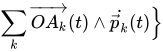
∑
k
O
A
k
→
(
t
)
∧
p
→
k
˙
(
t
)
}
{\displaystyle \sum _{k}{\overrightarrow {OA_{k}}}(t)\wedge {\dot {{\vec {p}}_{k}}}(t){\Big \}}}
.
↑ En tenant compte des remarques développées dans la note « 128 ».
↑ La raison pour laquelle ceci ne peut pas être étendu à un système de points matériels fermé déformable alors que l'expression du torseur statique reste valable La raison pour laquelle ceci ne peut pas être étendu à un système de points matériels fermé déformable est que celle du torseur cinématique est exclusivement réservée à un système indéformable La raison pour laquelle ceci ne peut pas être étendu à un système de points matériels fermé déformable est que celle du torseur
(
{\displaystyle {\big (}}
nécessité pour que le champ des vitesses soit équiprojectif
)
{\displaystyle {\big )}}
; s'il est licite de réduire l'ensemble des actions mécaniques s'exerçant sur un système déformable aux actions extérieures car la résultante et le moment résultant des actions intérieures sont nuls, dès qu'on envisage un mouvement accompagné d'une déformation, la puissance des actions intérieures n'étant plus nulle ne doit plus être omise, ceci se traduisant par le fait que les éléments de réduction du torseur cinématique écrits pour un solide sont insuffisants pour un système déformable car ils ne traduisent pas les mouvements relatifs internes
…
{\displaystyle \;\ldots }