Début de la boite de navigation du chapitre
fin de la boite de navigation du chapitre
En raison de limitations techniques, la typographie souhaitable du titre, «
Fonction dérivée : Dérivée d'un quotient
Fonction dérivée/Dérivée d'un quotient », n'a pu être restituée correctement ci-dessus.
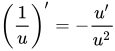
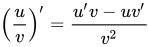
Début d’un théorème
Fin du théorème
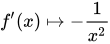
Début de l'exemple
Dérivée de la fonction inverse
Fin de l'exemple
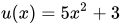
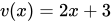
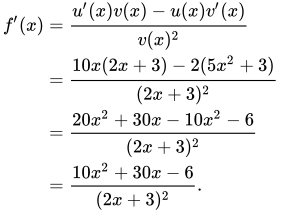
On souhaite dériver la fonction 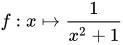 , définie sur
  .
.
Pour tout  :
:


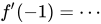 .
.
On souhaite dériver la fonction 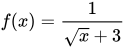 , définie sur
  .
.
Pour tout  :
:
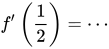 .
.
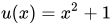
Solution
Pour tout  ,
, 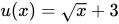 .
.
 est dérivable sur
 ![{\displaystyle \color {red}]\color {black}0,+\infty [}](https://wikimedia.org/api/rest_v1/media/math/render/svg/7e6839717bba2c5a324a5e3090ed822a29f6b755) et, pour tout
et, pour tout ![{\displaystyle x\in \color {red}]\color {black}0,+\infty [}](https://wikimedia.org/api/rest_v1/media/math/render/svg/993f866280c85d11e5fcc6767cddd0f8a397b89b) :
:
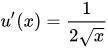 .
.
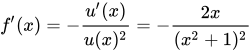
ne s'annule pas sur ![{\displaystyle ]0,+\infty [}](https://wikimedia.org/api/rest_v1/media/math/render/svg/e91ea5ab8b69e30f90c2bdf5db4b620815bde815) donc, d’après le théorème,
donc, d’après le théorème,  est dérivable sur et, pour tout
 ![{\displaystyle x\in ]0,+\infty [}](https://wikimedia.org/api/rest_v1/media/math/render/svg/6be0f8a2cc4631bf6a880eb1b0291ad20cd9628f) :
:
 .
. .
.
Début d’un théorème
Fin du théorème
Démonstration
On peut montrer facilement cette formule à partir de la précédente :
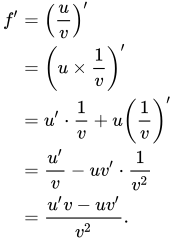
On souhaite dériver la fonction 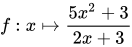 définie sur
 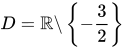 .
.
Pour tout  :
:


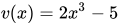
On souhaite dériver la fonction 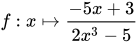 , définie sur
 ![{\displaystyle D=\mathbb {R} \backslash \left\{{\sqrt[{3}]{\frac {5}{2}}}\right\}}](https://wikimedia.org/api/rest_v1/media/math/render/svg/8fad0dad81e505774dcd7adc45da8cfd1581b2c8) .
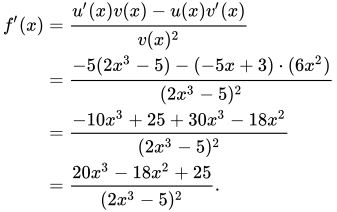
.
Pour tout :