

Application linéaire/Propriétés générales


Soient E, F et G trois K-espaces vectoriels.
Injectivité, surjectivité[modifier | modifier le wikicode]
Puisqu'une application linéaire de E dans F est un cas particulier de morphisme de groupes de (E, +) dans (F, +), on a la caractérisation ci-dessous de son injectivité (quant à la caractérisation de la surjectivité, elle est tautologique).

Soit .

- u est injective si et seulement si Ker(u) = {0}.
- u est surjective si et seulement si Im(u) = F.
Image d'une base[modifier | modifier le wikicode]
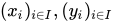
Une base de étant fixée, une application est entièrement déterminée par la famille de vecteurs de . Plus précisément :


Pour toute base de , l'application

est bijective.
Il s'agit de démontrer que cette application (linéaire) de dans est bijective, c'est-à-dire que pour toute famille de vecteurs de , il existe une unique application linéaire telle que .



- Unicité. Soit une telle application. Pour tout vecteur de , si désigne la famille presque nulle de ses coordonnées dans la base , on a (par linéarité de ) :
,
ce qui détermine complètement . - Existence. Soit définie en chaque vecteur de par la formule ci-dessus. Pour tout indice , en appliquant cette formule à , on trouve bien . D'autre part, est bien linéaire car pour tous vecteurs de , de coordonnées dans , et pour tout scalaire , la définition de donne :
- .








Par conséquent, toutes les propriétés de doivent pouvoir « se lire sur » l'image d'une base par . Pour l'injectivité ou la surjectivité, cette « lecture » est simple :
Soit .
- est surjective si et seulement si l'image par d'au moins une famille génératrice de est génératrice de (de plus, l'image par de toute famille qui engendre est alors génératrice de ) ;
- est injective si et seulement si l'image par d'au moins une base de est libre (de plus, l'image par de toute famille libre est alors libre) ;
- est un isomorphisme si et seulement si l'image par d'au moins une base (ou de toute base) de est une base de .
- Les assertions concernant la surjectivité viennent simplement du fait que pour toute famille qui engendre , .
- Supposons injective et libre. Alors, pour toute famille presque nulle de scalaires, , ce qui prouve que est libre.
- Supposons maintenant qu'il existe une base de dont l'image par est libre. Alors, pour tout , de coordonnées dans cette base, , donc , ce qui prouve que est injective.







Propriétés de L(E, F)[modifier | modifier le wikicode]
À partir d'ici, le corps K des scalaires est supposé commutatif.
Structure d'espace vectoriel[modifier | modifier le wikicode]
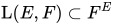
est un K-espace vectoriel.
Montrons que est un sous-espace vectoriel de FE.
- L'application nulle appartient à
- Soit


Donc .

Finalement, est un sous-espace vectoriel de FE, donc est un K-espace vectoriel.

En particulier, si F est aussi de dimension finie alors L(E, F) l'est également.
Soit . On utilise la bijection de sur fournie par le choix d'une base de (voir supra). Puisque K est supposé commutatif, est un K-espace vectoriel et cette bijection est linéaire donc est un isomorphisme. On en déduit :


- .

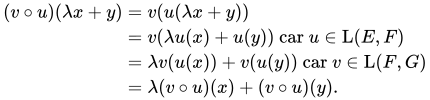
Si et , alors .


Soit .

Donc .
Composition[modifier | modifier le wikicode]

La linéarité par rapport à v est tautologique, et celle par rapport à u est due à la linéarité de v.
Linéarité des inverses[modifier | modifier le wikicode]
La réciproque d'une bijection linéaire est linéaire.
Soit une bijection linéaire. Soient et . Par linéarité de , on a


- ,

ce qui prouve que donc est linéaire.


Structure d'algèbre[modifier | modifier le wikicode]


est un -espace vectoriel et est bilinéaire (et bien sûr associative), donc est une -algèbre associative. De plus, est neutre pour .




En particulier, est un anneau unifère.


