Une page de Wikiversité, la communauté pédagogique libre.
Début de la boite de navigation du chapitre
fin de la boite de navigation du chapitre
En raison de limitations techniques, la typographie souhaitable du titre, «
Fonction logarithme : Propriétés algébriques du logarithme Fonction logarithme/Propriétés algébriques du logarithme », n'a pu être restituée correctement ci-dessus.
Le logarithme népérien étant la primitive de la fonction inverse définie sur
]
0
,
+
∞
[
{\displaystyle \left]0,+\infty \right[}
1
{\displaystyle 1}
Début d’un théorème
Théorème
∀
a
,
b
∈
]
0
,
+
∞
[
ln
(
a
b
)
=
ln
(
a
)
+
ln
(
b
)
{\displaystyle \forall a,b\in \left]0,+\infty \right[\quad \ln(ab)=\ln(a)+\ln(b)}
.
Fin du théorème
Démonstration
Pour
a
>
0
{\displaystyle a>0}
dérivée de la fonction composée
x
↦
ln
(
a
x
)
{\displaystyle x\mapsto \ln(ax)}
]
0
,
+
∞
[
{\displaystyle \left]0,+\infty \right[}
x
↦
ln
′
(
a
x
)
=
a
a
x
=
1
x
=
ln
′
(
x
)
{\displaystyle x\mapsto \ln '(ax)={\frac {a}{ax}}={\frac {1}{x}}=\ln '(x)}
Il existe une constante réelle
k
{\displaystyle k}
∀
x
>
0
ln
(
a
x
)
=
k
+
ln
(
x
)
{\displaystyle \forall x>0\quad \ln(ax)=k+\ln(x)}
Pour
x
=
1
{\displaystyle x=1}
ln
(
a
.1
)
=
k
+
ln
(
1
)
{\displaystyle \ln(a.1)=k+\ln(1)}
Ainsi :
ln
(
a
)
=
k
{\displaystyle \ln(a)=k}
Donc :
∀
x
>
0
ln
(
a
x
)
=
ln
(
a
)
+
ln
(
x
)
⟺
∀
a
,
b
>
0
ln
(
a
.
b
)
=
ln
(
a
)
+
ln
(
b
)
{\displaystyle \forall x>0\quad \ln(ax)=\ln(a)+\ln(x)\Longleftrightarrow \forall a,b>0\quad \ln(a.b)=\ln(a)+\ln(b)}
CQFD
Début de l'exemple
Exemple
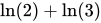
Calculer séparément à la calculatrice :
ln
(
2
)
+
ln
(
3
)
{\displaystyle \ln(2)+\ln(3)}
ln
(
6
)
{\displaystyle \ln(6)}
Fin de l'exemple
r
=
p
/
q
{\displaystyle r=p/q}
p
{\displaystyle p}
q
{\displaystyle q}
a
p
/
q
{\displaystyle a^{p/q}}
a
p
q
=
(
a
q
)
p
{\displaystyle {\sqrt[{q}]{a^{p}}}=\left({\sqrt[{q}]{a}}\right)^{p}}




![{\displaystyle \left]0,+\infty \right[}](https://wikimedia.org/api/rest_v1/media/math/render/svg/010ebc9c2d0f3af5ce1c0594c44823f107968561)


![{\displaystyle \forall a,b\in \left]0,+\infty \right[\quad \ln(ab)=\ln(a)+\ln(b)}](https://wikimedia.org/api/rest_v1/media/math/render/svg/172f941fb3bdd521849a9e17f87a601622da2ca8)













![{\displaystyle {\sqrt[{q}]{a^{p}}}=\left({\sqrt[{q}]{a}}\right)^{p}}](https://wikimedia.org/api/rest_v1/media/math/render/svg/2946fcad281655c59981f9ba3fa66630e5bc1e72)

