Début de la boite de navigation du chapitre
fin de la boite de navigation du chapitre
En raison de limitations techniques, la typographie souhaitable du titre, «
Cinématique (Expert) : Géométrie des systèmes mécaniques Cinématique (Expert)/Géométrie des systèmes mécaniques », n'a pu être restituée correctement ci-dessus.
Dans un problème de mécanique, on a souvent besoin de trouver :
Le positionnement d'un solide par rapport au solide de référence.
Le positionnement d'un solide S par rapport à un autre solide, car les deux solides appartiennent au système mécanique étudié.
Le positionnement d'un centre de liaison et de son axe de direction.
On connait la position du point A au sein d'un solide S₁ (elle ne change pas au cours du temps) :
O
1
A
→
=
x
1
i
→
1
+
y
1
j
→
1
+
z
1
k
→
1
{\displaystyle {\overrightarrow {O_{1}A}}=x_{1}{\vec {i}}_{1}+y_{1}{\vec {j}}_{1}+z_{1}{\vec {k}}_{1}}
On souhaite savoir la position du point A par rapport au repère de référence R₀ de centre O :
O
A
→
=
x
i
→
+
y
j
→
+
z
k
→
{\displaystyle {\overrightarrow {OA}}=x{\vec {i}}+y{\vec {j}}+z{\vec {k}}}
Pour parvenir à exprimer le vecteur
O
A
→
{\displaystyle {\overrightarrow {OA}}}
relation de Chasles :
O
A
→
=
O
O
1
→
+
O
1
A
→
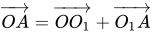
{\displaystyle {\overrightarrow {OA}}={\overrightarrow {OO_{1}}}+{\overrightarrow {O_{1}A}}}
Liberté entre deux solides :
3 translations
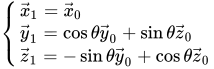
3 rotations Le problème du changement de base intervient lors de rotations entre différentes bases (systèmes d'axes).
À l'instant
t
=
0
{\displaystyle t=0}
t₀ ), nous observons un solide S₁ muni d'un repère
R
1
(
O
1
,
x
1
→
,
y
1
→
,
z
1
→
)
{\displaystyle R_{1}(O_{1},{\vec {x_{1}}},{\vec {y_{1}}},{\vec {z_{1}}})}
R
0
(
O
0
,
x
0
→
,
y
0
→
,
z
0
→
)
{\displaystyle R_{0}(O_{0},{\vec {x_{0}}},{\vec {y_{0}}},{\vec {z_{0}}})}
On considère un point
A
(
t
0
)
{\displaystyle A(t_{0})}
A
(
t
1
)
{\displaystyle A(t_{1})}
A entre l'instant
(
t
0
)
{\displaystyle (t_{0})}
(
t
1
)
{\displaystyle (t_{1})}
Le déplacement du point A appartenant au solide S₁ entre les instants
t
0
{\displaystyle t_{0}}
t
1
{\displaystyle t_{1}}
D
(
A
)
→
=
A
(
t
0
)
A
(
t
1
)
→
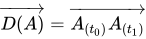
{\displaystyle {\overrightarrow {D(A)}}={\overrightarrow {A_{(t_{0})}A_{(t_{1})}}}}
D
(
A
)
→
=
A
(
t
0
)
O
→
+
O
A
(
t
1
)
→
{\displaystyle {\overrightarrow {D(A)}}={\overrightarrow {A_{(t_{0})}O}}+{\overrightarrow {OA_{(t_{1})}}}}
D
(
A
)
→
=
−
O
A
(
t
0
)
→
+
O
A
(
t
1
)
→
{\displaystyle {\overrightarrow {D(A)}}=-{\overrightarrow {OA_{(t_{0})}}}+{\overrightarrow {OA_{(t_{1})}}}}
Début d’un théorème
Bilan
Pour connaître le déplacement du point A , il suffit de connaître :
la position du point A à l'instant
(
t
0
)
{\displaystyle (t_{0})}
la position du point A à l'instant
(
t
1
)
{\displaystyle (t_{1})}
Fin du théorème
Position du point A à l'instant
(
t
1
)
{\displaystyle (t_{1})}
[ modifier | modifier le wikicode ] La position du point A à l'instant
(
t
1
)
{\displaystyle (t_{1})}
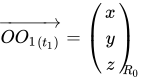
O
A
(
t
1
)
→
|
R
0
=
O
O
1
(
t
1
)
→
|
R
0
+
O
1
A
(
t
1
)
→
|
R
1
{\displaystyle {\overrightarrow {OA_{(t_{1})}}}{\Big |}_{R_{0}}={\overrightarrow {O{O_{1}}_{(t_{1})}}}{\Big |}_{R_{0}}+{\overrightarrow {O_{1}A_{(t_{1})}}}{\Big |}_{R_{1}}}
On peut remarquer que dans l'équation écrite un peu plus haut, on veut soustraire deux vecteurs appartenant à des bases différentes (
R
0
{\displaystyle R_{0}}
R
1
{\displaystyle R_{1}}
Pour résoudre ce problème on devra utiliser la matrice de passage entre
R
0
{\displaystyle R_{0}}
R
1
{\displaystyle R_{1}}
O
1
A
(
t
1
)
→
{\displaystyle {\overrightarrow {O_{1}A_{(t_{1})}}}}
R
1
{\displaystyle R_{1}}
R
0
{\displaystyle R_{0}}
O
1
A
(
t
1
)
→
|
R
0
=
P
[
R
0
→
R
1
]
O
1
A
(
t
1
)
→
|
R
1
{\displaystyle {\overrightarrow {O_{1}A_{(t_{1})}}}{\Big |}_{R_{0}}=\mathbb {P} _{[R_{0}\rightarrow R_{1}]}\ {\overrightarrow {O_{1}A_{(t_{1})}}}{\Big |}_{R_{1}}}
On peut maintenant réécrire l’expression générale du déplacement du point A .
Définition
D
(
A
)
→
=
P
[
R
0
→
R
1
]
O
1
A
(
t
1
)
→
−
O
A
(
t
0
)
→
+
O
O
1
(
t
1
)
→
{\displaystyle {\overrightarrow {D(A)}}=\mathbb {P} _{[R_{0}\rightarrow R_{1}]}\ {\overrightarrow {O_{1}A_{(t_{1})}}}-{\overrightarrow {OA_{(t_{0})}}}+{\overrightarrow {O{O_{1}}_{(t_{1})}}}}
R
0
{\displaystyle R_{0}}
O
A
(
t
0
)
→
=
(
x
a
y
a
z
a
)
R
0
=
O
1
A
(
t
1
)
→
=
(
x
a
y
a
z
a
)
R
1
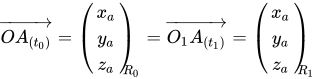
{\displaystyle {\overrightarrow {OA_{(t_{0})}}}={\begin{pmatrix}x_{a}\\y_{a}\\z_{a}\end{pmatrix}}_{\!\!\!\!R_{0}}={\overrightarrow {{O_{1}}A_{(t_{1})}}}={\begin{pmatrix}x_{a}\\y_{a}\\z_{a}\end{pmatrix}}_{\!\!\!\!R_{1}}}
Les deux repères sont coïncidents pour
t
=
0
{\displaystyle t=0}
O
O
1
(
t
1
)
→
=
(
x
y
z
)
R
0
{\displaystyle {\overrightarrow {O{O_{1}}_{(t_{1})}}}={\begin{pmatrix}x\\y\\z\end{pmatrix}}_{\!\!\!\!R_{0}}}
On peut maintenant remplacer les vecteurs par leurs composantes :
Début d’un théorème
Formule générale
D
(
A
)
→
=
(
x
y
z
)
+
P
[
R
0
→
R
1
]
(
x
a
y
a
z
a
)
−
(
x
a
y
a
z
a
)
{\displaystyle {\overrightarrow {D(A)}}={\begin{pmatrix}x\\y\\z\end{pmatrix}}+\mathbb {P} _{[R_{0}\rightarrow R_{1}]}\ {\begin{pmatrix}x_{a}\\y_{a}\\z_{a}\end{pmatrix}}\ -{\begin{pmatrix}x_{a}\\y_{a}\\z_{a}\end{pmatrix}}}
Fin du théorème
Relation entre les déplacements de deux points d'un solide S₁ [ modifier | modifier le wikicode ] Considérons un point C tel que :
O
1
C
t
1
→
=
x
c
i
1
→
+
y
c
j
1
→
+
z
c
k
1
→
{\displaystyle {\overrightarrow {O_{1}C_{t_{1}}}}=x_{c}{\overrightarrow {i_{1}}}+y_{c}{\overrightarrow {j_{1}}}+z_{c}{\overrightarrow {k_{1}}}}
Si nous appliquons la relation générale du déplacement, le vecteur
D
(
C
)
→
|
R
0
{\displaystyle {\overrightarrow {D(C)}}|_{R_{0}}}
D
(
C
)
→
=
(
x
−
x
c
y
−
y
c
z
−
z
c
)
+
P
[
R
0
→
R
1
]
×
(
x
c
y
c
z
c
)
{\displaystyle {\overrightarrow {D(C)}}={\begin{pmatrix}x-x_{c}\\y-y_{c}\\z-z_{c}\end{pmatrix}}+\mathbb {P} _{[R_{0}\rightarrow R_{1}]}\times {\begin{pmatrix}x_{c}\\y_{c}\\z_{c}\end{pmatrix}}}
Pour déterminer la relation qui existe entre les déplacements de deux points d'un solide, nous observons la différence des déplacements.
D
(
C
)
→
−
D
(
A
)
→
]
|
R
0
=
(
x
a
−
x
c
y
a
−
y
c
z
a
−
z
c
)
+
P
[
R
0
→
R
1
]
×
(
x
c
−
x
a
y
c
−
y
a
z
c
−
z
a
)
{\displaystyle {\overrightarrow {D(C)}}-{\overrightarrow {D(A)}}]|_{R_{0}}={\begin{pmatrix}x_{a}-x_{c}\\y_{a}-y_{c}\\z_{a}-z_{c}\end{pmatrix}}+\mathbb {P} _{[R_{0}\rightarrow R_{1}]}\times {\begin{pmatrix}x_{c}-x_{a}\\y_{c}-y_{a}\\z_{c}-z_{a}\end{pmatrix}}}
En écriture matricielle :
D
(
C
)
→
−
D
(
A
)
→
|
R
0
=
[
P
[
R
0
→
R
1
]
−
1
]
×
(
x
c
−
x
a
y
c
−
y
a
z
c
−
z
a
)
{\displaystyle {\overrightarrow {D(C)}}-{\overrightarrow {D(A)}}|_{R_{0}}=[\mathbb {P} _{[R_{0}\rightarrow R_{1}]}-1]\times {\begin{pmatrix}x_{c}-x_{a}\\y_{c}-y_{a}\\z_{c}-z_{a}\end{pmatrix}}}
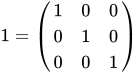
On a noté 1 la matrice identité:
1
=
(
1
0
0
0
1
0
0
0
1
)
{\displaystyle 1={\begin{pmatrix}1&0&0\\0&1&0\\0&0&1\end{pmatrix}}}
Dans ce cas, on a :
Début d’un théorème
Relation entre les déplacements
Fin du théorème
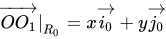
La position du solide à l'instant
t
1
{\displaystyle t_{1}}
O
O
1
→
|
R
0
=
x
i
0
→
+
y
j
0
→
{\displaystyle {\overrightarrow {OO_{1}}}|_{R_{0}}=x{\overrightarrow {i_{0}}}+y{\overrightarrow {j_{0}}}}
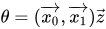
La position angulaire est donnée par l'angle
θ
{\displaystyle \theta }
θ
=
(
x
0
→
,
x
1
→
)
z
→
{\displaystyle \theta =({\overrightarrow {x_{0}}},{\overrightarrow {x_{1}}}){\vec {z}}}
Remarque
Les variables x et y constituent deux paramètres,
θ
{\displaystyle \theta }
Dans le cas d'un système plan, il est intéressant de donner les formules ci-dessus en fonction de la matrice rotation :
Rappel
P
[
0
→
1
]
=
(
cos
θ
−
sin
θ
0
sin
θ
cos
θ
0
0
0
1
)
{\displaystyle \mathbb {P} _{[0\rightarrow 1]}={\begin{pmatrix}\cos \theta &-\sin \theta &0\\\sin \theta &\cos \theta &0\\0&0&1\end{pmatrix}}}
Dans le plan, la matrice peut s'écrire :
P
[
0
→
1
]
=
(
cos
θ
−
sin
θ
sin
θ
cos
θ
)
{\displaystyle \mathbb {P} _{[0\rightarrow 1]}={\begin{pmatrix}\cos \theta &-\sin \theta \\\sin \theta &\cos \theta \end{pmatrix}}}
O
1
A
(
t
0
)
→
=
x
a
i
1
→
+
y
a
j
1
→
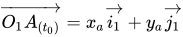
{\displaystyle {\overrightarrow {O_{1}A_{(t_{0})}}}=x_{a}{\overrightarrow {i_{1}}}+y_{a}{\overrightarrow {j_{1}}}}
O
0
A
(
t
1
)
→
=
(
x
y
)
+
P
[
0
→
1
]
×
(
x
a
y
a
)
{\displaystyle {\overrightarrow {O_{0}A_{(t_{1})}}}={\begin{pmatrix}x\\y\end{pmatrix}}+\mathbb {P} _{[0\rightarrow 1]}\times {\begin{pmatrix}x_{a}\\y_{a}\end{pmatrix}}}
x et y sont les coordonnées de
O
1
{\displaystyle O_{1}}
O
1
A
t
1
→
=
O
1
A
t
0
→
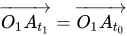
{\displaystyle {\overrightarrow {O_{1}A_{t_{1}}}}={\overrightarrow {O_{1}A_{t_{0}}}}}
Début d’un théorème
Déplacement d'un point
D
(
A
)
→
=
(
x
−
x
a
y
−
y
a
)
+
P
[
0
→
1
]
×
(
x
a
y
a
)
{\displaystyle {\overrightarrow {D(A)}}={\begin{pmatrix}x-x_{a}\\y-y_{a}\end{pmatrix}}+\mathbb {P} _{[0\rightarrow 1]}\times {\begin{pmatrix}x_{a}\\y_{a}\end{pmatrix}}}
Fin du théorème
Relation entre les déplacements de deux points d'un solide S₁ [ modifier | modifier le wikicode ] Début d’un théorème
Relation entre les déplacements de deux points
Fin du théorème
Surtout valable pour de petites rotations.
Étude dans le cas d'un problème plan puis généralisation. Nous considérons une rotation
θ
{\displaystyle \theta }
z
→
{\displaystyle {\vec {z}}}
A et C , nous avons observé :
D
(
C
)
→
−
D
(
A
)
→
|
R
0
=
(
cos
θ
−
1
−
sin
θ
sin
θ
cos
θ
−
1
)
×
(
x
c
−
x
a
y
c
−
y
a
)
{\displaystyle {\overrightarrow {D(C)}}-{\overrightarrow {D(A)}}|_{R_{0}}={\begin{pmatrix}\cos \theta -1&-\sin \theta \\\sin \theta &\cos \theta -1\end{pmatrix}}\times {\begin{pmatrix}x_{c}-x_{a}\\y_{c}-y_{a}\end{pmatrix}}}
Supposons que le déplacement
θ
{\displaystyle \theta }
δ
θ
{\displaystyle \delta \theta }
δ
A
→
{\displaystyle {\overrightarrow {\delta A}}}
δ
C
→
{\displaystyle {\overrightarrow {\delta C}}}
δ
C
→
−
δ
A
→
=
(
cos
δ
θ
−
1
−
sin
δ
θ
sin
δ
θ
cos
δ
θ
−
1
)
×
(
x
c
−
x
a
y
c
−
y
a
)
{\displaystyle {\overrightarrow {\delta C}}-{\overrightarrow {\delta A}}={\begin{pmatrix}\cos \delta \theta -1&-\sin \delta \theta \\\sin \delta \theta &\cos \delta \theta -1\end{pmatrix}}\times {\begin{pmatrix}x_{c}-x_{a}\\y_{c}-y_{a}\end{pmatrix}}}
On rappelle le développement limité d'une fonction de x , pour x autour de 0 :
f
(
x
)
=
f
(
0
)
+
x
f
′
(
0
)
+
x
2
2
!
f
″
(
0
)
+
x
3
3
!
f
‴
(
0
)
+
…
{\displaystyle f(x)=f(0)+xf'(0)+{\frac {x^{2}}{2!}}f''(0)+{\frac {x^{3}}{3!}}f'''(0)+\ldots }
En utilisant cette formule pour les fonctions sinus et cosinus, on obtient :
sin
x
=
x
−
x
3
3
!
⟹
sin
δ
x
=
δ
x
−
δ
x
3
3
!
{\displaystyle \sin x=x-{\frac {x^{3}}{3!}}\Longrightarrow \sin \delta x=\delta x-{\frac {\delta x^{3}}{3!}}}
cos
x
=
1
−
x
2
2
!
⟹
cos
δ
x
=
1
−
δ
x
2
2
!
{\displaystyle \cos x=1-{\frac {x^{2}}{2!}}\Longrightarrow \cos \delta x=1-{\frac {\delta x^{2}}{2!}}}
Si on approche aux dérivées de 1er ordre, on retrouve ainsi :
sin
δ
θ
≈
δ
θ
{\displaystyle \sin \delta \theta \approx \delta \theta \,}
cos
δ
θ
≈
1
{\displaystyle \cos \delta \theta \approx 1\,}
On a donc :
Début d’un théorème
Approximation des petits déplacements
δ
C
→
−
δ
A
→
=
(
0
−
δ
θ
δ
θ
0
)
×
(
x
c
−
x
a
y
c
−
y
a
)
{\displaystyle {\overrightarrow {\delta C}}-{\overrightarrow {\delta A}}={\begin{pmatrix}0&-\delta \theta \\\delta \theta &0\end{pmatrix}}\times {\begin{pmatrix}x_{c}-x_{a}\\y_{c}-y_{a}\end{pmatrix}}}
Fin du théorème
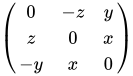
V
→
(
x
y
z
)
{\displaystyle {\vec {V}}~{\begin{pmatrix}x\\y\\z\end{pmatrix}}}
(
0
−
z
y
z
0
x
−
y
x
0
)
{\displaystyle {\begin{pmatrix}0&-z&y\\z&0&x\\-y&x&0\end{pmatrix}}}
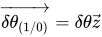
Posons maintenant un vecteur de petite rotation :
δ
θ
(
1
/
0
)
→
=
δ
θ
z
→
{\displaystyle {\overrightarrow {\delta \theta _{(1/0)}}}=\delta \theta {\vec {z}}}
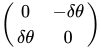
Sa matrice associée est :
(
0
−
δ
θ
δ
θ
0
)
{\displaystyle {\begin{pmatrix}0&-\delta \theta \\\delta \theta &0\end{pmatrix}}}
En utilisant les nouvelles notations, on peut écrire :
δ
C
→
−
δ
A
→
=
δ
θ
(
1
/
0
)
→
∧
A
C
→
{\displaystyle {\overrightarrow {\delta C}}-{\overrightarrow {\delta A}}={\overrightarrow {\delta \theta _{(1/0)}}}\wedge {\overrightarrow {AC}}}
δ
C
→
=
δ
A
→
+
A
C
→
∧
δ
θ
(
1
/
0
)
→
{\displaystyle {\overrightarrow {\delta C}}={\overrightarrow {\delta A}}+{\overrightarrow {AC}}\wedge {\overrightarrow {\delta \theta _{(1/0)}}}}
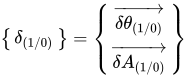
Nous sommes en présence d'un torseur de petit déplacement :
Début d’un théorème
Torseur des petits déplacements
{
δ
(
1
/
0
)
}
=
{
δ
θ
(
1
/
0
)
→
δ
A
(
1
/
0
)
→
}
{\displaystyle {\begin{Bmatrix}\delta _{(1/0)}\end{Bmatrix}}={\begin{Bmatrix}{\overrightarrow {\delta \theta _{(1/0)}}}\\{\overrightarrow {\delta A_{(1/0)}}}\end{Bmatrix}}}
Fin du théorème












![{\displaystyle \Longrightarrow \mathbb {P} _{[R_{0}\rightarrow R_{1}]}={\begin{pmatrix}1&0&0\\0&\cos \theta &\sin \theta \\0&-\sin \theta &\cos \theta \end{pmatrix}}}](https://wikimedia.org/api/rest_v1/media/math/render/svg/08134edea2e00134cd4aef788a76eb202925b715)

![{\displaystyle \mathbb {P} _{[R_{1}\rightarrow R_{0}]}=\mathbb {P} _{[R_{0}\rightarrow R_{1}]}^{-1}=\mathbb {P} _{[R_{0}\rightarrow R_{1}]}^{t}}](https://wikimedia.org/api/rest_v1/media/math/render/svg/4b9fe36463b24ecc7c6cf325c81d01fdf417c84f)











![{\displaystyle {\overrightarrow {V}}{\Big |}_{R_{0}}=\mathbb {P} _{[R_{0}\rightarrow R_{1}]}\ {\overrightarrow {V}}{\Big |}_{R_{1}}}](https://wikimedia.org/api/rest_v1/media/math/render/svg/76b8703f7ab318992dd484ff3b871883032b2632)

![{\displaystyle {\overrightarrow {O_{1}A_{(t_{1})}}}{\Big |}_{R_{0}}=\mathbb {P} _{[R_{0}\rightarrow R_{1}]}\ {\overrightarrow {O_{1}A_{(t_{1})}}}{\Big |}_{R_{1}}}](https://wikimedia.org/api/rest_v1/media/math/render/svg/6cfd1006002c2b0a91a44759d1bcf1d907d4527e)
![{\displaystyle {\overrightarrow {D(A)}}=\mathbb {P} _{[R_{0}\rightarrow R_{1}]}\ {\overrightarrow {O_{1}A_{(t_{1})}}}-{\overrightarrow {OA_{(t_{0})}}}+{\overrightarrow {O{O_{1}}_{(t_{1})}}}}](https://wikimedia.org/api/rest_v1/media/math/render/svg/2fd2c1ba6cd9661c3d981649bf6b4dc1cbf4812f)
![{\displaystyle {\overrightarrow {D(A)}}={\begin{pmatrix}x\\y\\z\end{pmatrix}}+\mathbb {P} _{[R_{0}\rightarrow R_{1}]}\ {\begin{pmatrix}x_{a}\\y_{a}\\z_{a}\end{pmatrix}}\ -{\begin{pmatrix}x_{a}\\y_{a}\\z_{a}\end{pmatrix}}}](https://wikimedia.org/api/rest_v1/media/math/render/svg/029d3b67e63a03dd3726e79cdcc703247ba701ea)


![{\displaystyle {\overrightarrow {D(C)}}={\begin{pmatrix}x-x_{c}\\y-y_{c}\\z-z_{c}\end{pmatrix}}+\mathbb {P} _{[R_{0}\rightarrow R_{1}]}\times {\begin{pmatrix}x_{c}\\y_{c}\\z_{c}\end{pmatrix}}}](https://wikimedia.org/api/rest_v1/media/math/render/svg/7951a3a6cb27f22c11761ff7a636b75d602fe756)
![{\displaystyle {\overrightarrow {D(C)}}-{\overrightarrow {D(A)}}]|_{R_{0}}={\begin{pmatrix}x_{a}-x_{c}\\y_{a}-y_{c}\\z_{a}-z_{c}\end{pmatrix}}+\mathbb {P} _{[R_{0}\rightarrow R_{1}]}\times {\begin{pmatrix}x_{c}-x_{a}\\y_{c}-y_{a}\\z_{c}-z_{a}\end{pmatrix}}}](https://wikimedia.org/api/rest_v1/media/math/render/svg/ad7f04042be6d19405b5c12d9836d7223e66ad6e)
![{\displaystyle {\overrightarrow {D(C)}}-{\overrightarrow {D(A)}}|_{R_{0}}=[\mathbb {P} _{[R_{0}\rightarrow R_{1}]}-1]\times {\begin{pmatrix}x_{c}-x_{a}\\y_{c}-y_{a}\\z_{c}-z_{a}\end{pmatrix}}}](https://wikimedia.org/api/rest_v1/media/math/render/svg/1ef5a52af0f75e00779b70198decbd63d6d2c1c5)
![{\displaystyle [\mathbb {P} _{[R_{0}\rightarrow R_{1}]}-1]={\begin{pmatrix}0&0&0\\0&\cos \theta -1&\sin \theta -1\\0&-\sin \theta -1&\cos \theta -1\end{pmatrix}}}](https://wikimedia.org/api/rest_v1/media/math/render/svg/3d62c4528a91e9d6ff75e1713fa623a302efed1d)




![{\displaystyle \mathbb {P} _{[0\rightarrow 1]}={\begin{pmatrix}\cos \theta &-\sin \theta &0\\\sin \theta &\cos \theta &0\\0&0&1\end{pmatrix}}}](https://wikimedia.org/api/rest_v1/media/math/render/svg/e5b8aa07b703189e84c222039c9fca0cb0395253)
![{\displaystyle \mathbb {P} _{[0\rightarrow 1]}={\begin{pmatrix}\cos \theta &-\sin \theta \\\sin \theta &\cos \theta \end{pmatrix}}}](https://wikimedia.org/api/rest_v1/media/math/render/svg/126c0650c8bef90f24bfdfc5b0bc5155c4ff5b4e)
![{\displaystyle {\overrightarrow {O_{0}A_{(t_{1})}}}={\begin{pmatrix}x\\y\end{pmatrix}}+\mathbb {P} _{[0\rightarrow 1]}\times {\begin{pmatrix}x_{a}\\y_{a}\end{pmatrix}}}](https://wikimedia.org/api/rest_v1/media/math/render/svg/13b6a2e45285e79b3cd5d813119011f00b4f7f52)

![{\displaystyle {\overrightarrow {D(A)}}={\begin{pmatrix}x-x_{a}\\y-y_{a}\end{pmatrix}}+\mathbb {P} _{[0\rightarrow 1]}\times {\begin{pmatrix}x_{a}\\y_{a}\end{pmatrix}}}](https://wikimedia.org/api/rest_v1/media/math/render/svg/e94f306a1d7c3a1974d28cff4c9b4e618aa5bde0)
![{\displaystyle {\overrightarrow {D(C)}}-{\overrightarrow {D(A)}}|_{R_{0}}=[\mathbb {P} _{[0\rightarrow 1]}-1]\times {\begin{pmatrix}x_{c}-x_{a}\\y_{c}-y_{a}\end{pmatrix}}}](https://wikimedia.org/api/rest_v1/media/math/render/svg/5ba1c46a1cbd14cd9ad6f2272fb1e01e4857f1db)












 Faites ces exercices : Matrice de passage, vecteur déplacement.