Disclaimer : Les informations qui suivent ne sont pas dans l'espace wikiversitaire et pourraient ne pas être pertinentes, justes, vérifiées ou logiques. Lisez à vos risques & périls.
On note E et B les champs électrique et magnétique, respectivement. Ces champs sont liés par les quatre équations de Maxwell. En l'absence de charges, elles s'écrivent :



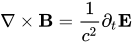
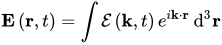
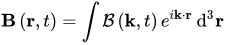
On peut développer ces champs dans l'espace des phases, via la transformée de Fourier, si bien que :
Dans cet espace, l'opérateur nabla peut être réduit à l'opérateur k, de sorte qu'on peut réécrire les équations de Maxwell :


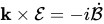
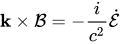
En posant ω = ck, on peut réécrire en manipulant les produits vectoriels cette dernière équation sous la forme :
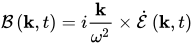
Rapportant cette expression dans la troisième des équations de Maxwell dans l'espace des phases, on obtient :
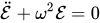
En particulier, pour deux k différents, l'évolution des champs est indépendante. On peut réécrire cette relation :
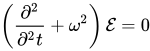
On pose la relation :

Avec N une fonction paire. Alors :

Les champs électriques et magnétiques étant réels, cela impose des conditions sur le conjugué de leur transformée de Fourier. On a ainsi :

La fonction α suffit ainsi à connaitre E et sa dérivée, puisque l’on a :
![{\displaystyle {\mathcal {E}}(\mathbf {k} ,t)=N(k)\left[\alpha (\mathbf {k} ,t)+\alpha ^{*}(-\mathbf {k} ,t)\right]}](https://wikimedia.org/api/rest_v1/media/math/render/svg/c872730aa595e2b12dd3c5e7f01122c2a0f1c608)
![{\displaystyle {\dot {\mathcal {E}}}(\mathbf {k} ,t)=-i\omega N(k)\left[\alpha (\mathbf {k} ,t)-\alpha ^{*}(-\mathbf {k} ,t)\right]}](https://wikimedia.org/api/rest_v1/media/math/render/svg/5ee44f3ce5f7749026b0d8d271c9cf1a69159dda)
Ainsi, cette fonction décrit complètement le champ électromagnétique. Si on reprend l’expression de tout à l’heure :
En utilisant :

et sachant que la définition de α impose qu'elle est proportionnelle à
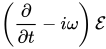
on peut réécrire l'équation terminant la section précédente sous la forme :
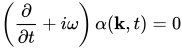
Cela, après multiplication par  , donne enfin :
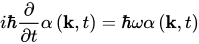
Ce qui peut s'interpréter comme une équation de Schrödinger.

