Utilisateur:Crocblanc77/CoursPhysique/MomentCinétique

Une page de Wikiversité.

Sommaire

[modifier] Moment d'une force

Une force est caractérisée par :

  • Le vecteur force :
    • sa direction
    • son sens
    • sa norme
  • Son point d'application M

[modifier] Moment par rapport à un point

[modifier] Définition

Le moment de  \overrightarrow{F} caractérise l'aptitude de cette force à faire tourner le point M autour d'un point où d'un axe.

Il est donc défini relativement à un point O, centre de cette rotation.
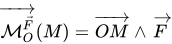
\overrightarrow{\mathcal{M}_O^\vec{F}}(M) = \overrightarrow{OM}\wedge\overrightarrow{F}

Ceci est le moment de  \overrightarrow{F} en M, par rapport à O.

[modifier] Conséquences directes

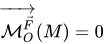
  • Si la direction de F est selon \overrightarrow{OM}, alors :

\overrightarrow{\mathcal{M}_O^\vec{F}}(M) = 0

  • Si M=O, alors de même :

\overrightarrow{\mathcal{M}_O^\vec{F}}(M) = 0

  • Soit d\, la distance de O à M et \theta\, l'angle  (\overrightarrow{OM}; \overrightarrow{F})

Dans ce cas: ||\overrightarrow{\mathcal{M}_O^\vec{F}}(M)||= d\times||\overrightarrow{F}||\times\sin{\theta}

Ce moment est maximal quand \overrightarrow{F}\bot \overrightarrow{OM}

[modifier] Moment par rapport à un axe

[modifier] Définition

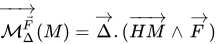
Soit \Delta\, un axe dirigé par un vecteur unitaire \overrightarrow{\Delta}.

Par définition, le moment de \overrightarrow{F} en M par rapport à \Delta\, vaut :

\overrightarrow{\mathcal{M}_\Delta^\vec{F}}(M) = \overrightarrow{\Delta}.(\overrightarrow{HM}\wedge\overrightarrow{F})


où H est le projeté de M sur \Delta\,

[modifier] Conséquences directes

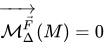
  • Si \overrightarrow{F} et \overrightarrow{\Delta} sont colinéaires :

\overrightarrow{\mathcal{M}_\Delta^\vec{F}}(M) = 0

  • Si M est sur \Delta \, :

\overrightarrow{\mathcal{M}_\Delta^\vec{F}}(M) = 0

  • Si la direction de \overrightarrow{F} coupe l'axe Δ :

\overrightarrow{\mathcal{M}_\Delta^\vec{F}}(M) = 0

[modifier] En coordonnées cylindriques

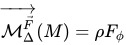
En effectuant l'étude en coordonnées cylindriques, le repère étant défini par  (\overrightarrow{e_\rho},\overrightarrow{e_\phi},\overrightarrow{e_z}), on a:

\overrightarrow{\mathcal{M}_\Delta^\vec{F}}(M) = \overrightarrow{e_z}.(\overrightarrow{HM}\bot\overrightarrow{F})=\overrightarrow{e_z}.(\rho\overrightarrow{e_\rho}\wedge(F_\rho \overrightarrow{e_\rho}+F_\phi \overrightarrow{e_\phi}+F_z \overrightarrow{e_z}))

\overrightarrow{\mathcal{M}_\Delta^\vec{F}}(M) =\overrightarrow{e_z}.(\rho F_\phi \overrightarrow{e_z}-\rho F_z \overrightarrow{e_\phi})

\overrightarrow{\mathcal{M}_\Delta^\vec{F}}(M) = \rho F_\phi

Le moment d'une force \overrightarrow{F} par rapport à un axe \Delta\, appliquée en M a pour valeur :

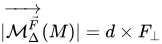
|\overrightarrow{\mathcal{M}_\Delta^\vec{F}}(M)| = d \times F_\bot

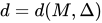
avec  d = d(M,\Delta) \, et F_\bot la composante orthogonale à l'axe et à \overrightarrow{HM} (soit selon \overrightarrow{e_\phi}

Remarque : Le moment cinétique sera positif sera positif si la force à tendance à faire tourner M dans le sens trigonométrique autour de \overrightarrow{\Delta}.

[modifier] Moment cinétique

Le moment cinétique est une qualité qui décrit la rotation d'un point M autour d'un point O.

On définit le moment cinétique de M par rapport à O comme ceci :
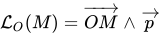
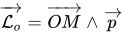
 \mathcal{L}_O (M) = \overrightarrow{OM}\wedge\overrightarrow{p}

\overrightarrow{p} est la quantité de mouvement.

[modifier] Axe et coordonnées cylindrique

Comme pour le moment d'une force on peut définir le moment cinétique par rapport à un axe de la façon suivante :
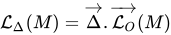
 \mathcal{L}_\Delta (M) = \overrightarrow{\Delta}.\overrightarrow{\mathcal{L}_O} (M)

Et on peut retrouver en coordonnées cylindriques :

 \mathcal{L}_\Delta (M) = m \times {\rho}^2 \times \dot\phi

[modifier] Théorème du moment cinétique

Soit un point M de masse m soumis à des forces extérieures :  \sum \overrightarrow{F}_{ext}(M)
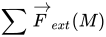
On a alors :

 \overrightarrow{\mathcal{L}_o}=\overrightarrow{OM} \wedge \overrightarrow{p}

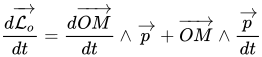
 \frac{d\overrightarrow{\mathcal{L}_o}}{dt}=\frac{d\overrightarrow{OM}}{dt} \wedge \overrightarrow{p} + \overrightarrow{OM} \wedge \frac{\overrightarrow{p}}{dt}

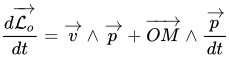
 \frac{d\overrightarrow{\mathcal{L}_o}}{dt}=\overrightarrow{v} \wedge \overrightarrow{p} + \overrightarrow{OM} \wedge \frac{\overrightarrow{p}}{dt}

Et on tire du Principe Fondamental de la dynamique :
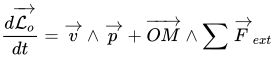
 \frac{d\overrightarrow{\mathcal{L}_o}}{dt}=\overrightarrow{v} \wedge \overrightarrow{p} + \overrightarrow{OM} \wedge \sum \overrightarrow{F}_{ext}

\overrightarrow{v} et  \overrightarrow{p} étant colinéaires, on arrive à :

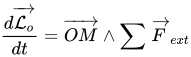
 \frac{d\overrightarrow{\mathcal{L}_o}}{dt}=\overrightarrow{OM} \wedge \sum \overrightarrow{F}_{ext}

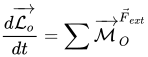
Vient enfin le théorème du moment cinétique :


Théorème

 \frac{d\overrightarrow{\mathcal{L}_o}}{dt}=\sum \overrightarrow\mathcal{M}_O^{\vec{F}_{ext}}