Phénomènes d'induction/Loi de Faraday

Une page de Wikiversité.


Loi de Faraday
Logo physics.svg
Chapitre 2
Leçon : Phénomènes d'induction
Chap. préc. : Induction mutuelle, induction propre
Chap. suiv. : Loi de Lenz


Icon falscher Titel.svg

En raison de limitations techniques, la typographie souhaitable du titre, « Phénomènes d'induction : Loi de Faraday
Phénomènes d'induction/Loi de Faraday
 », n'a pu être restituée correctement ci-dessus.

Sommaire

[modifier] Champ électromoteur

Champ électromoteur induit

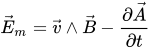
Soit un fil conducteur en mouvement dans un champ magnétique \vec B. Alors tout point du conducteur est le siège d'un champ électromoteur \vec E_m valant

\vec E_m=\vec v\wedge\vec B-\frac{\partial\vec A}{\partial t}

Logo physics.svg Voir les exercices sur : Champ électromoteur.


Définition

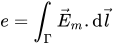
La force électromotrice induite e le long d'une courbe orientée Γ vaut e=\int_\Gamma\vec E_m. \mathrm d\vec l

[modifier] Loi de Faraday

[modifier] Cas d'un circuit mobile lorsque B est indépendant du temps

Dispositif

Moving coil in magnetic field.svg

On dispose d'une spire Γ mobile dans un champ magnétique \vec B indépendant du temps.

On considère Γ aux instants t et t+dt'. On dispose également

  • d'une surface S qui s'appuie sur Γ(t), orientée en concordance avec Γ(t), au travers de laquelle le flux de \vec B vaut Ф
  • d'une surface S' qui s'appuie sur Γ(t+dt), orientée en concordance avec Γ(t+dt), au travers de laquelle le flux de \vec B vaut Ф'

Un point courant P de Γ à l'instant t a subi une translation élémentaire \overrightarrow{\mathrm dP} pour devenir P'.


Si \vec B est indépendant du temps, \vec A aussi et \vec E_m=\vec v\wedge\vec B

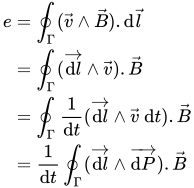
\begin{align}
e &= \oint_\Gamma (\vec v \wedge \vec B).\mathrm d \vec l\\
&= \oint_\Gamma (\mathrm d \vec l \wedge \vec v).\vec B\\
&= \oint_\Gamma \frac1{\mathrm dt} (\mathrm d \vec l \wedge \vec v~\mathrm dt).\vec B\\
&= \frac1{\mathrm dt} \oint_\Gamma  (\mathrm d \vec l \wedge \overrightarrow{\mathrm dP}).\vec B
\end{align}

  • La surface infinitésimale \mathrm d^2S_c~ engendrée par \mathrm d\vec l et \overrightarrow{\mathrm dP} est appelée surface coupée élémentaire, ou parfois surface balayée élémentaire. Elle est orientée dans le sens de \mathrm d\vec P\wedge\overrightarrow{\mathrm dl}.
  • La réunion de toutes les surfaces coupées élémentaires forme la surface coupée \mathrm dS_c~. Elle forme une sorte de tube s'appuyant sur S et S'.
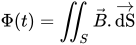
  • Le flux de \vec B à travers la surface coupée \mathrm dS_c~ s'appelle le flux coupéc.

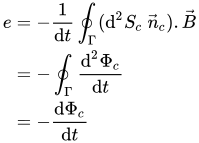
\begin{align}
e&= -\frac1{\mathrm dt} \oint_\Gamma  (\mathrm d^2S_c ~ \vec n_c).\vec B\\
&= -\oint_\Gamma  \frac{\mathrm d^2 \Phi_c}{\mathrm dt}\\
&= -\frac{\mathrm d\Phi_c}{\mathrm dt}
\end{align}
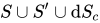
Comme S\cup S'\cup\mathrm dS_c est une surface fermée, on a ~\Phi-\Phi'+\mathrm d\Phi_c=0

Donc ~\mathrm d\Phi_c=\Phi-\Phi'=\mathrm d\Phi

On a finalement e=-\frac{\mathrm d\Phi}{\mathrm dt}

[modifier] Cas d'un circuit fixe dans B(t)

Conductor ring in variable magnetic field.svg


Dispositif

On dispose d'une spire Γ orientée immobile dans un champ magnétique \vec B(t). On dispose également d'une surface Σ qui s'appuie sur Γ, orientée en concordance avec Γ, au travers de laquelle le flux de \vec B vaut Ф.

Pour un circuit fixe, \vec v=\vec0 donc \vec E_m=-\frac{\partial\vec A}{\partial t}

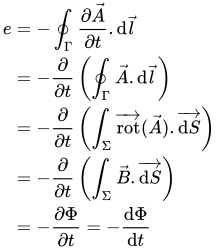
\begin{align}
e&=-\oint_\Gamma \frac{\partial\vec A}{\partial t}.\mathrm d\vec l\\
&=-\frac{\partial}{\partial t}\left(\oint_\Gamma\vec A.\mathrm d\vec l\right)\\
&=-\frac{\partial}{\partial t}\left(\iint_\Sigma\overrightarrow{\mathrm{rot}}(\vec A).\overrightarrow{\mathrm d^2S}\right)\\
&=-\frac{\partial}{\partial t}\left(\iint_\Sigma\vec B.\overrightarrow{\mathrm d^2S}\right)\\
&=-\frac{\partial\Phi}{\partial t}=-\frac{\mathrm d\Phi}{\mathrm dt}
\end{align}

[modifier] Cas général

Logo physics.svg Voir les exercices sur : Phénomènes d'induction.
Nuvola apps important.svg Il est absolument fondamental de connaître et savoir correctement appliquer ce résultat. La méthode d'application est détaillée dans les exercices.


Loi de Faraday

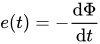
Pour un circuit fermé : e=-\frac{\mathrm d \Phi}{\mathrm dt}


Crystal Clear action back.png Induction mutuelle, induction propre
Autres langues