Matrice/Trace

Une page de Wikiversité.


Trace
Nuvola apps edu mathematics-p.svg
Chapitre 6
Leçon : Matrice
Chap. préc. : Déterminant
Chap. suiv. : Inverse (12)


Icon falscher Titel.svg

En raison de limitations techniques, la typographie souhaitable du titre, « Matrice : Trace
Matrice/Trace
 », n'a pu être restituée correctement ci-dessus.

Dans tous le chapitre, on ne traitera que des matrices carrées. Nous allons introduire la trace, qui constitue un outil de base d'étude des matrices.

Sommaire

[modifier] Définition

Trace d'une matrice

Soit A une matrice carrée n × n. La trace de A est la somme des éléments diagonaux de A, elle est notée :

\mathrm{tr}\,\mathbf A

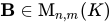
Il s'agit d'une forme linéaire sur \mathfrak M_n\left(\mathbb K \right).


Exemples

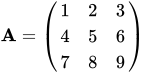
Soit la matrice :

\mathbf A = \begin{pmatrix} 1 & 2 & 3 \\ 4 & 5 & 6 \\ 7 & 8 & 9\end{pmatrix}

Alors sa trace est :

\mathrm{tr}\,\mathbf A = 1 + 5 + 9 = 15

La trace de In est n. La trace de la matrice nulle est 0.

Nuvola apps important.svg Il s'agit bien de la diagonale qui va du coin en haut à gauche au coin en bas à droite.

[modifier] Propriétés

Propriétés

Soient A et B deux matrices carrées de même taille, si a est un nombre, alors :

  • \mathrm{tr}\, \left( \mathbf A + \mathbf B \right) = \mathrm{tr}\,\mathbf A + \mathrm{tr}\,\mathbf B
  • \mathrm{tr}\, \left( a \cdot \mathbf A \right) = a \cdot \mathrm{tr}\,\mathbf A
  • \mathrm{tr}\, \left(\mathbf A \cdot \mathbf B \right) = \mathrm{tr}\, \left(\mathbf B \cdot \mathbf A \right)


Démonstration

Les deux premières propriétés sont immédiates. La dernière n'est pas beaucoup plus subtile :

 \mathrm{tr}(\mathbf A \cdot \mathbf B) = \sum_{i=1}^n (\mathbf A \cdot \mathbf B)_{ii} = \sum_{i=1}^n \sum_{j=1}^n a_{ij} \cdot b_{ji} = \sum_{j=1}^n \sum_{i=1}^n b_{ji} \cdot a_{ij} = \sum_{j=1}^n (\mathbf B \cdot \mathbf A)_{jj} = \mathrm{tr}(\mathbf B \cdot \mathbf A)


La trace est un invariant de similitude

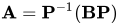
Soit A et B deux matrices carrées, telles qu'il existe une matrice P inversible vérifiant :

\mathbf A = \mathbf P^{-1} \mathbf B \mathbf P

c'est-à-dire que A est semblable à B, alors :

\mathrm{tr}\,\mathbf A = \mathrm{tr}\,\mathbf B


Démonstration

\begin{align}
\mathrm{tr}\, \mathbf A 
& = \mathrm{tr} \left( \mathbf P^{-1} \cdot \mathbf B \cdot \mathbf P \right) \\ \ 
& = \mathrm{tr} \left( \left( \mathbf P^{-1} \cdot \mathbf B \right) \cdot \left(\mathbf P \right) \right) \\ \ 
& = \mathrm{tr} \left( \left( \mathbf P \right) \cdot \left( \mathbf P^{-1} \cdot \mathbf B \right) \right) \\ \ 
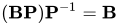
& = \mathrm{tr} \left( \left( \mathbf P \cdot \mathbf P^{-1} \right) \cdot \mathbf B \right) \\ \ 
& = \mathrm{tr}\,\mathbf B 
\end{align}


Propriété

Le fait que la trace soit identique pour deux matrices semblables signifie que la trace d'une matrice est une propriété intrinsèque de la matrice, peu importe la base dans laquelle on l'exprime. Elle est donc l' « empreinte », la « trace » d'une matrice.

Réciproquement, on montre que toute forme linéaire invariante par similitude est proportionnelle à la trace.

[modifier] Produit scalaire

L'utilisation de la trace permet de définir le produit scalaire canonique de \mathfrak M_n \left( \mathbb K \right) :


Produit scalaire canonique des matrices carrées

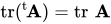
On définit le produit scalaire canonique et on note \scriptstyle \langle \cdot, \cdot \rangle l'application bilinéaire :

\langle \cdot, \cdot \rangle : \left( \mathbf A, \mathbf B \right) \mapsto \mathrm{tr}\, \left( ^t\mathbf A \cdot \mathbf B\right)


Exemple

Soient les matrices :

\mathbf A = \begin{pmatrix} 1 & 2 \\ 3 & 4 \end{pmatrix}
\mathbf B = \begin{pmatrix} 2 & 3 \\ 4 & 5 \end{pmatrix}

Alors leur produit scalaire vaut :

\langle \mathbf A, \mathbf B \rangle = \mathrm{tr}\, \begin{pmatrix} 14 & 18 \\ 20 & 26 \end{pmatrix} = 14 + 26 = 40

Ce produit scalaire induit une norme (la norme de Frobenius), mais cela fera l'objet d'un autre chapitre.

[modifier] Remarques

Une autre notation pour la trace est Tr.

En théorie des graphes, on peut associer à tout graphe une matrice, dite matrice d'adjacence. Si le graphe ne contient aucun sommet connecté à lui-même, alors la trace de cette matrice est nulle.

Crystal Clear action back.png Déterminant